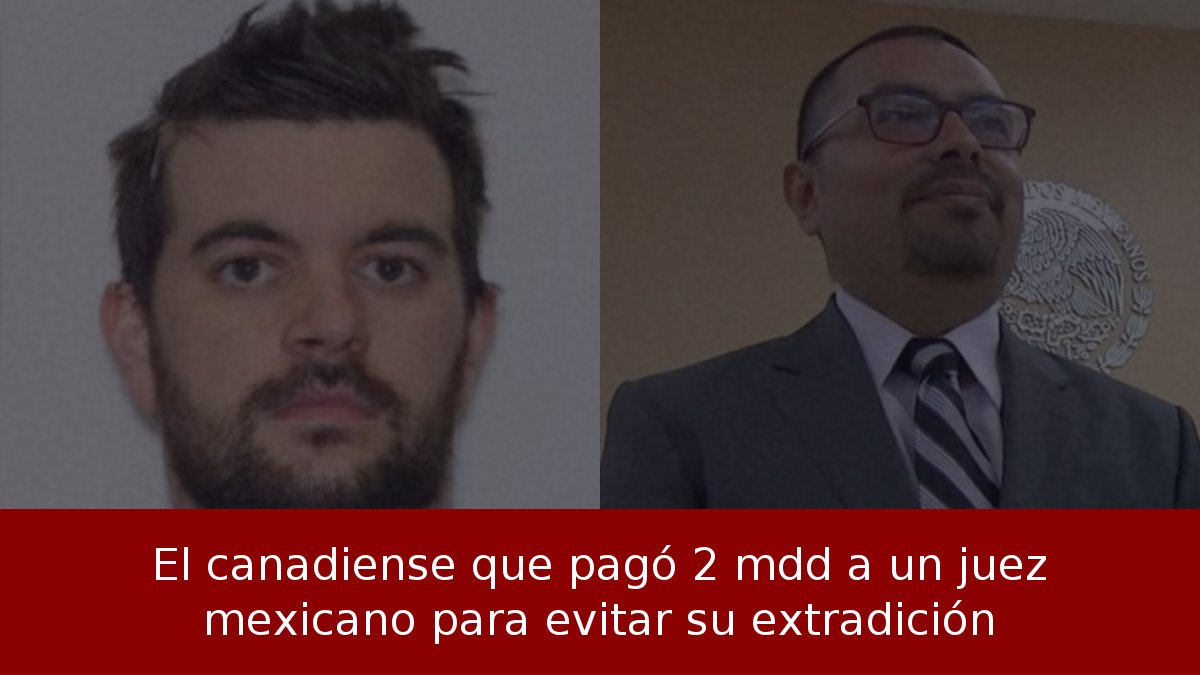
Andrew Clark, alias "El Dictador", stands at the center of one of the most serious judicial corruption cases documented in Mexico in recent years. The 36-year-old Canadian, second-in-command of the drug trafficking organization led by former Olympic athlete Ryan Wedding, paid two million dollars to a Mexico City judge to secure his release while facing extradition proceedings to the United States.
- Million-dollar bribe: Clark handed two million dollars to Judge Luis Benítez Alcántara, who ordered his release on February 24, 2025.
- Transnational network: Ryan Wedding's organization generated over one billion dollars annually and moved cocaine from Colombia to Canada via Mexico and California.
- Documented violence: The U.S. indictment links Clark to at least four homicides in Canada and one in Colombia.
From arrest in Zapopan to judicial bribery
Clark was detained in October 2024 by Mexican Navy personnel at a shopping center in Zapopan, Jalisco. From November of that year through February 2025, he transferred approximately 2.75 million dollars through intermediaries in small amounts to avoid detection, aiming to buy his exit from the Mexican judicial system, according to the U.S. Department of Justice.
The two-million-dollar payment was made on February 24, 2025. That same day, Judge Luis Benítez Alcántara issued a ruling granting bail and ordering Clark's release. The plan did not succeed: days later he was detained again and on February 27, 2025, he was transferred to the United States along with 28 other drug traffickers, including Rafael Caro Quintero and Antonio Oseguera Cervantes, in the first mass transfer of kingpins Mexico handed to Washington. He appeared on March 3 before the District Court in Phoenix under a 16-count indictment; if convicted, he faces a mandatory minimum sentence of life in prison.
Benítez Alcántara was arrested last Sunday in Colombia and faces nine federal charges in the United States for accessory after the fact, having helped Clark evade apprehension, trial, or punishment. The formal indictment was returned by a grand jury on September 4, 2025, and each count carries a maximum penalty of 15 years in federal prison. The U.S. government has already formally requested his extradition from Bogotá.
The role of "El Dictador" within the network
According to the formal indictment from the Central District of California, Clark "closely directed several of the network's operations, particularly drug trafficking in Canada and the execution of murders." Authorities documented 17 aliases used by the Canadian, including "El Dictador," "El niño problemático," and "El chiquito loco."
Clark operated as an intermediary capable of doing business between rival Mexican organizations. He served as a logistical link between the Sinaloa Cartel and the Jalisco New Generation Cartel (CJNG), structures that fight over territory with extreme violence but shared figures like him to move cocaine without friction. Security and Citizen Protection Secretary Omar García Harfuch confirmed this on October 29, 2024, when he publicly presented the arrest: Clark was the "logistical link" between the CJNG and an organization identified as CDP, in addition to being linked to the trafficking of fentanyl, methamphetamines, and weapons between Mexico, the United States, Canada, Ecuador, and Colombia.
Before his criminal history became known, Clark presented himself as an ordinary man. In April 2020, Canadian magazine Toronto Life interviewed him as an elevator mechanic and owner of seven properties in Toronto that he rented to six tenants.
The operation: cocaine, money laundering, and homicides
U.S. authorities estimate that the organization Clark managed alongside Wedding generated more than one billion dollars annually in illicit profits, according to statements by then Attorney General Pam Bondi. The logistics began in Colombia, where large shipments of cocaine were purchased and transported to Mexico with protection and temporary storage from the Sinaloa Cartel. From there, the drug crossed the border into southern California, mainly to Los Angeles, in tractor-trailers with secret compartments. Los Angeles, San Bernardino, and Riverside counties served as the distribution center before shipment to Canada.
The transportation network in Canada was led by Hardeep Rate and Gurpreet Singh, who charged between 175,000 and 225,000 dollars for shipments of up to 350 kilograms of cocaine already placed in Canadian territory. Between January and August 2024, Wedding and Clark allegedly conspired to export more than 1,800 kilograms of cocaine from southern California to Canada, an operation valued between 23.4 and 25.2 million dollars on the Los Angeles market. The organization also used cryptocurrencies, international transfers, and shell companies in Mexico, Canada, Europe, and the United Kingdom to launder money.
Violence was a management tool for Clark. The U.S. indictment documents at least four homicides in Canada directly linked to him. On November 20, 2023, Jagtar and Harbhajan Sidhu were killed in Ontario in retaliation for the theft of a cocaine shipment in southern California; the victims had no connection to organized crime and a third family member survived with serious injuries. On April 1, 2024, Clark was identified as the mastermind behind the homicide of Randy Fader, for which he paid 100,000 Canadian dollars to Malik Damion Cunningham, arrested two weeks later. According to intercepted communications, Clark allegedly arranged for Cunningham to receive "military training" in Mexico in March 2024, before the crime. On May 18 of that year, Mohammed Zafar was killed over a drug debt.
The violence extended to Colombia: on January 31, 2025, Colombian-Canadian Jonathan Christopher Acevedo García, 42, was killed while eating at a restaurant in the Mall del Indio in Medellín. According to journalist Calvi Leon of the Toronto Star, Acevedo García had operated as a police informant in building the case against Wedding and Clark.
Reactions and scope of the case
First Assistant U.S. Attorney Bill Essayli emphasized the scope of the matter: "This case underscores our office's commitment to dismantling criminal organizations at all levels, including holding accountable those who abuse positions of public trust."
"Benítez Alcántara was a district judge in Mexico City who allegedly accepted two million dollars in exchange for granting bail and ordering the release of Wedding's second-in-command, while Wedding orchestrated a billion-dollar transnational criminal organization," declared FBI Director Kash Patel.
The investigation was conducted by the FBI with the collaboration of the Los Angeles Police Department, the Royal Canadian Mounted Police, the Colombian National Police, and that country's Criminal Investigation Directorate and Interpol. The case exposes how international drug trafficking networks seek to infiltrate judicial institutions and places Benítez Alcántara's extradition as the next chapter in a file that already includes charges on both sides of the border.