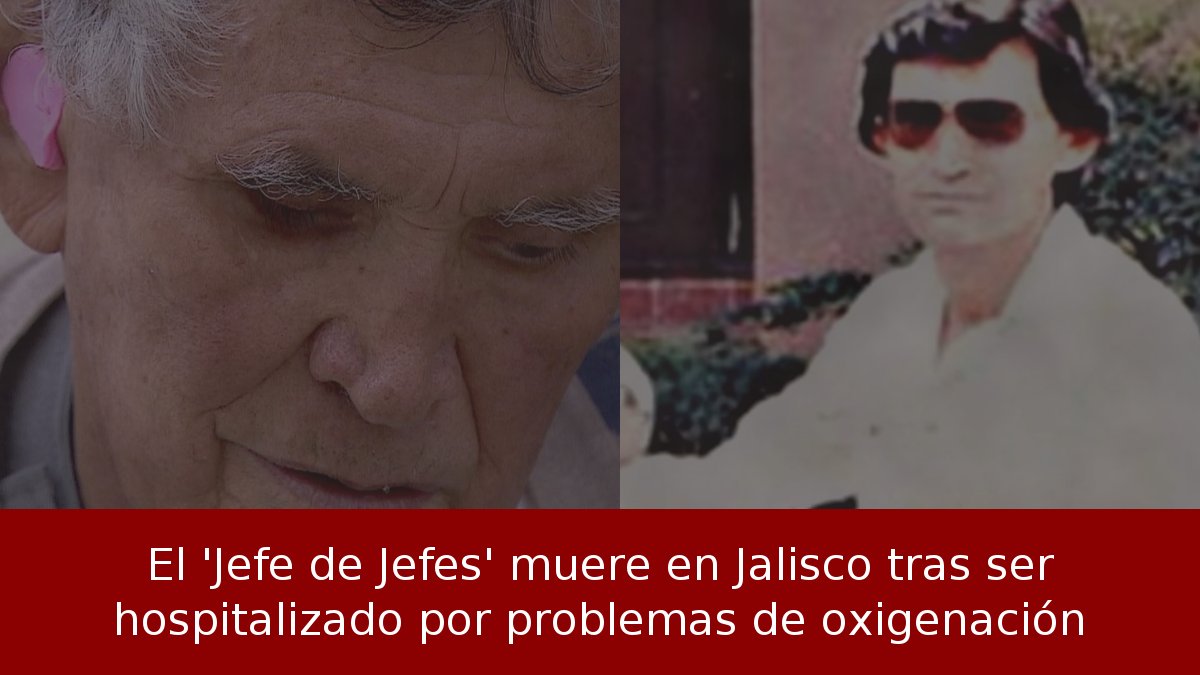
Miguel Ángel Félix Gallardo, the man known as the 'Jefe de Jefes' and founder of the now-defunct Guadalajara Cartel, died this Sunday in Jalisco, two days after being moved from Puente Grande prison to a private hospital due to health complications.
- Death: The drug lord died in Jalisco after being hospitalized on Friday, November 13, for oxygenation problems.
- Criminal legacy: He founded the Guadalajara Cartel along with Rafael Caro Quintero and Ernesto Fonseca Carrillo, alias 'Don Neto'.
- Sentences: He was serving sentences of 37 and 40 years for the murder of Enrique 'Kiki' Camarena and Alfredo Zavala Avelar, as well as for drug trafficking offenses.
The transfer and death
On Friday, November 13, Félix Gallardo was taken to a hospital in Jalisco for oxygenation problems, according to initial reports. The transfer was carried out under a security detail from the state police. So far, not enough official details had been released to establish a diagnosis, the severity of his condition, or how long he remained hospitalized.
His physical deterioration and the various ailments he faced were recurring arguments by his defense to request prison benefits. In September 2022, a federal judge authorized him to serve the remainder of his 40-year sentence for drug-related crimes under house arrest. The ruling considered his age and the health conditions he presented after more than three decades in prison.
However, that determination did not automatically resolve the situation of the second conviction, corresponding to the 37 years for the murders of Camarena and Zavala. In July 2026, Jalisco prison authorities reported that a federal judge had granted the benefit of house arrest for one of the sentences. Nevertheless, a resolution on the other conviction was still pending, so his definitive release from the Puente Grande penitentiary complex had not been finalized.
From Judicial Police to criminal empire
Miguel Ángel Félix Gallardo was born on January 8, 1946, in Culiacán, Sinaloa. Before becoming one of the most wanted men by Mexican and U.S. authorities, he had a career within his state's security forces. During his youth he worked in the Sinaloa Judicial Police and even served as a bodyguard for people close to then-governor Leopoldo Sánchez Celis, who led the state government between 1963 and 1968.
His time in security institutions and his relationships with political figures allowed him to learn the protection and surveillance mechanisms that would later be pointed out as part of the conditions that facilitated the growth of his criminal activities.
Félix Gallardo began associating with traffickers operating in the so-called Golden Triangle, a mountainous region comprising areas of Sinaloa, Durango, and Chihuahua, where marijuana and poppy were historically cultivated. One of the figures he was linked to was Pedro Avilés Pérez, known as 'El León de la Sierra,' considered one of the pioneers of Mexican drug trafficking. Avilés Pérez's death in a confrontation with authorities in 1978 represented a turning point for the criminal business in Sinaloa.
In 1977, the Mexican government launched Operation Condor, a campaign to eradicate illicit crops that concentrated much of its actions in Sinaloa, Durango, and Chihuahua. The pressure on crops and routes in the northwest helped modify the territorial distribution of traffickers. Guadalajara, Jalisco, gained importance as a meeting and coordination point for criminal operations, due to its location, infrastructure, and commercial connections.
Félix Gallardo was one of the figures who took advantage of that reorganization. Instead of relying exclusively on regional production, he began consolidating a network that connected different operators, transporters, and suppliers. The change also allowed him to strengthen relations with foreign organizations. The connection with Colombian traffickers dedicated to the cocaine trade was decisive in expanding the group's business into the United States.
The Guadalajara Cartel and the Camarena case
The Guadalajara Cartel consolidated during the 1970s and 1980s as one of the most powerful criminal organizations in Mexico. Its main figures were Miguel Ángel Félix Gallardo, Rafael Caro Quintero, and Ernesto Fonseca Carrillo, alias 'Don Neto.' Although Félix Gallardo was identified as the organization's principal coordinator, all three had their own trajectories, contacts, and operational capabilities.
Caro Quintero developed businesses related to marijuana production and commercialization, while Fonseca Carrillo had experience in drug trafficking and relationships with other groups. Félix Gallardo, for his part, stood out for his ability to establish alliances, coordinate networks, and connect different operators.
One of the episodes that exposed the scale of the Guadalajara Cartel's operations was the seizure of the El Búfalo ranch in Chihuahua in November 1984. The property was linked to Rafael Caro Quintero and housed a huge marijuana plantation. Mexican authorities found crops covering an extraordinary extension and employing thousands of people. Estimates released about the operation indicated that more than 8,000 tons of marijuana were destroyed.
DEA agent Enrique Camarena had participated in the investigations that made it possible to identify the traffickers' activities and locate the crops. On February 7, 1985, Camarena was kidnapped as he left the U.S. consulate in Guadalajara. Mexican pilot Alfredo Zavala Avelar was also deprived of his freedom. Both were taken to a property on Lope de Vega street, where they were tortured and interrogated. Their bodies were found on March 5, 1985, in a rural area of Michoacán.
The murder of the U.S. agent caused a diplomatic crisis between Mexico and the United States. The DEA launched a large-scale investigation to identify those responsible and reconstruct the circumstances of the crime. The agency launched Operation Legend, considered one of the most important investigations in its history.
Caro Quintero was arrested in Costa Rica in April 1985, while Fonseca Carrillo was captured in Puerto Vallarta. Félix Gallardo managed to stay out of the authorities' reach for another four years. On April 8, 1989, he was arrested in Guadalajara, Jalisco, during an operation by Mexican authorities.
In August 2017, a federal judge sentenced him to 37 years in prison for the murders of Camarena and Zavala. The ruling also included a reparations payment of 20 million 810 thousand pesos. In addition to that conviction, the drug lord received a 40-year sentence for drug trafficking, weapons stockpiling, and bribery offenses.
The fragmentation that changed the criminal map
Félix Gallardo's arrest accelerated the organization's fragmentation. The structure that had concentrated much of Mexico's drug trafficking operations ceased to function under the coordination that had characterized its period of greatest power. The redistribution of routes and territories favored the emergence and consolidation of different criminal groups. Among them were the organization of the Arellano Félix brothers, which extended its influence in Tijuana, and Sinaloa trafficking networks that later shaped the Sinaloa Cartel.
The history of the latter group became linked to figures such as Joaquín 'El Chapo' Guzmán and Ismael 'El Mayo' Zambada, who developed their own structures and alliances. The fragmentation was not an immediate process nor a simple administrative division ordered by Félix Gallardo. It was a criminal reconfiguration in which former collaborators, regional operators, and new generations of traffickers disputed control of activities that had been connected to the Guadalajara Cartel.
At 80 years old, Félix Gallardo leaves behind a long criminal trajectory that transformed drug trafficking in Mexico. His organization disappeared as a centralized structure, but the networks, routes, and disputes he helped consolidate marked the development of the criminal groups that dominated the country in the following decades.