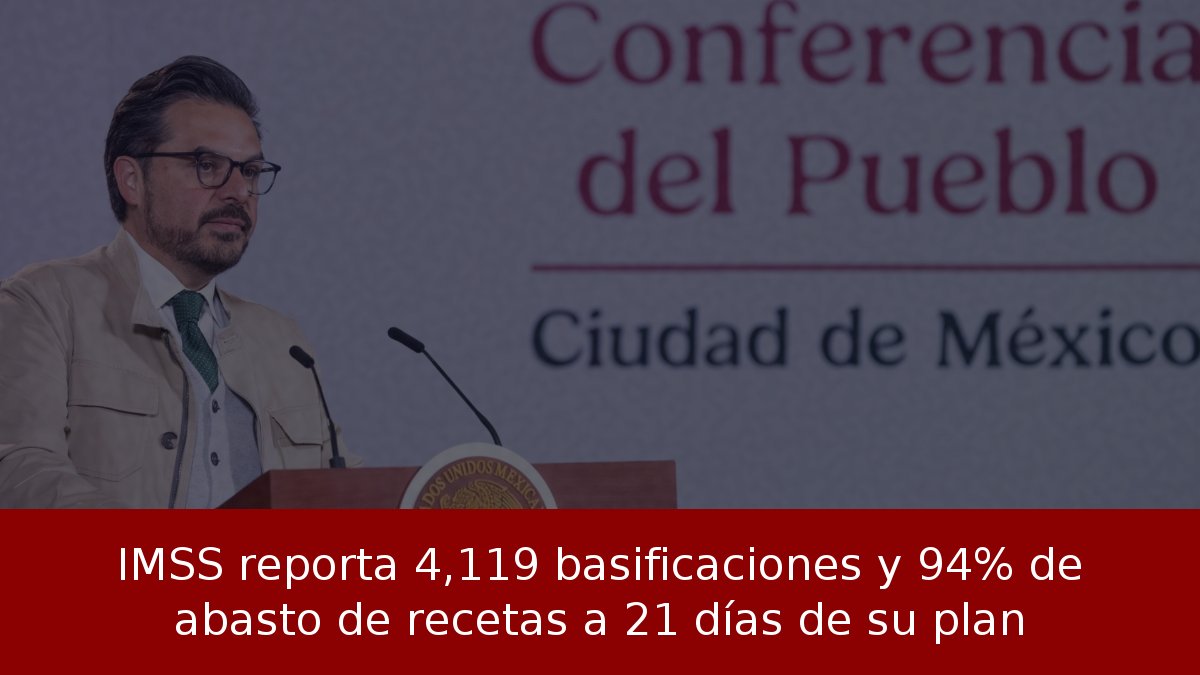
Twenty-one days after launching its 12-point plan, the Mexican Social Security Institute (IMSS) has granted 4,119 permanent positions, reached a 94% full-prescription fill rate, and put 64 high-tech medical devices into operation, according to a report by Director General Zoé Robledo Aburto at the morning press conference in the National Palace.
- Permanent positions: 4,119 definitive posts awarded, equal to 38% of the 10,939 target set for January 1, 2027.
- Medicines: 94% of complete prescriptions filled; missing items can be reported at recetacompleta.gob.mx.
- Equipment: 64 high-tech devices already treating patients, 17 in testing, and 81 installed.
- Surgeries: 6,294 additional operations performed during nights and weekends since October 12.
The conference was led by Interior Secretary Rosa Icela Rodríguez in the absence of President Claudia Sheinbaum, who was in Shenzhen, China, for the Asia-Pacific Economic Cooperation (APEC) forum. Robledo said the plan will conclude on February 24, 2027, Flag Day, and that the Institute will issue weekly reports and hospital-by-hospital results.
Permanent positions and salary increase
Robledo explained that the beneficiaries had held temporary posts known internally as “cero ocho,” a scheme in which staff substitute for those on vacation, sick leave, rest days, or guard duty. The categories include nurses, doctors, stretcher-bearers, laboratory technicians, and hygiene, cleaning, warehouse, and pharmacy personnel. Some of these workers joined IMSS during the COVID-19 pandemic.
The positions were distributed in three blocks: 2,239 took effect on October 16, 1,361 were added on November 1, and 519 were applied on November 16, totaling 4,119. The goal is 10,939 permanent positions by January 1, 2027.
Robledo also reported that the salary increase for Institute workers was fully completed and had begun to be reflected in the previous pay period.
Medicine supply and equipment
IMSS reached a 94% full-prescription fill rate, an indicator that according to the official shows a recovery in medicine delivery to beneficiaries. Those who do not receive all prescribed products can report the shortage at recetacompleta.gob.mx; the Institute then locates the medicine and contacts the patient when it is available at the corresponding pharmacy.
The Institute's instructions are to check that the prescription is complete upon leaving the pharmacy, report missing medicines on the website, wait for IMSS to call when the product is available, and go to the assigned pharmacy to pick it up. The report did not include the number of prescriptions served or total items delivered during the period.
On equipment, 64 high-tech medical devices were already treating patients, another 17 were undergoing operational testing and staff training, and 81 devices were already installed. Robledo detailed that incorporation requires adapting spaces, removing old equipment, installing new devices, conducting power and performance tests, training medical and technical staff, and treating the first patient.
Among the devices are 256-slice CT scanners. Two of them were to receive their first patients on Tuesday: one at Hospital General Regional No. 1 in Charo, Michoacán, and another at Hospital General de Zona No. 42 in Puerto Vallarta, Jalisco. The plan includes 26 such scanners nationwide, which allow faster and more precise studies for heart, trauma, and orthopedic diagnoses.
Emergency care, specialist hiring, and surgeries
IMSS reported progress in caring for families and companions of patients admitted through emergency rooms: 5,854 of 6,656 security personnel received training in dignified treatment, an 88% completion rate. Most of these staff work for private companies and are often the first contact for families arriving at a hospital. In addition, 489 360-degree cameras were installed in emergency areas, reaching 81% progress.
The second recruitment process for medical specialists remained open with 1,688 applicants registered against a target of 2,500 professionals. Activities for substitute workers already employed at the Institute were scheduled for November 18 and 19, and participation of specialists from other institutions was planned for November 20 and 21. Those interested can register at medicos-especialistas.imss.gob.mx.
Since October 12, IMSS performed 6,294 additional surgeries during nights and weekends to reduce waiting lists. Of that total, 3,072 procedures were cataract operations, followed by gallbladder, hernia, knee, and hip interventions.
With the plan running until February 2027, weekly and hospital-level monitoring will be key to verifying whether the targets for permanent positions, medicine supply, and equipment are met on the announced schedules. Publishing results by medical unit will allow beneficiaries and workers themselves to assess the real pace of the promised improvements following the labor stoppage.