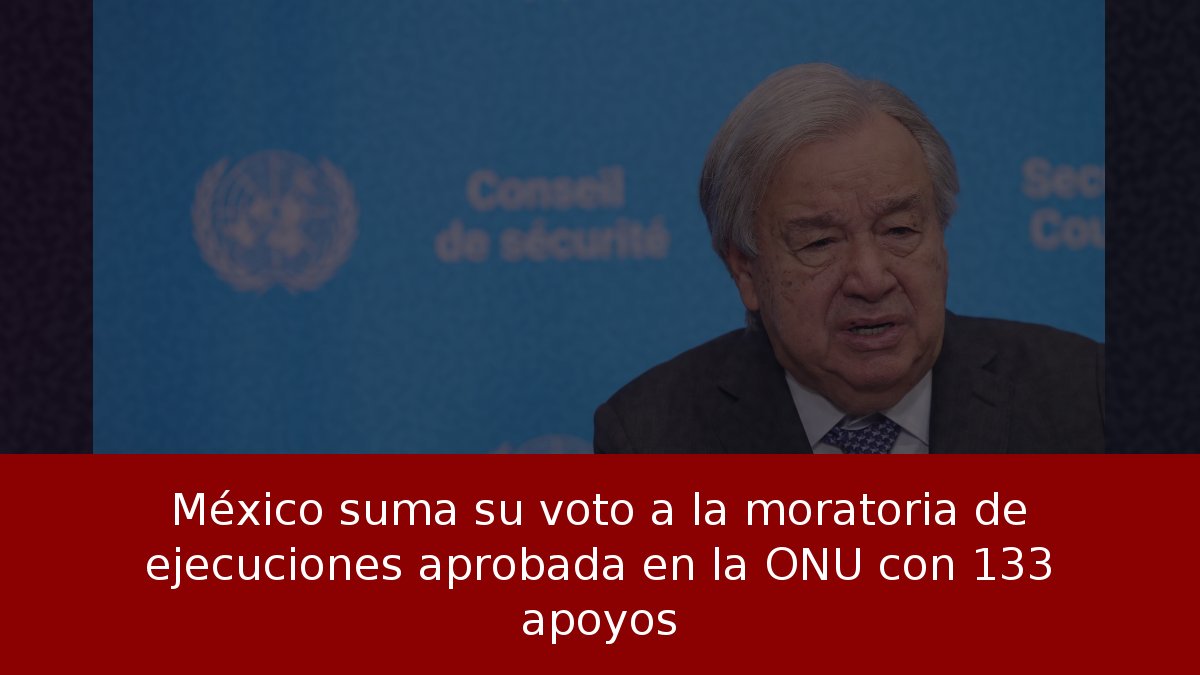
Mexico joined the majority of United Nations member states on November 13, 2026, by voting in favor of a resolution calling for a moratorium on the death penalty. The ballot took place in the Third Committee of the General Assembly, which handles social, humanitarian and cultural matters, and concluded at 16:25 New York time. The draft, known as A/C.3/81/L.43 and approved with oral revisions and amendments, drew 133 votes in favor, 33 against and 16 abstentions.
- Vote tally: 133 in favor, 33 opposed and 16 abstentions in the Third Committee.
- Mexico's stance: the delegation backed the text, consistent with the constitutional ban on capital punishment in force since 2005.
- Next step: the draft must still go before the full General Assembly, expected in December.
Legal foundations at home
Mexico's vote rests on domestic law. The Constitution abolished the death penalty on December 9, 2005, through a reform of Articles 14 and 22. Today the first paragraph of Article 22 states explicitly that death sentences are prohibited.
The country later strengthened its international commitment. On September 26, 2007, Mexico acceded to the Second Optional Protocol to the International Covenant on Civil and Political Rights, aimed at abolishing capital punishment, and to the equivalent protocol of the American Convention on Human Rights. Under Article 4.3 of that convention, states that have abolished the death penalty may not reinstate it.
The text approved in committee does not legally prohibit capital punishment. It urges states that still apply it to suspend executions with a view to abolition.
A divided regional picture
The voting board showed differing positions across the hemisphere. The United States voted against, while Canada voted in favor. Colombia, Brazil, Argentina, Chile and Guatemala also supported the moratorium. Cuba abstained, and Venezuela does not appear with a recorded vote.
Outside the region, China, Iran, Saudi Arabia, India, Japan and Singapore voted against, according to the board. Russia appears in favor.
France's Mission to the UN welcomed the text's adoption "by a broad majority" on its official X account. The French representation described it as an important step toward the universal abolition of capital punishment and restated its commitment to that goal.
A biennial track record
The resolution is biennial and part of a path begun in 2007. Since then, the General Assembly has adopted ten such resolutions. In December 2024, 130 states voted in favor of the tenth, according to Amnesty International. This result is two votes higher than the previous one.
The draft, identified as A/C.3/81/L.43 and approved with oral revisions and amendments, must still reach the plenary of the General Assembly, with its 193 member states, in a session planned for December. Committee results usually foreshadow the final vote.
Context: executions on the rise
The diplomatic support comes as executions increase worldwide. According to Amnesty International's annual report, at least 2,707 executions were recorded in 17 countries in 2025, 78% more than in 2024 and the highest figure since 1981.
Among the countries with the most cases, the report cites Iran, with at least 2,159 executions; Saudi Arabia, with at least 356; Yemen, with 51; and the United States, with 47. China remains the country that most resorts to capital punishment, though its real figure is unknown because it is considered a state secret.
Amnesty also documented 1,257 executions for drug offenses in five countries: China, Iran, Kuwait, Saudi Arabia and Singapore. In the opposite direction, 113 countries had abolished the death penalty for all crimes by the end of 2025, and 145 had removed it from their legislation or no longer applied it in practice.
The U.S. position has direct relevance for Mexico. Mexican consular offices have for years provided assistance to nationals sentenced to death in that country, as the Foreign Ministry itself documents in specialized publications. The United States carried out 47 executions in 2025, the highest level since 2009, with eleven states applying capital punishment.
Although the death penalty is prohibited in Mexico, the issue resurfaces from time to time in public debate. There have been initiatives to reinstate it for crimes such as kidnapping, though the constitutional ban remains in force. The November 13 vote sets the Third Committee's position; the full General Assembly will have the final say in December.