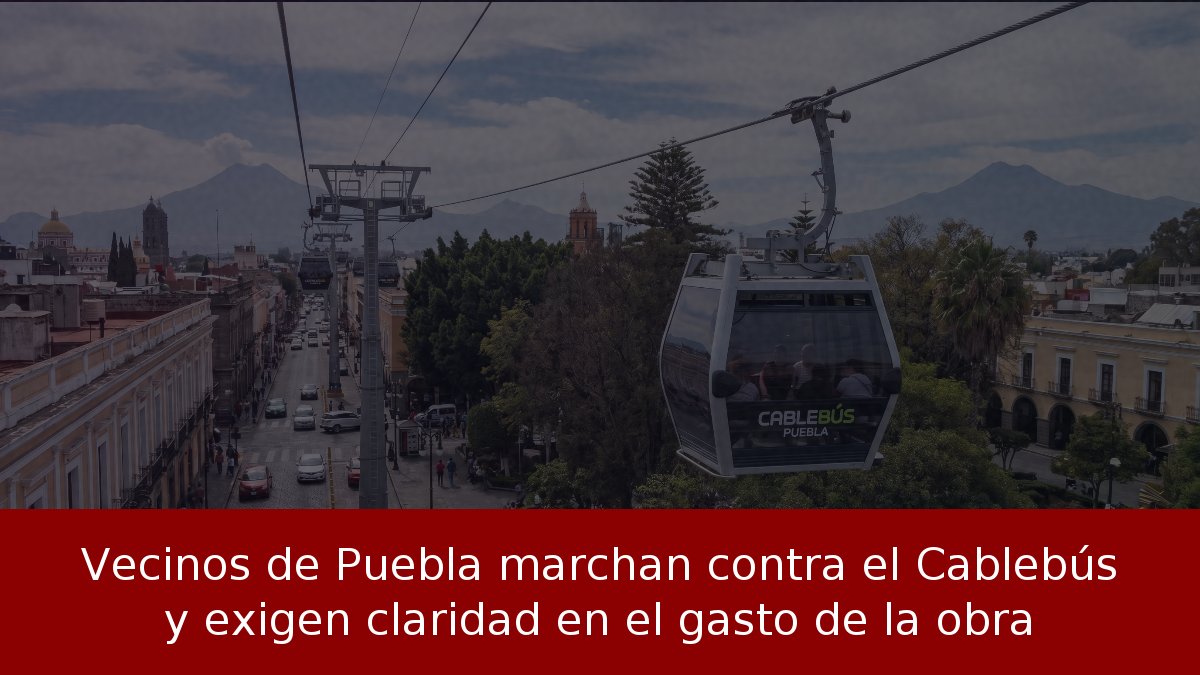
Residents and environmental groups marched to Puebla's Zócalo on Sunday, November 15, to reject the Cablebús project and allege irregularities in the neighborhood consultations. They demanded transparency regarding the funds allocated to the construction and insisted that informational assemblies include the people directly affected.
- March route and traffic: The demonstration began at Juan de Palafox y Mendoza Avenue and 26 Norte-Sur Street, causing road closures at the intersections of 18, 16, 14 and 12 Norte, as well as on Héroes del 5 de Mayo Boulevard.
- Financial questions: Protesters questioned the use of 2,835 million pesos recorded in the state government's financial statements, against an estimated total cost of 6,752.95 million pesos.
- Minimal progress: According to the government microsite cited by opponents, the project has a physical progress of only 2.7 percent.
Affected neighborhoods and complaints about the assemblies
The demonstrators come from neighborhoods such as El Ángel, México 68 and Bosques de Amalucan. They said the meetings organized by the state government are not convened through institutional channels and are instead spread through WhatsApp groups that few citizens can access. They also denounced the alleged presence of people from outside the involved neighborhoods.
“Those tailored meetings, full of bused-in people, to which the affected neighbors are not invited, are not assemblies or informational meetings; they are one more simulation,” a speaker said during the protest.
At the end of the march, the opponents announced they will conduct informational tours in the neighborhoods where the towers of the elevated transport system would be installed. They also said this is the eleventh march against the project, although the count of citizen mobilizations rises to 14. Their concerns include possible harm to green areas, the lack of safety protocols and doubts about technical feasibility and environmental impact studies.
The official project and the government's position
The Puebla government reported that work has begun on a station in Parque Ecológico and that others are planned in Parque Juárez and Amalucan. These works correspond to the first phase of the Cable Transport System, which envisions four lines and a state investment of 6,752.95 million pesos to be executed between 2025 and 2029.
José Luis García Parra, the state Cabinet coordinator, maintained that the project is advancing according to the planned schedule. The residents, for their part, anticipated that they will tour the affected areas to gather information and maintain their questions about community participation in the project.
The protest reflects a tension between the execution of a transport project that the government considers strategic and citizens' demands for clear information and real participation. With minimal physical progress and a multimillion-peso amount at stake, the conflict over the Cablebús in Puebla could intensify if the claims about transparency and neighborhood consultation are not addressed.