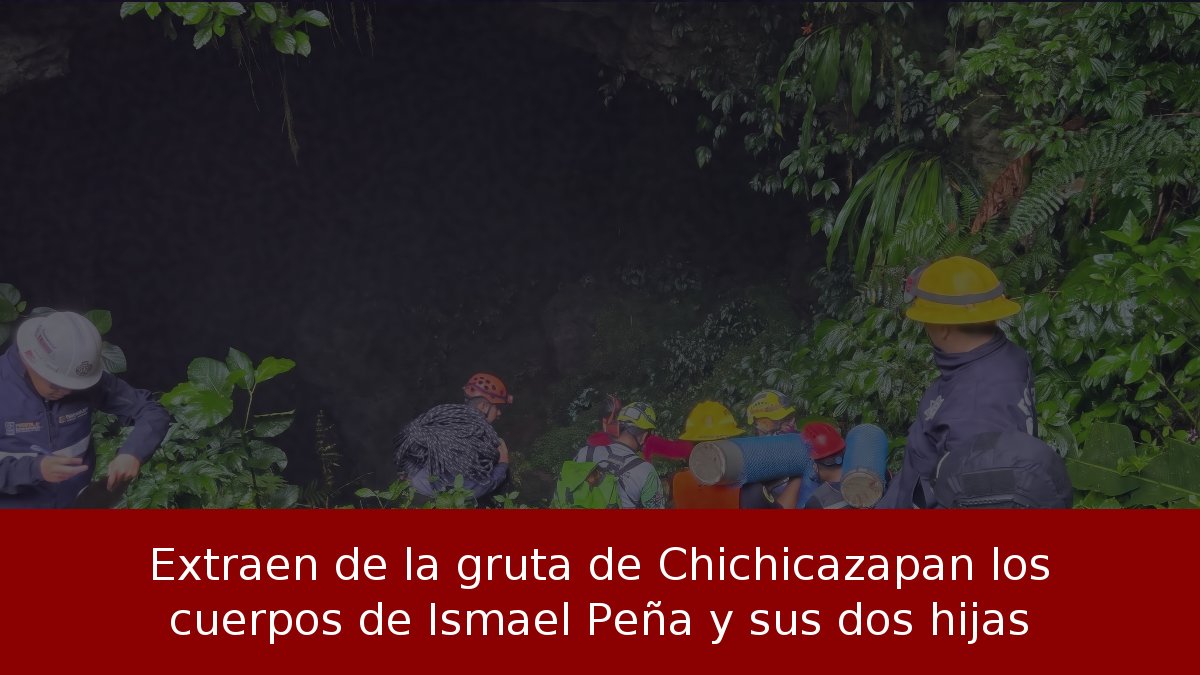
The remains of Ismael Peña and his two daughters, Karime Antonio Peña and Yazmín Lizbeth Peña Antonio, were brought out of the Chichicazapan grotto in Cuetzalan, Puebla, ending an operation that lasted more than four months because of hazardous conditions inside the cave. Puebla governor Alejandro Armenta described the work as a “labor titánica” and stressed the specialized training the operation demanded.
- Recovery completed: The bodies of Ismael Peña and his daughters Karime and Yazmín Lizbeth were removed from the Chichicazapan grotto in Cuetzalan.
- November restart: State Civil Protection reported that extraction work resumed on November 10, when rainfall decreased.
- Extreme conditions: The bodies were about two kilometers from the entrance, near a waterfall and a pool, and the journey could take over ten hours.
- Accident toll: The incident occurred on July 7 when a group of seven entered the grotto and the underground river rose.
An operation shaped by weather and water
According to State Civil Protection, extraction efforts restarted on November 10, taking advantage of reduced rainfall so specialized teams could re-enter the cave. The maneuvers spanned several days: between November 13 and 14, the bodies of Karime and Yazmín Lizbeth were recovered, and later their father's body was extracted.
The three family members were in a deep section of the grotto, close to a waterfall and a pool, roughly two kilometers from the entrance. Reaching that point meant crossing narrow passages, uneven ground and water currents, requiring caving expertise and particular physical fitness. The governor noted the trip could take more than ten hours.
“Labor titánica” was the phrase Governor Alejandro Armenta used to describe the rescue, emphasizing that not just anyone has the necessary preparation to enter such caves.
Armenta explained that teams had to wait for current levels to drop to carry out the maneuvers without endangering rescuers and cavers. He also announced a press conference would be held to disclose details of the operation, which involved caving specialists, emergency responders and authorities from different levels of government.
The accident that triggered the emergency
The victims were from the municipality of Chignautla, Puebla. Ismael Peña was 40; Karime Antonio Peña, 24; and Yazmín Lizbeth Peña Antonio, 20. The accident happened on July 7, when the family traveled to Cuetzalan to celebrate a birthday and, during their visit to the Pueblo Mágico, entered the Chichicazapan grotto with a tour guide.
The group consisted of seven people. Rain in the region caused a sudden rise in the underground river that runs through the cavity, surprising the visitors and preventing everyone from getting out. Besides Ismael and his two daughters, Gerardo Julián de los Santos, 31, died; his body was recovered on July 8.
Survivors included Araceli Antonio Peña, Ismael's wife and the young women's mother; Agustín Julián Benito, partner of one of the young women and Gerardo's brother, who managed to get out and seek help; and the tour guide.
Months of waiting and assessments
Although the bodies of Ismael and his daughters were located in the first days after the accident, their extraction had to be postponed due to conditions inside the grotto. Rainfall raised the underground river's flow and created currents that prevented teams from entering safely, so authorities suspended maneuvers on several occasions and recovery depended on suitable conditions.
In the following months, assessments were made to determine when work could resume. Even extraction plans scheduled for October had to be modified due to weather conditions.
Once the bodies were recovered, personnel from the Fiscalía General del Estado de Puebla carried out the corresponding procedures and ordered their transfer to the Servicio Médico Forense for required examinations before returning them to family members.
With the extraction of Ismael, Karime and Yazmín Lizbeth, the work that lasted more than four months since the July 7 emergency at the Chichicazapan grotto came to an end. The case highlights the risks of tourism in cave systems with underground rivers and the need for safety protocols and weather monitoring for visitors.