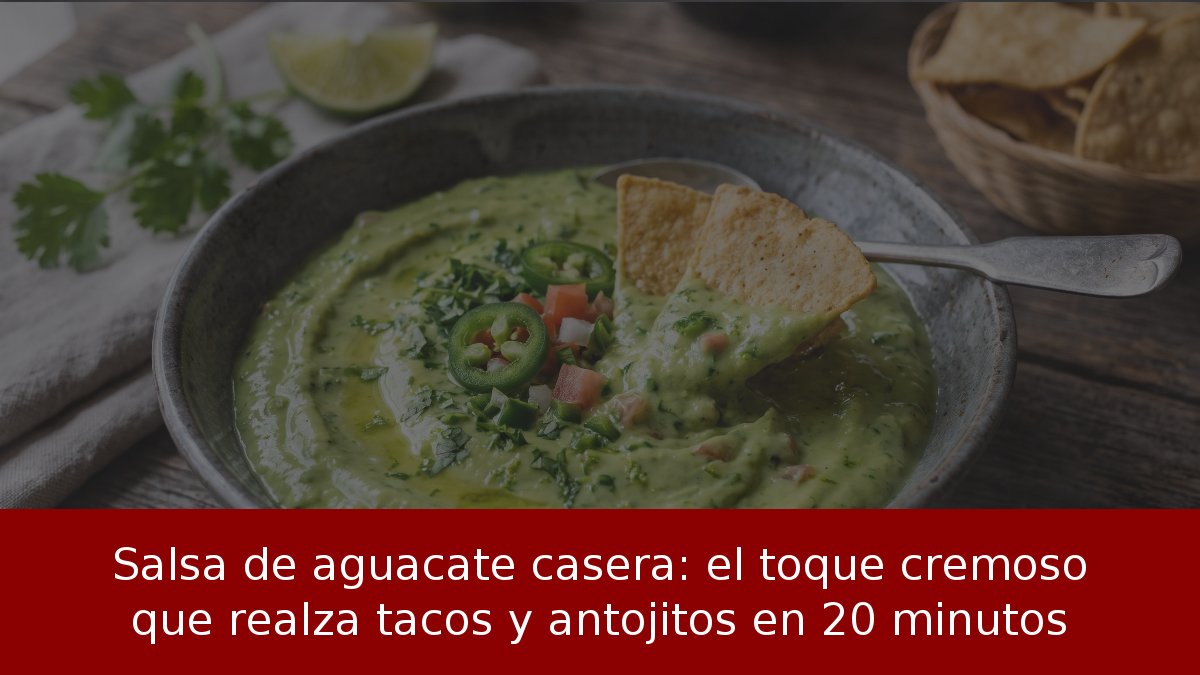
A creamy, fresh sauce with a mild kick can completely transform simple tacos. Avocado, the star ingredient, brings a silky texture that balances the acidity of green tomatoes and lime, while serrano chile adds character. In Mexico, this sauce commonly accompanies tacos, quesadillas, meats and other snacks, and unlike guacamole its consistency is more liquid and homogeneous, ideal for coating or drizzling over dishes.
- Total time: 20 minutes, with only 10 minutes of cooking.
- Key ingredients: ripe avocado, cooked green tomatoes, serrano chile, onion, garlic, cilantro and lime.
- Yield: approximately 8 servings of 2 tablespoons each.
Ingredients for avocado sauce
The list is short and accessible. You need 2 ripe avocados, 3 medium green tomatoes, 1 or 2 serrano chiles depending on desired heat, half a white onion, 1 garlic clove, a handful of fresh cilantro, the juice of 1 lime, 1 tablespoon of olive oil, about 1 cup of water and salt to taste.
Step-by-step preparation
The process starts by washing the green tomatoes and boiling them in a pot with water for 8 to 10 minutes, until they change color and are tender. Then drain and let them cool for a few minutes.
Meanwhile, peel the avocados, remove the pits and place the flesh in the blender jar. Add the green tomatoes, onion, serrano chiles, garlic, cilantro and lime juice. Blend until you get a uniform mixture.
Next, incorporate the water little by little until you reach a liquid texture but not too watery. Then add the olive oil and a pinch of salt, and blend for a few more seconds. Before serving, taste the sauce and adjust salt, lime or heat.
Serve immediately over tacos, quesadillas, nachos, meats, fish or roasted vegetables.
Nutritional value and storage
The recipe yields about 8 servings, calculated as 2 tablespoons per person. Each serving provides approximately 90 calories, 7 grams of fat, 6 grams of carbohydrates, 1 gram of protein and 3 grams of fiber. Sodium depends on the amount of salt added. These are estimates, as precise values vary according to the ingredients used.
To store, keep it in an airtight container in the refrigerator for a maximum of 2 days. Covering the surface with plastic wrap in direct contact helps reduce oxidation. Before serving, stir. If the sauce changes color significantly, smells bad or develops a strange texture, it is best to discard it.
This preparation joins other homemade sauces that aim to give personality to dishes without complicating daily cooking. Its versatility allows it to accompany anything from a quick meal to a barbecue, and its 20-minute preparation makes it a practical option for those looking to enhance the flavor of their recipes with fresh ingredients.