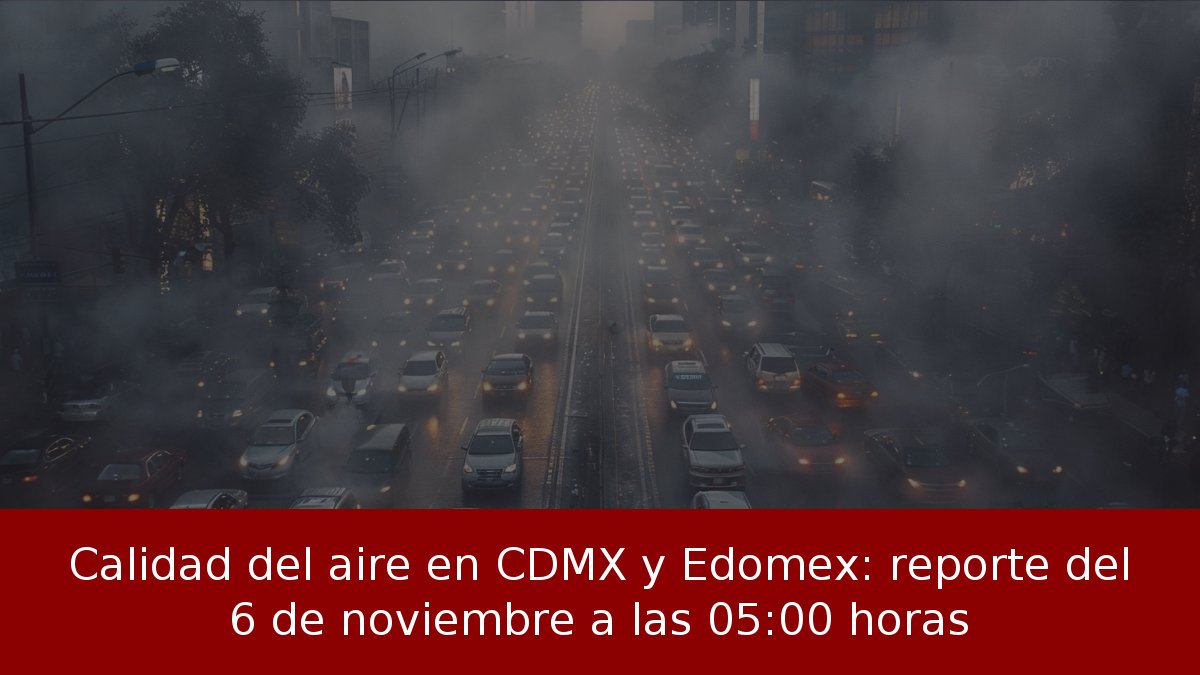
The capital's air monitoring agency has issued its latest hourly bulletin for the Mexico City metropolitan area, covering the State of Mexico's conurbated municipalities as well. The reading, taken on 6 November at 05:00, classifies air quality as "Acceptable", which corresponds to a "Moderate" health risk for residents.
- Overall rating: Air is deemed acceptable, posing a moderate risk to the public.
- UV index: Solar radiation registered at level 0, meaning no sun protection is needed outdoors.
- Station status: Several monitoring sites in both the capital and the State of Mexico are listed as having no data or being under maintenance.
The city government tracks pollutants around the clock, refreshing its public reports every hour. Those figures guide official advice on outdoor activity and, when conditions deteriorate, trigger measures such as the Environmental Contingency or the double Hoy No Circula driving restriction.
Guidance for residents and current conditions
According to the bulletin, people in the capital and neighboring state municipalities may carry out outdoor activities without major limitations. Still, the moderate-risk classification calls for extra caution among vulnerable groups, including children, the elderly and those with respiratory or cardiovascular conditions.
On solar radiation, the ultraviolet index stood at level 0, indicating that no protection is required while outside. City authorities released this guidance alongside the rest of the morning report.
Station-by-station results
The capital's network comprises 16 stations tracking air quality across its boroughs. At the 05:00 reading, most reported Good conditions: Tlalpan (AJM), Benito Juárez (BJU), Coyoacán (CCA), Cuajimalpa (CUA), Gustavo A. Madero (GAM), Cuauhtémoc (HGM), Iztacalco (IZT), Álvaro Obregón (PED), Iztapalapa (SAC), Tláhuac (TAH) and Coyoacán (UAX).
Venustiano Carranza (MER) was the only capital station rated Acceptable. Meanwhile, Azcapotzalco (CAM), Miguel Hidalgo (MGH), Cuajimalpa (SFE) and Iztapalapa (UIZ) were marked as no data or under maintenance.
In the State of Mexico, the network has 13 stations. Results were: Atizapán (ATI) Acceptable; Naucalpan (FAC), Nezahualcóyotl (FAR), Ecatepec (LLA), Nezahualcóyotl (NEZ), Ecatepec (SAG), Tultitlán (TLI), Coacalco (VIF) and Ecatepec (XAL) Good; while Chalco (CHO), Cuautitlán Izcalli (CUT), Anexo de Tlalnepantla (LPR) and Tlalnepantla (TLA) reported no data or under maintenance.
The agency noted that some municipalities and boroughs appear more than once because they host multiple monitoring stations.
Mexico's broader pollution picture
Mexico ranks among Latin American nations with the worst atmospheric pollution, and Mexico City slightly exceeds Santiago de Chile in fine-particle concentration. The 2024 World Air Quality Report, produced by IQAir, warns that air pollution in the country is a significant problem, driven mainly by high levels of fine PM2.5 particles, the most dangerous to health.
According to that report, in 2024 Mexico's PM2.5 concentration was roughly 3.5 times higher than the annual reference value recommended by the World Health Organization (WHO). The main pollutant nationwide and in cities such as Monterrey is PM2.5, made up of organic chemicals, dust, soot and metals from vehicles, factories and material burning.
These microscopic particles can enter the bloodstream and are linked to respiratory, cardiovascular and other serious illnesses. That is why constant monitoring and hourly public reports matter: they let residents adjust their routines and help authorities decide whether additional driving or outdoor-activity restrictions are warranted.