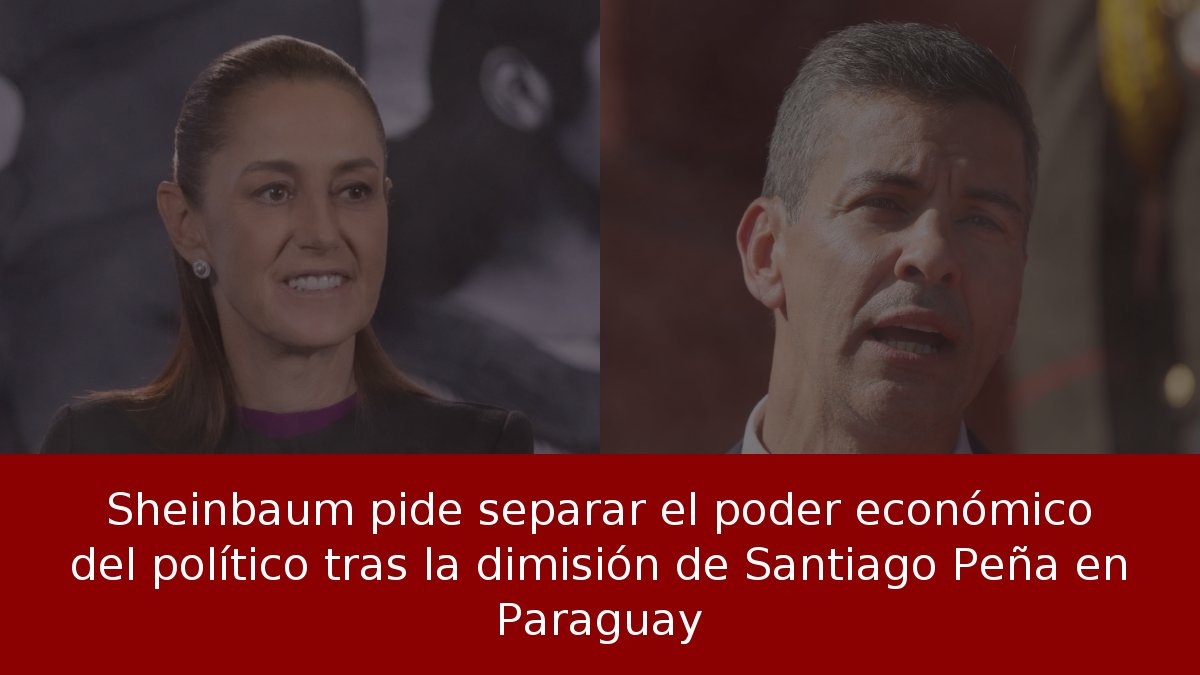
The resignation of Santiago Peña as president of Paraguay, amid a financial and political crisis triggered by the collapse and intervention of Ueno Bank, resonated at the morning press conference on November 6 at Palacio Nacional. Mexico's president, Claudia Sheinbaum, addressed the case and stressed the need for a clear boundary between economic interests and political activity.
- Presidential stance: Sheinbaum suggested that the now former Paraguayan leader may have been involved with the intervened bank, which would explain his decision to step down.
- Government principle: The president reiterated that her administration upholds the conviction of separating economic power from political power.
- Paraguayan context: The Senate summoned Peña to appear in the impeachment trial for alleged poor performance, following the accusation promoted by the Chamber of Deputies.
Sheinbaum's reading of Peña's exit
During the morning press conference, the Mexican president cautioned that more information is still needed to offer a complete opinion, but she advanced a preliminary interpretation of the case. In her words, the now former Paraguayan president appeared linked to the bank whose intervention set off the crisis, and that would be the reason he made the decision to resign.
“Vamos a tener más información para poder dar una opinión, pero sí, parece que el hoy expresidente, pues tenía staba involucrado en este banco, ¿no? Que esa es la razón por la cual él toma la decisión de dimitir”
The president also used the issue to insist on one of the premises her government has defended: that the economic and political spheres must run on separate tracks. In that regard, she recalled that for decades a close link between both spheres prevailed and that today the aim is to correct that dynamic.
“Cada uno su parte. Fueron treinta y seis años del vínculo total, pero bueno, para poder informar más vamos a recibir más información”
Paraguayan Senate summons Peña to testify
That same Friday, the Senate of Paraguay summoned President Santiago Peña to appear before the full chamber to respond to the accusations he faces in the impeachment trial for alleged poor performance of his duties. The summons comes amid the financial and political crisis stemming from the intervention of Ueno Bank.
The upper chamber rejected the president's request to postpone his appearance for 72 hours. The petition was dismissed by a vote of three in favor and 42 against, so lawmakers required him to present his arguments within 30 minutes. The session went into recess while they awaited the arrival of the head of state.
The origin of the political process
The proceedings against Peña began after the Chamber of Deputies pushed an accusation directly linking him to the intervention of Ueno Bank, an institution that left the savings of millions of Paraguayans blocked. A day earlier, the Senate had constituted itself as a tribunal to carry out the political procedure.
Sheinbaum's statement adds to a regional debate about the limits between the financial sector and the conduct of the state. With Peña's appearance in the Senate and the impeachment trial underway, the Paraguayan crisis enters a decisive phase that will define the country's institutional stability and the future of the savings affected by the bank intervention.