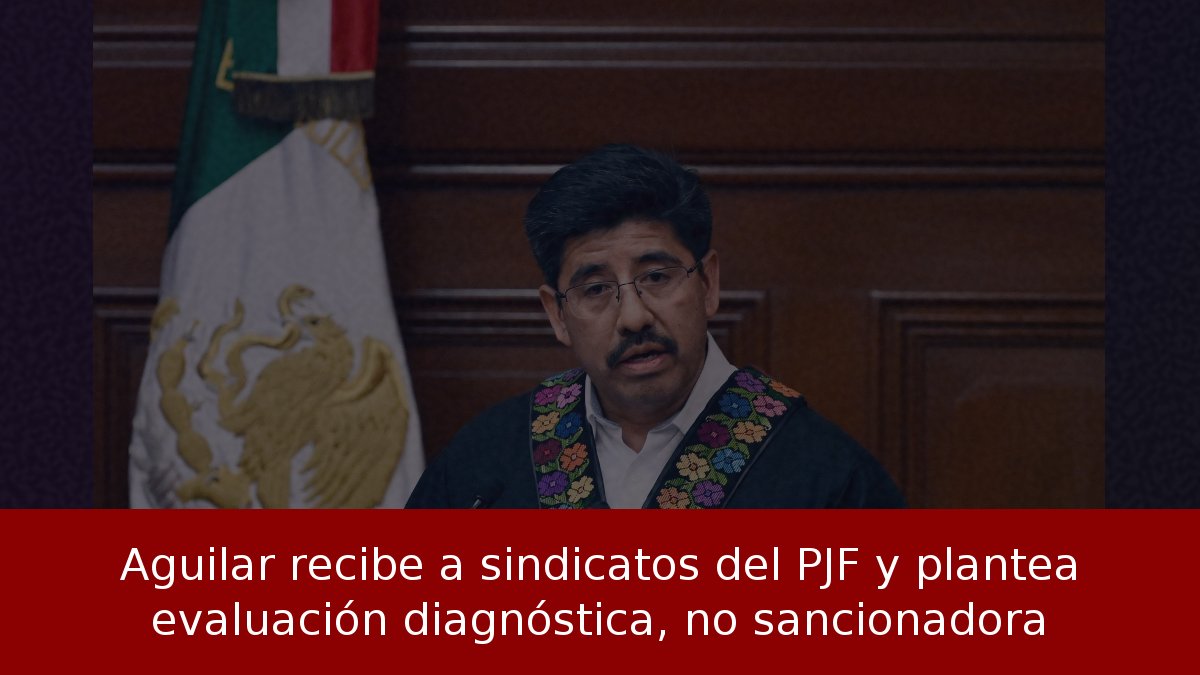
Hugo Aguilar, president of Mexico's Supreme Court (SCJN), met with union leaders of the Federal Judicial Branch (PJF) as a national strike over the new performance evaluation system—a key component of the judicial reform—continues. The meeting aimed to hear workers' demands and seek agreements to channel the conflict through institutional means.
- Meeting with unions: Aguilar spoke with Jesús Gilberto González Pimentel and Juan Alberto Prado Gómez, general secretaries of two PJF unions.
- Court's view: Evaluations should identify training needs, not serve as punishment for employees.
- Protest: More than a thousand workers at the Eighteenth Circuit stopped work in Morelos; the movement then went national with blockades in at least 17 states.
- OAJ's stance: The first evaluation, scheduled for December 2026, will be diagnostic and will not affect job continuity.
Dialogue prioritized over imposition
According to an SCJN statement, the chief justice listened to staff concerns and pledged to build agreements with the Judicial Administration Body (OAJ) to steer institutional processes. The meeting included Jesús Gilberto González Pimentel, general secretary of the Union of Workers of the Federal Judicial Branch, and Juan Alberto Prado Gómez, general secretary of the National Renewal Union Serving Federal Judicial Workers.
Aguilar described workers as the "backbone" of the justice system and said institutional decisions must be discussed with PJF personnel, even when they have legal backing.
"The legality of a decision does not replace the need to discuss it," the SCJN statement says.
The court maintains that strengthening the judiciary requires respect, listening and a willingness to reach agreements among workers, authorities and judicial administration bodies.
Evaluation to train, not punish
The chief justice proposed that performance evaluation serve to identify training areas and improve the PJF's functioning, without becoming a punitive measure against workers.
"Evaluation should not be punitive, but a tool to strengthen capacities and increase the PJF's efficiency," the Court says.
Employees' discontent centers on the OAJ's criteria for evaluating secretaries, court clerks and officials. They argue the scheme jeopardizes the judicial career and could affect the permanence of their positions, and that it does not sufficiently recognize their experience, preparation and track record.
The strike spreads across the country
On Thursday, November 5, more than a thousand workers from the PJF's Eighteenth Circuit suspended activities in Morelos. The following day, Friday, November 6, staff began a national strike and chained shut the San Lázaro judicial headquarters in Mexico City. Protesters warned the blockade would be indefinite and called for extending mobilizations to at least 17 states.
In Monterrey, Nuevo León, judicial offices closed around 9:00 a.m. and workers blocked the regular and express lanes of Constitución Avenue, one of the city's main roads. The mobilization caused traffic disruptions for about four hours; around 12:30 p.m. protesters cleared the avenue and returned to the judicial facilities.
The day also brought tension in Durango, where Néstor Vargas Solano, head of the OAJ, attended a meeting with protesting workers and ended up on the ground during the exchange. Demonstrators demanded information about evaluations scheduled for mid-December and their possible labor consequences. Protests also occurred in Sonora and Yucatán, where staff gathered outside the Petronila building in Mérida and voiced their grievances to an OAJ magistrate.
In response to the strike, the OAJ said the first round of evaluations, scheduled for December 1, 4, 8 and 15, 2026, will be diagnostic. The body assured there will be no pass or fail and no individual effects on job continuity, adding that the first ordinary evaluation with legal consequences will come after the corresponding training courses.
With dialogue open, the challenge for the SCJN and OAJ will be turning gestures of openness into concrete guarantees for judicial staff. The strike's scale and territorial spread put the judicial reform's legitimacy to a practical test: convincing those who operate the system that evaluation will strengthen their capacities and not become a filter for eliminating positions.