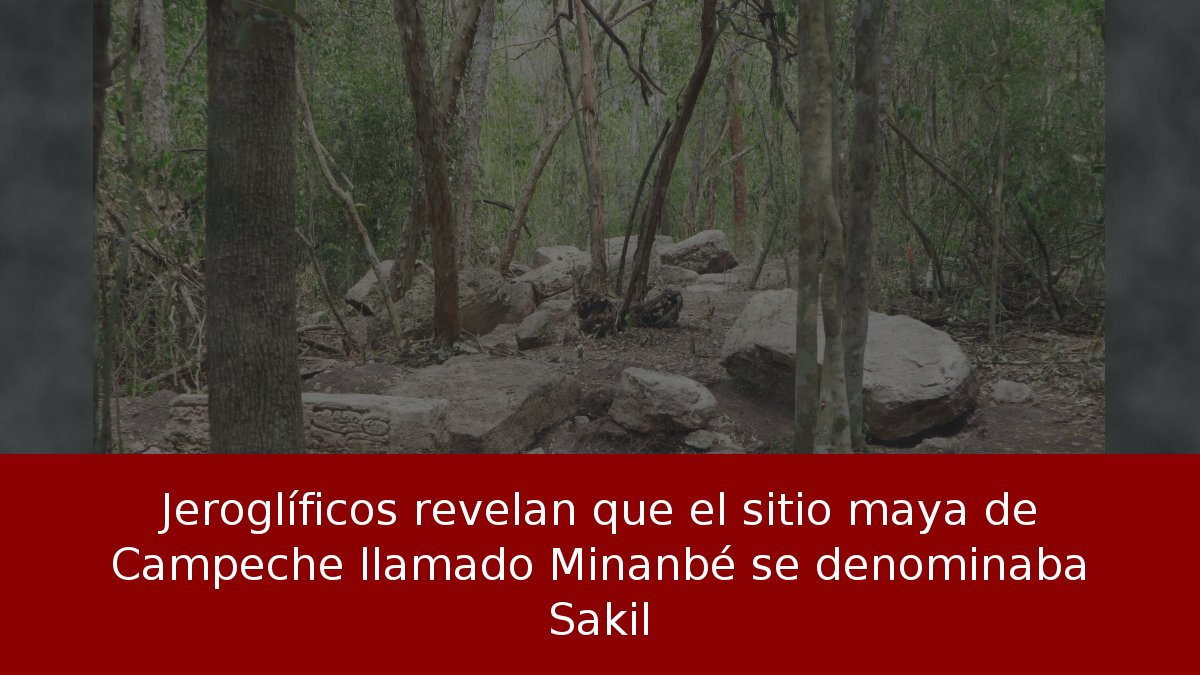
A Maya settlement discovered in May 2026 north of the Calakmul Biosphere Reserve in Campeche has recovered its historical name. Through epigraphic and iconographic study of its monuments, specialists determined that the site, provisionally called Minanbé, was actually named Sakil, a Maya term denoting whiteness. The announcement, released by the INAH, not only corrects the site's name but also reveals details of its political organization.
- Original name: the hieroglyphs on the monuments indicate that the site baptized Minanbé —“no road” in Maya— was called Sakil.
- Recorded ruler: Stela 7 and Altar 6 mention the lord Suutz', whose name means bat, who bore the title kalo'mte'.
- Wartime rivalry: the inscriptions point to conflicts with Ocomtún, a larger center located 40 kilometers to the northwest.
The epigraphic key to the name
The archaeological team had designated the settlement Minanbé because of the difficulties in reaching it. Identification of its original name emerged from comparing two epigraphic sources.
On Stela 7 of Minanbé, which the Maya themselves fragmented into three pieces, the hieroglyphic cartouches on the left side show the name of ruler Suutz' accompanied by a toponymic title composed of the logograms sak and ajaw.
The second source is Monument 1 of Ocomtún, a step in Structure B6 that originally served as a doorway lintel and was later reset as a stair tread. It depicts an animated mountain associated with a captive face down with wrists bound, and a toponym in the left column indicates that the prisoner came from Sakil. The similar structure of the toponymic title in both records allowed the connection to be established.
The findings were presented by epigrapher Octavio Esparza Olguín, of the Center for Maya Studies at UNAM's Institute of Philological Research, in a conference organized by the Ministry of Culture through the INAH Center in Campeche. Esparza Olguín is part of the project “Expanding the archaeological panorama of the Central Maya Lowlands,” led by Mayanist Ivan Šprajc, of the Research Center of the Slovenian Academy of Sciences and Arts.
“It allows us to move from locating a site to knowing part of its history: its name, one of its rulers and links with other Maya cities. Thus, archaeological research expands public knowledge about the political organization of that civilization and the depth of our past,” stated Claudia Curiel de Icaza, Secretary of Culture of the Government of Mexico.
Photogrammetry to decipher reliefs
Many of the epigraphic elements were recovered through photogrammetric models. This technique made it possible to precisely record the carvings on reliefs deteriorated by more than a thousand years of abandonment, manipulate lighting with computer programs to reveal strokes illegible to the naked eye, and produce more accurate line drawings from the digital models.
Of nearly 20 monuments located at the site, at least five retain remnants of texts and images. Much of the information was lost due to mutilations that the Maya made on the stones.
A lordship with a regional title and conflicts
Beyond the name, the monuments provided data on Sakil's political structure. Ruler Suutz' —bat— appears on both Stela 7 and Altar 6. On the latter, his name is followed by the title kalo'mte', exclusive in the Classic period to lords with regional dominion, although toward the end of that era it extended to smaller-scale sites such as this settlement of barely 15 hectares.
The records also indicate that Minanbé maintained wartime conflicts with Ocomtún —whose pre-Hispanic name was Maatz'—, a larger center located 40 kilometers to the northwest and discovered by the same project in 2023, at least during part of the Late Classic period (600-900 AD). Esparza Olguín noted that the site must have had links with other nearby centers such as Chactún, Tamchén and Lagunita.
The identification of Sakil and its ruler suggests that southeastern Campeche hosted a political network more complex than its modest size indicated. The monuments of the Calakmul region continue to reveal, season after season, how the Maya cities of the Late Classic organized and competed.