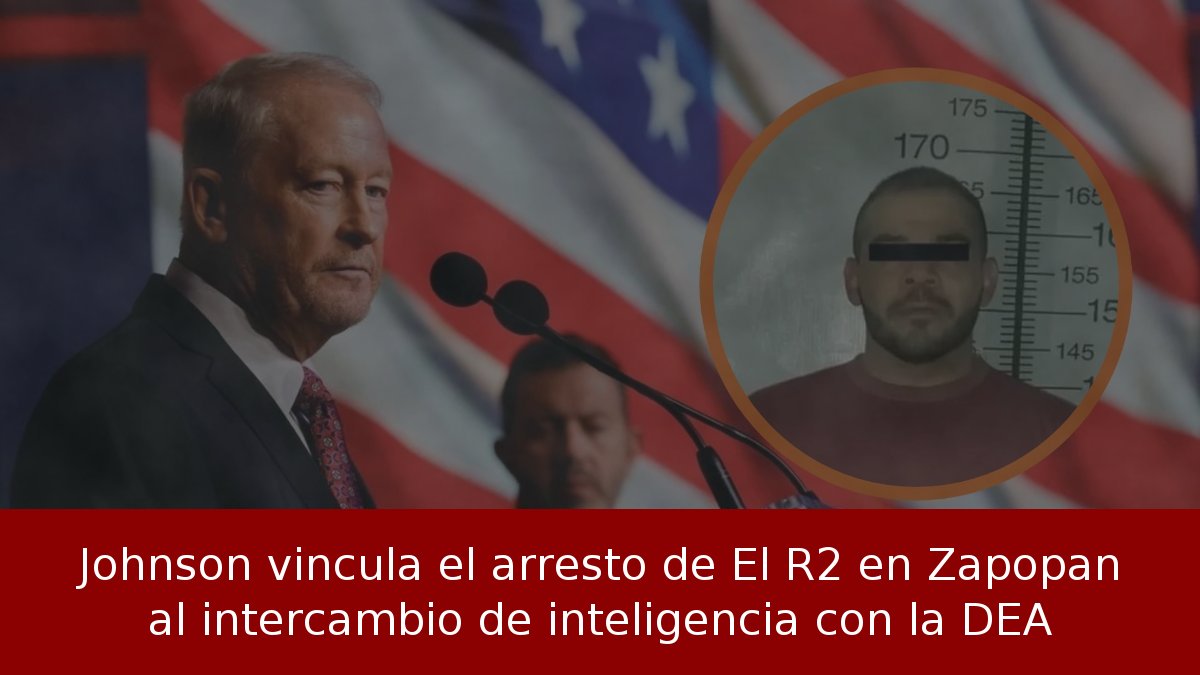
The detention of Rafael Álvarez Ayala, known as El R2 and identified as a leader of a cell of the Jalisco Nueva Generación Cartel (CJNG), was presented by the U.S. ambassador to Mexico, Ronald Johnson, as a direct result of intelligence sharing between the two countries. The diplomat said information provided by the U.S. Drug Enforcement Administration (DEA) enabled Mexican authorities to locate and arrest the operative, captured in Zapopan, Jalisco, along with 19 other people.
- Binational cooperation: Johnson stated that DEA intelligence was key to locating El R2.
- Profile of the detainee: He is identified as a commander of Los Rs, a CJNG cell operating in Jalisco and Michoacán.
- Pending proceedings: El R2 faces an arrest warrant for aggravated homicide and another for extradition to the United States.
The ambassador's message and DEA backing
In a post on his official X account, Johnson wrote that “criminal networks depend on secrecy” and that intelligence “helps us expose them.” In the same message he described the detainee as “a key leader of a CJNG cell linked to drug trafficking, extortion, kidnapping and murder.”
“Information shared by the DEA helped Mexican authorities locate and arrest Rafael ‘N’,” Johnson posted, adding that El R2 “is also wanted for extradition to the United States.”
DEA Administrator Terry Cole echoed the ambassador's message, stating that sharing information “strengthens our ability to identify, target and dismantle criminal organizations.” Cole framed the operation within a broader effort he called “Mission Mexico,” aimed at “dismantling terrorist networks, holding perpetrators accountable and protecting our communities.”
The ambassador's statement follows earlier remarks on the U.S. strategy of targeting criminal organizations through their financial structures. Days earlier, Johnson had highlighted in similar terms the arrest of Bojun He, alias “El Chino,” described as an operator of a money-laundering network.
Who is El R2 and how was the capture carried out
Authorities identified the detainee as Rafael Álvarez Ayala, described as a commander of the cell known as “Los Rs,” linked to the CJNG and operating in Jalisco and Michoacán. The group is accused of extortion against avocado producers, as well as drug trafficking, homicides and kidnappings.
Rafael Álvarez Ayala is the brother of Ramón Álvarez Ayala, alias “R1,” identified as the organization's leader and arrested last July. Both were named by U.S. authorities in a federal indictment filed in August, for alleged conspiracy to manufacture and distribute cocaine and methamphetamine destined for the United States, as well as firearms-related offenses.
The capture took place on Sunday, November 8, in Zapopan, in an operation led by the Naval Special Operations Unit (UNOPES) of the Secretariat of the Navy (Semar), with support from the Secretariat of Security and Citizen Protection (SSPC) and Mexican Army Special Forces.
Security and Citizen Protection Secretary Omar García Harfuch confirmed the detention on social media and stated that El R2 is identified as “an important generator of violence and commander” of Los Rs. He noted that the detainee has an active arrest warrant for aggravated homicide, issued by the First Criminal Court of Apatzingán, Michoacán, as well as a warrant for extradition to the United States.
The operation led to an armed confrontation in which the detainee and a naval officer were wounded. After his capture, El R2 was taken to a hospital in Guadalajara, where he received medical attention under custody, while investigations continue to determine the legal status of the other 19 people detained in the same deployment.
Political reading of the operation
The sequence of messages from Johnson and Cole seeks to underscore the role of U.S. intelligence in an operation carried out on Mexican soil, in a context of bilateral pressure on the CJNG. Before those statements, the DEA had issued a release describing El R2 as “a high-ranking leader of the CJNG terrorist organization responsible for drug trafficking, extortion, kidnappings and deadly violence throughout Mexico,” and praised “the decisive actions” of the SSPC, Semar, Sedena and CNI “in bringing this dangerous cartel leader into custody.” The case now moves forward on two fronts: the judicial process in Mexico and the extradition request from Washington.