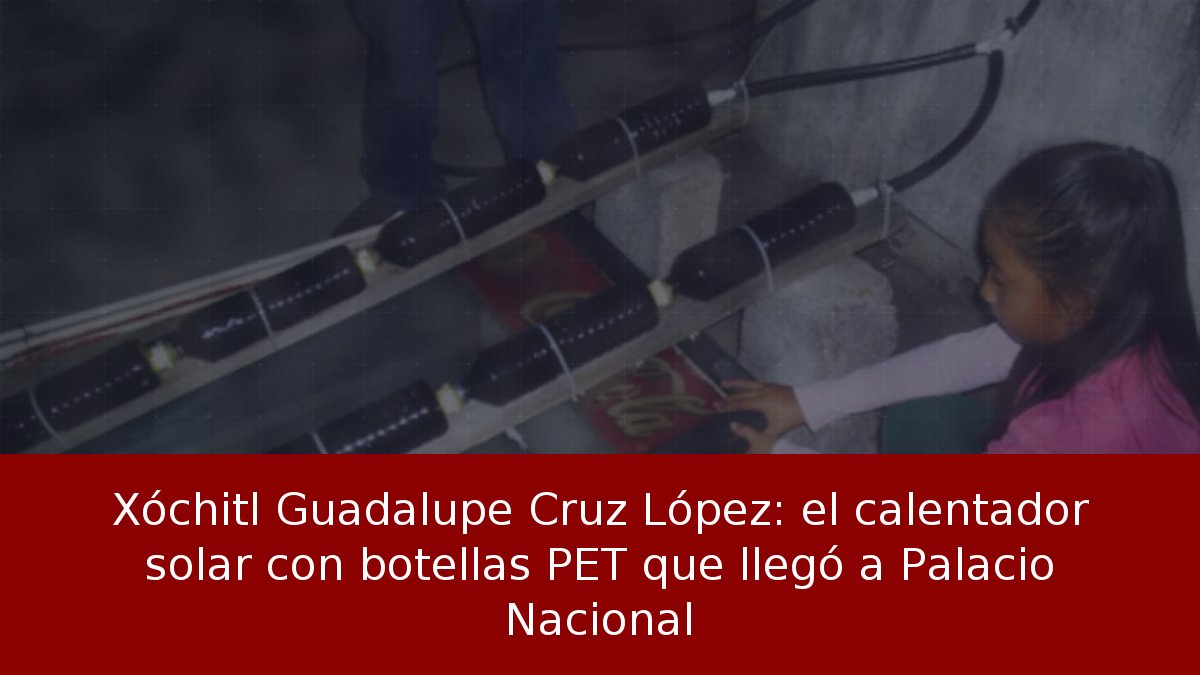
A young Chiapanecan inventor brought her low-cost solar water heater to the national stage when she met with President Claudia Sheinbaum at the National Palace on November 5. Xóchitl Guadalupe Cruz López, who began developing the device at age eight, explained how the system works and shared other research focused on social and environmental issues. The project, called Baño Calientito, was born from the difficulty some families in San Cristóbal de las Casas face in obtaining hot water in a cold region without relying on gas or firewood.
- Key Point: The solar heater uses plastic bottles, hoses, wood and reused refrigerator glass; the PET bottles are painted black to absorb solar heat and transfer it to the water.
- Key Point: The system heats water by solar energy and moves it to a tank through natural circulation, requiring no electricity, gas or pumps; one version can heat up to 50 liters to nearly 70 °C.
- Key Point: The proposal seeks to offer an affordable option for households, lower fuel costs and reduce firewood use, which puts pressure on natural resources.
- Key Point: In 2018, at age eight, Xóchitl became the first girl to receive the ICN Recognition for Women from UNAM's Institute of Nuclear Sciences, and Time magazine included her among young inventors and visionaries at the 2020 World Economic Forum in Davos.
From a viral video to a presidential meeting
The story reached the president after content creator Alexis Omman posted a video that drew more than 1.6 million views. On November 1, Sheinbaum replied to Omman:
“Querido Alexis, vi tu video. Me encantaría conocer a Xóchitl y apoyarla”.Four days later, Xóchitl visited the National Palace with her mother. During the meeting she explained her solar heater and presented research on social and environmental topics. The president expressed interest in learning about her other projects and exploring ways to support her investigations.
Wetlands, pandemic and child violence: other research
Xóchitl developed her skills and research through the Adopte un Talento program, PAUTA, linked to UNAM. The ICN Recognition for Women, awarded by UNAM's Institute of Nuclear Sciences, aims to highlight women's contributions to science and promote gender equality in the scientific field. It originated with the institute's then Gender Equity Committee—now the Internal Commission for Gender Equality—and has been given for outstanding academic and research careers as well as for exceptional science communication skills. In her conversation with Sheinbaum, Xóchitl also presented studies on social media use during the COVID-19 pandemic, conservation of the mountain wetlands of San Cristóbal de las Casas, and child violence.
Two paths linked by energy
The meeting brought together two trajectories related to science and energy use. Claudia Sheinbaum studied Physics at UNAM's Faculty of Sciences and did postgraduate work in Energy Engineering; her undergraduate thesis was a thermodynamic study of domestic wood stoves. That theme was later taken up in public policy through the National Program of Efficient Wood Stoves for Wellbeing, which plans to install one million efficient stoves in rural and Indigenous communities during her administration. The first phase began in April 2025 in Purépecha communities of Michoacán.
The case of Xóchitl Guadalupe Cruz López shows how a low-cost solution built from waste materials can move from the community level to national public conversation. The presidential backing opens the possibility that her research, centered on environmental and social problems in Chiapas, may find institutional channels to develop beyond the classroom.