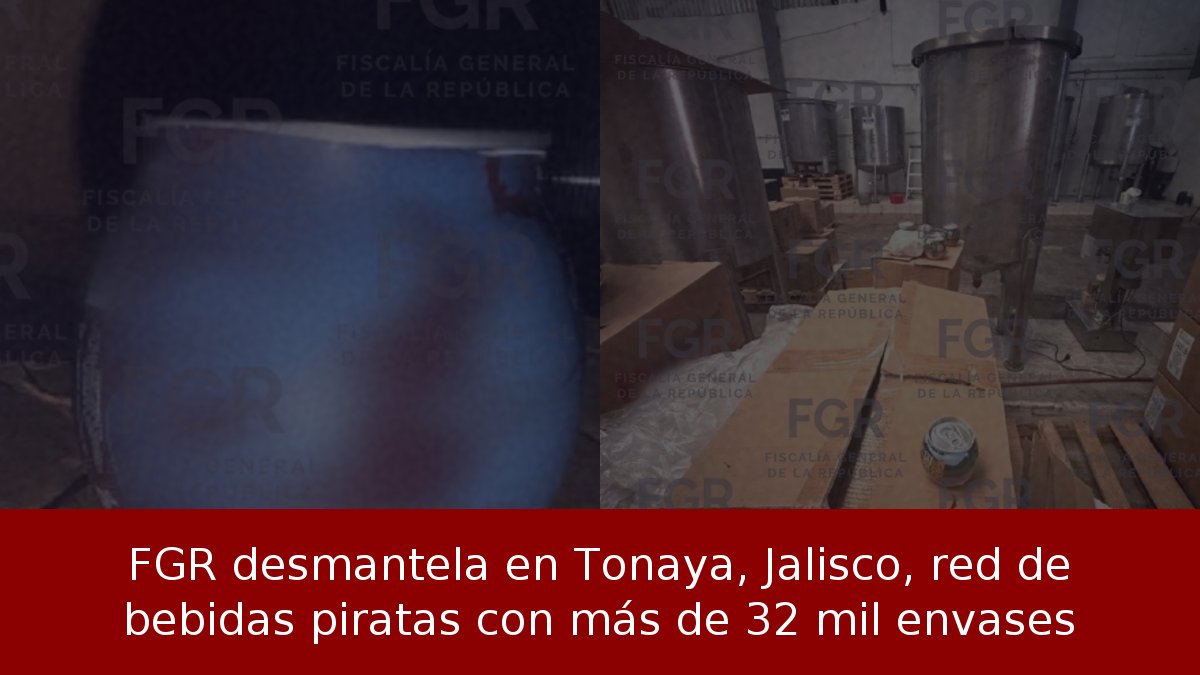
Federal prosecutors in Mexico have uncovered an illicit alcohol bottling operation in Tonaya, Jalisco, tied to two companies, after carrying out four search warrants. The Fiscalía General de la República (FGR) said the raids stemmed from an investigation into the possible manufacture, storage and sale of alcoholic drinks in containers that allegedly copy a protected three-dimensional trademark.
- Key Point: Four properties and equipment thought to have been used for making alcoholic beverages were seized during the operation in Tonaya, Jalisco.
- Key Point: Authorities made a preliminary count of more than 32,000 spherical bottles, along with work-in-progress merchandise and raw materials.
- Key Point: Three people were detained and handed over to the federal Public Ministry, which will decide their legal status.
Equipment, records and cash seized
According to the authorities, the properties contained machinery apparently used to fill and seal containers, as well as paperwork, electronic devices, cash and other evidence linked to the case. The estimated legitimate value of the counted goods exceeds one million pesos.
The probe focuses on the alleged counterfeiting of the distinctive spherical shape of an alcohol bottle, which is protected as a three-dimensional trademark. The FGR explained that this form of industrial property lets a product be identified by the shape of its container, no matter what words, labels, colors or names appear on the bottle.
“Esta figura de propiedad industrial permite distinguir un producto por la configuración de su envase, independientemente de las palabas, etiquetas, colores o denominaciones colocadas en el recipiente”, detalló en un comunicado.
The agency added that the distinctive shape and its protection represent the safeguarding of innovation and entrepreneurship, since the design was developed as part of a business project and later recognized for its growth and contribution to the sector. Recently, alcoholic drinks using that distinctive container have become popular and are sold in convenience stores; they are pre-mixed cocktails in individual sizes.
Prosecution requires a complaint and possible penalties
The facts are being investigated under Article 402, section II, of the Federal Law for the Protection of Industrial Property, which covers producing, storing, distributing or selling, for commercial speculation, objects bearing counterfeit trademarks. Article 403 of the same law sets a penalty of 3 to 10 years in prison and a fine of 2,000 to 500,000 Units of Measurement and Update (UMA), at the value in force when the offense is committed, if the conduct is confirmed.
The crime can only be prosecuted on complaint from the injured party, meaning the trademark owner must file a formal report with the Public Ministry. In addition, under Article 405 of the same law, for the Fiscalía to bring criminal charges in these cases, the Mexican Institute of Industrial Property must issue a technical opinion within no more than 30 business days; that opinion does not prejudge any civil or criminal actions that may follow.
Recent precedent in Lázaro Cárdenas
In recent days, Customs personnel, the Secretariat of the Navy (Semar) and the FGR seized 33,097 allegedly counterfeit items at the port of Lázaro Cárdenas, Michoacán, in two containers from Hong Kong. The operation involved two inspections and is part of the Mexican government's “Operación Limpieza.”
In the first container, falsely declared as “pens,” authorities found 22,865 items, including 4,700 high-end watches, 4,500 headphones, 9,870 electronic accessories, 3,650 pairs of sneakers and 145 costumes. The second held another 10,232 products, including 10,100 headphones and 132 pairs of sneakers, also allegedly fake. The merchandise was placed at the disposal of the FGR to determine its legal status; the agency did not specify the economic value of the items or the brands involved, nor did it say whether anyone was detained.
The Tonaya case illustrates how authorities are moving against trademark counterfeiting in the alcoholic beverage industry, a phenomenon that mixes industrial property, public health and informal commerce. The legal outcome for the three detainees and the opinion from the Mexican Institute of Industrial Property will be decisive for the Fiscalía to bring criminal charges and, if applicable, hold the two companies linked to the production site accountable.