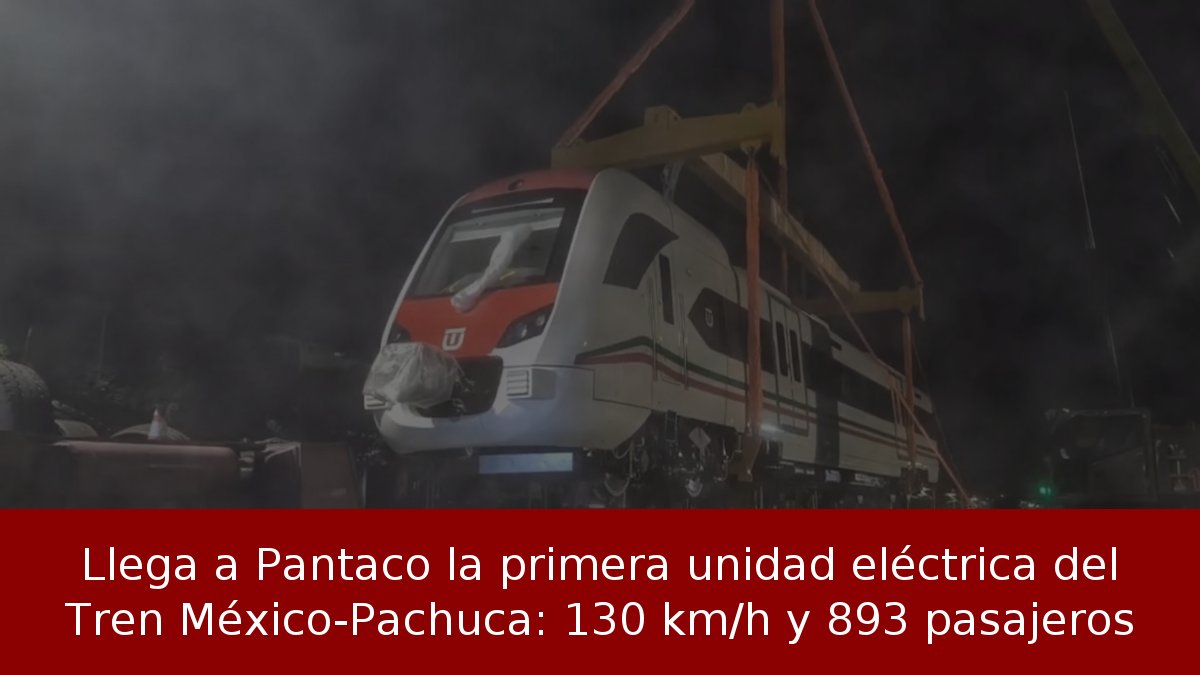
The first electric trainset for the Mexico City–Pachuca railway has arrived in Mexico. The convoy reached the Pantaco rail terminal in the north of the capital from China, where it will join testing for the passenger service linking Buenavista with the Hidalgo state capital, according to a press release from the Secretariat of Infrastructure, Communications and Transport (SICT).
- Arrival: the lead unit of the series reached Pantaco last Saturday, coinciding with Railway Workers' Day, observed on November 7.
- Manufacturing: the trainset was built at CRRC's workshops in Zhuzhou, China, departed that country in August and reached Mexico in November to continue assembly.
- Capacity and speed: it measures 102 meters, carries 893 passengers and can reach speeds of up to 130 kilometers per hour.
- Projection: the route will use 15 trains and expects demand above 100,000 passengers per day.
A Chinese-built convoy begins its assembly phase
The trainset, regarded as the lead unit of the series, was manufactured at CRRC's facilities in Zhuzhou, China. It left that country in August and arrived on Mexican soil in November to move on to the next stage of assembly.
The SICT said the units will be fully electric and capable of speeds of up to 130 kilometers per hour. The project aims to link communities in the Valley of Mexico and the Pachuca metropolitan area through a passenger rail service.
The design includes priority seating, luggage and bicycle areas, and a video surveillance system inside and outside the cars.
From Pantaco to Ciudad Sahagún: the assembly route
Andrés Lajous, director of the Integrated Train and Public Transport Agency (ATTRAPI), shared images of the first cars at the workshops and depots in Pantaco, in the Azcapotzalco borough. The units will remain there before being moved to Ciudad Sahagún for component assembly.
Hidalgo's secretary of economic development, Carlos Henkel Escorza, said the Chinese firm CRRC Zhuzhou Locomotive has rented an industrial building in Ciudad Sahagún to assemble part of the 15 trains destined for the Mexico-Pachuca project.
Henkel Escorza explained that the company has its headquarters in Querétaro and chose the Hidalgo location because of its proximity to the new line, since the cars must be moved for testing before entering service.
“La empresa que ganó el proyecto del tren México-Pachuca vía AIFA está estableciendo un centro de ensamblado en Ciudad Sahagún, dado que tiene su matriz en Querétaro. Rentó una nave industrial, está empezando a ensamblar”, declaró el funcionario estatal ante la prensa.
The head of Hidalgo's economic development secretariat said companies based in Ciudad Sahagún are working with the Chinese firm on prototypes and proposals in the metalworking and fiber-textile sectors. It remains to be decided which will participate as suppliers.
“Lo que nos dan a entender es que una gran parte de ellos, los trenes, se va a ensamblar en Ciudad Sahagún; insisto, son varios procesos”, afirmó Henkel Escorza.
The secretary added that Hidalgo companies have experience from their work with Alstom and Greenbrier, which are installed in the area and linked to national and international projects. According to Henkel Escorza, that activity has sustained jobs and industrial operations in Ciudad Sahagún.
A 100-kilometer route with seven stations
The Buenavista–Pachuca route will span 100 kilometers. Of that total, 58 kilometers correspond to new electrified track on the AIFA-Pachuca segment, being built by the “Felipe Ángeles” Engineers Group of the National Defense Secretariat.
The project envisions seven stations and one terminal, aiming to connect localities in Mexico City, the State of Mexico and Hidalgo. The Buenavista–Pachuca journey is expected to take one hour and 15 minutes.
The federal government is building the Felipe Ángeles Train toward Pachuca, a 58.12-kilometer double-track electrified route that will link AIFA with the Hidalgo capital. Operations are scheduled to begin in 2027, after about a year and a half of work.
The line will have four main stations and four intermediate stops in the State of Mexico and Hidalgo. In May, authorities reported overall civil works progress of 34.80%. Most of the alignment uses existing rights of way.
Construction of the elevated section is advancing in Xaltocan, where concrete girders have already been installed on the supports that will carry the track over the Circuito Exterior Mexiquense. The infrastructure will include two viaducts totaling 5.89 kilometers, four electrical substations and more than 51 kilometers of cut and embankment. The service will be exclusively for passengers.
With the first unit's arrival at Pantaco, the project enters a decisive stage: train testing will determine whether the route can meet its projected travel times and demand. Assembly in Ciudad Sahagún and completion of civil works in Xaltocan and Pachuca will be the next checkpoints for a service aiming to move more than 100,000 people a day.