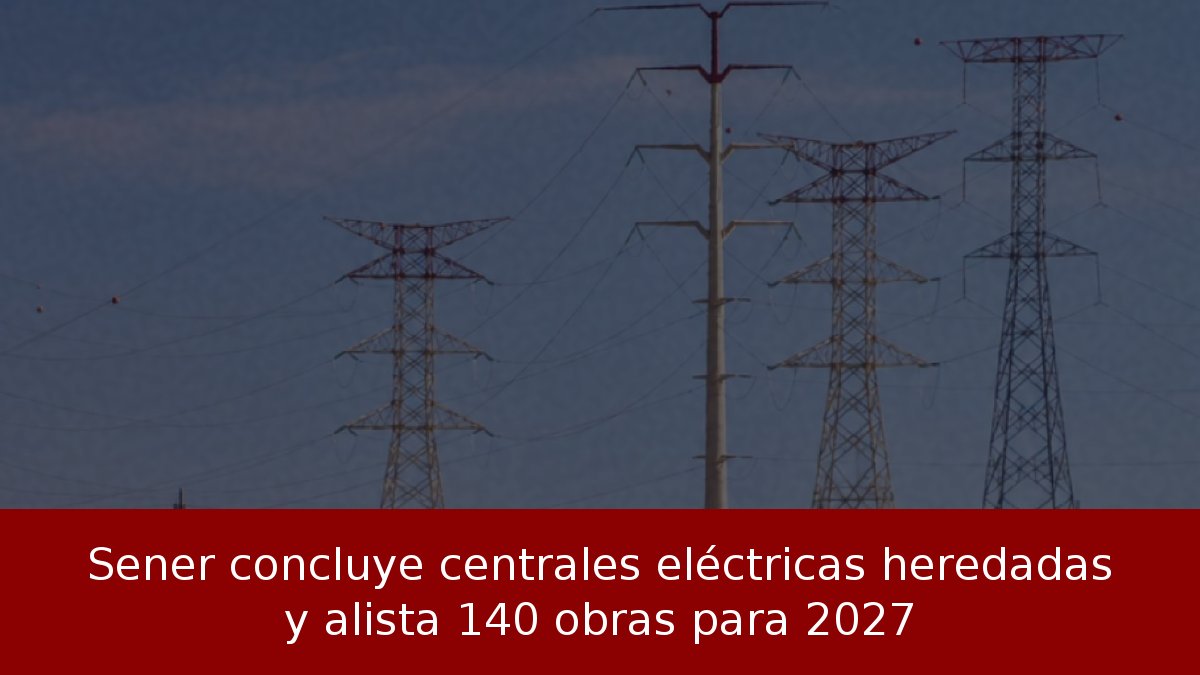
Two years into Claudia Sheinbaum Pardo's presidency, the Secretaría de Energía (Sener) continues to rely on projects and investment plans inherited from the previous administration, while preparing a new portfolio for next year. Energy Secretary Luz Elena González presented these details before the Senate Energy Commission as part of the Glosa del Segundo Informe de Gobierno.
- Inherited plants: Of the 10 combined-cycle plants that began construction under Andrés Manuel López Obrador (AMLO), none entered operation before 2024; six are now commercially operational and the remaining four will be inaugurated next year.
- New builds: The government plans 16 new public plants under CFE, including five combined-cycle, one internal combustion, and two photovoltaic plants in Puerto Peñasco.
- Mixed and private projects: 121 mixed projects and 19 private projects have been selected for solar and wind plants.
- 2030 target: Of the 32,000 MW to be added, 22,000 MW will come from renewable sources.
Six inherited plants operating, four awaiting inauguration
González said that between 2015 and 2026 the agency has worked to complete the combined-cycle plants started under the previous government. She acknowledged that none of the 10 met the promise to operate before 2024.
“En los primeros dos años de gobierno hemos puesto en operación comercial seis nuevas centrales de ciclo combinado que forman parte de 10 centrales que iniciaron en la administración pasada. Las cuatro centrales restantes las estaremos inaugurando el próximo año; se trata de centrales en Yucatán, Veracruz, Durango y Sonora, que aportarán otros tres mil 75 megawatts (MW)”, she said.
The Sener chief also said the government plans to build 16 new public plants under the Comisión Federal de Electricidad (CFE). These include five combined-cycle, one internal combustion, and two photovoltaic plants in Puerto Peñasco, which together will add 1,000 MW to the National Electric System. In addition, eight hydroelectric plants will be modernized and repowered.
121 mixed projects and 19 private ones to expand generation
González said 121 mixed projects and 19 private projects have been selected to build solar and wind plants in regions that need more generation capacity.
“De esta manera, a finales del próximo año vamos a tener más de 140 centrales de generación en construcción, un hito en la historia de México”, she added.
As a result, of the 32,000 MW to be added by 2030, 70 percent—22,000 MW—will come from renewable energy. To support this infrastructure, the federal government is committing public resources, according to the Sener chief.
Transmission and distribution investments
In transmission, investments exceed 161 billion pesos, and in distribution more than 72 billion, according to González Escobar.
“A dos años del inicio del gobierno, en materia de transmisión llevamos 35 proyectos terminados, 83 están en ejecución y 37 por iniciar. Tan sólo en el segundo año concluimos 19 obras y 53 iniciaron su ejecución. En distribución concluimos 32 nuevas estaciones, 57 ampliaciones de subestaciones existentes y realizamos mil 338 obras de modernización de las redes generales”, she told senators.
Sheinbaum highlights progress of Chicoasén II in Chiapas
On social media, President Claudia Sheinbaum Pardo highlighted progress on a CFE hydroelectric project on the Grijalva River in Chicoasén, Chiapas. The work is Chicoasén II, a plant that will generate electricity from water already used by another facility, without building an additional dam or displacing local communities.
The president shared a video showing construction progress; the plant will add 240 MW of clean energy to the National Interconnected System. The project uses technology designed to harness water even with relatively small height differences.
According to the explanation in the video, Chicoasén II will use runoff from the Grijalva River and water that has already passed through the turbines of the Manuel Moreno Torres plant, also known as Chicoasén. Unlike conventional hydroelectric plants, this infrastructure will not require a large dam to generate electricity. It will operate with three bulb turbines, each with 80 MW capacity, driven by water movement.
This technology integrates the generator into a sealed bulb-shaped structure. Water flow turns the turbine and produces electricity even when the height difference between water levels is relatively small. Sheinbaum stressed that this is an innovation developed by CFE and offers an alternative to expand power generation without displacing populations.
During a supervision visit on November 8, Sheinbaum confirmed that construction had reached 52.18 percent physical progress. More than 1,500 people are working at the site across different work fronts. The new plant will supply clean energy to the National Interconnected System and is expected to benefit 184,421 inhabitants and 54,241 households.
The picture presented by Sener combines completion of inherited works with an ambitious portfolio of public, mixed, and private projects. The challenge will be meeting the deadlines set for 2027 and 2030, in a context where the agency still operates based on investment plans from the AMLO government.