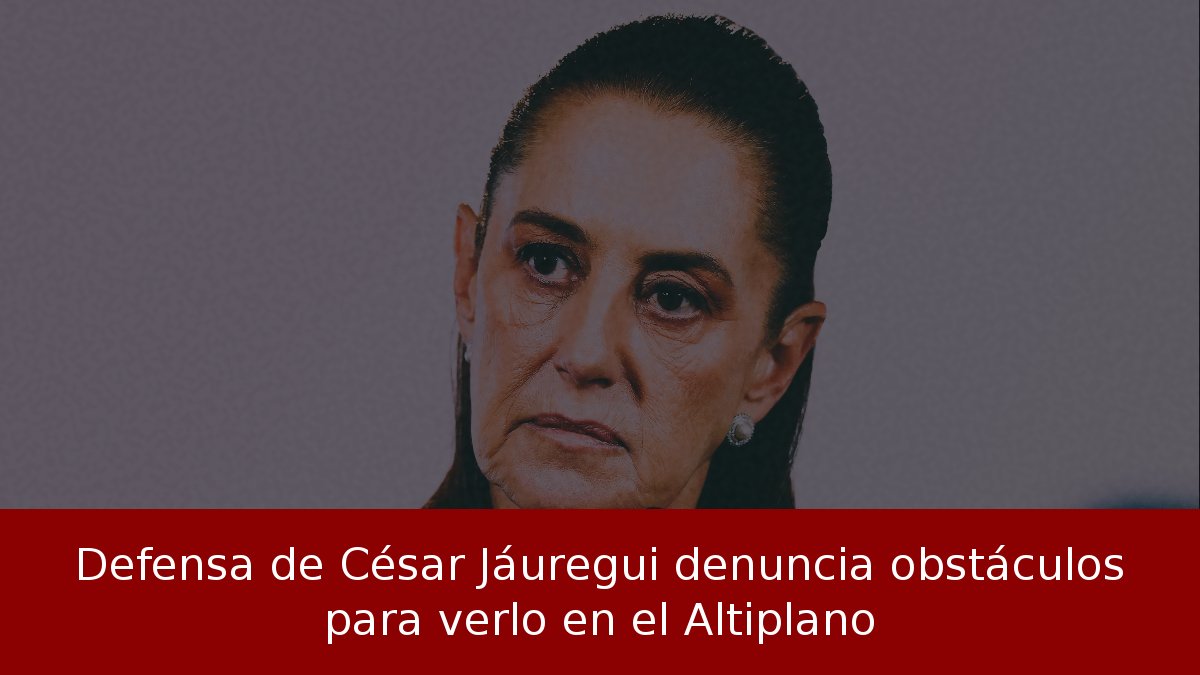
The defense attorney for César Jáuregui Moreno, former prosecutor of Chihuahua, has denounced that his client faces proceedings with restrictions that prevent him from exercising a defense on equal terms. Héctor Villasana, who leads the legal team, stated that the former official's confinement in a high-security federal prison hinders communication and the preparation of legal strategy.
- No direct contact: Villasana said the defense team has not seen Jáuregui Moreno in person since October 26.
- Held at Altiplano: The former prosecutor is detained at the Altiplano prison in the State of Mexico, more than 1,500 kilometers from Chihuahua.
- FGR accusation: The Attorney General's Office charges him with failing to report the presence of U.S. Embassy employees in an operation against drug labs.
“A serious violation of the right to defense”
Villasana was blunt in describing his client's situation. “There is a serious violation of the right to defense when you are prevented from exercising it under equal conditions against the accusing body,” he declared.
The lawyer explained that the distance and security measures of the federal prison have prevented private interviews. “We in the defense team have not physically been able to see him since October 26. That was the last time we had contact with him,” he said. Communication in recent days has been indirect, and he expects to meet again with Jáuregui Moreno on November 19.
“Without a doubt it is part of the strategy carried out by the Attorney General's Office precisely to hinder the right to defense of the accused person, in this case Mr. César Jáuregui, when there is no justification for them to be in a high-security prison, such as Altiplano, where security measures are very high, where they are at a very long distance from the place where he is being tried, where communication is limited,” Villasana warned.
The defender added that not even family members have been able to travel the distance separating Chihuahua from the prison. “It is a process that takes about 20 days of accreditation at the prison before you can see him as a family member,” he explained, and clarified that even that does not guarantee the visit.
The operation that led to the accusation
Jáuregui Moreno's arrest is related to the dismantling of two synthetic drug laboratories in the community of El Pinal, municipality of Morelos, carried out between April 17 and 19. During the return from the operation, a van went off the road, fell into a ravine in the Chihuahua mountains and caught fire, causing the deaths of four people: the then director of the State Investigation Agency (AEI), Pedro Román Oseguera Cervantes; his escort Manuel Genaro Méndez Montes, and two employees of the U.S. Embassy in Mexico.
The Attorney General's Office accuses the former prosecutor of not having reported the presence of the U.S. embassy employees in the operation. However, a source close to the case maintained that Jáuregui Moreno hid nothing: the day after the operation he published images of the drug lab and of those who participated, protecting their identity.
According to that version, local and federal authorities knew of his methodology for striking criminal gangs. “They pretend not to know for two reasons: to gain political advantage and to relieve pressure on their criminal associates. It would seem that Sheinbaum does not command Morena,” a person close to the former prosecutor reportedly said off the record.
Political pressures and conflicting versions
The case has generated tensions between President Claudia Sheinbaum and Chihuahua Governor María Eugenia Campos Galván, an opponent of the president. According to the text, Sheinbaum blamed Campos for the actions against the former prosecutor, but at the same time it emerged that it was the President who ordered her to make state tools available to arrest him. “Proceed,” was reportedly the instruction after Campos pointed out, without providing data or evidence, that Jáuregui Moreno was “corrupt and had casinos.”
Morena leaders, both in Chihuahua and nationally, reportedly convinced the president to accuse the former prosecutor of “treason against the fatherland.” Nationally, the party is led by Ariadna Montiel, while in Chihuahua the leader of that faction is Brighite Granados de la Rosa. A consulted source stated that their involvement in the persecution is “absolute.”
The outcome of this case will depend on how the restrictions denounced by the defense are resolved and on the authorities' ability to guarantee a fair process. Meanwhile, the figure of Jáuregui Moreno has become a point of friction between different levels of government and a reminder of the tensions surrounding the fight against drug trafficking in Chihuahua.