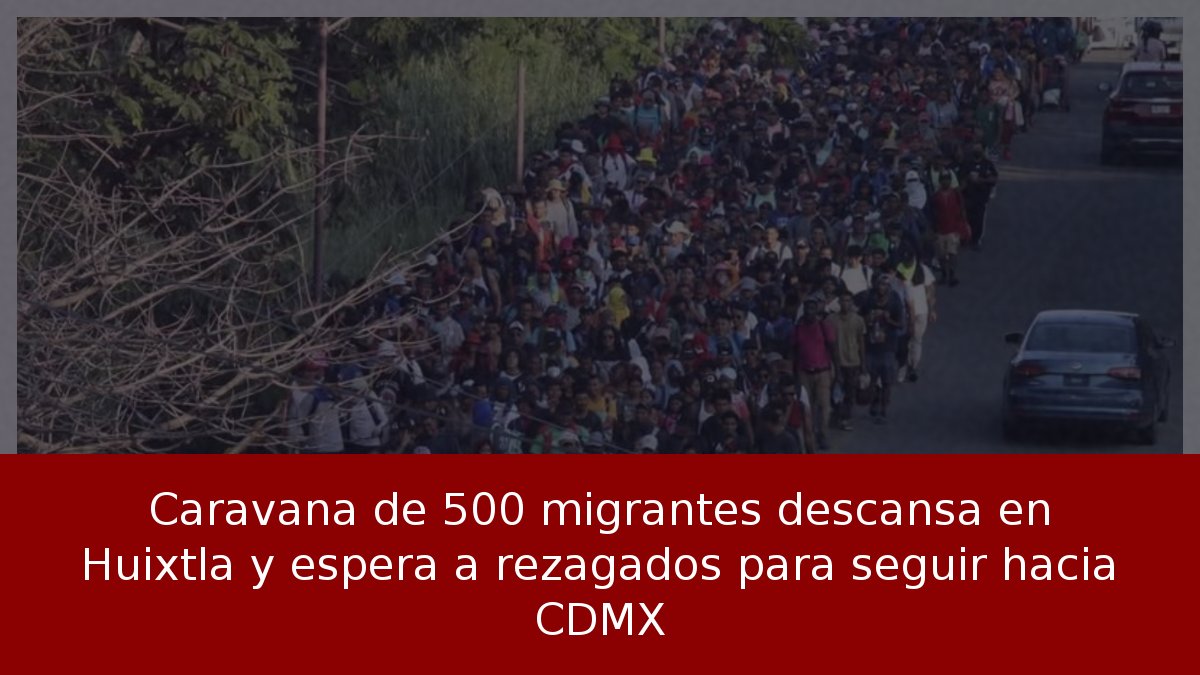
The migrant caravan known as “Dios con nosotros,” made up of roughly 500 people according to local newspaper estimates, paused in Huixtla, Chiapas, after covering about 40 kilometers from Tapachula. The group gathered under the dome in the Guadalupe neighborhood to rest, receive medical attention, and wait for those lagging behind before continuing along the coastal highway toward Escuintla, Mexico City, and eventually the U.S. border.
- Stop in Huixtla: The caravan is camped in the Guadalupe neighborhood after walking 40 kilometers from Tapachula.
- Who is traveling: Honduran families make up the majority, but the group also includes people from El Salvador, Guatemala, Nicaragua, Venezuela, Cuba, Haiti, and Ecuador.
- Medical care: Health brigades and Civil Protection personnel are treating dehydration, exhaustion, respiratory infections, and foot injuries.
- Political backdrop: The march comes after Donald Trump threatened to double tariffs on Mexico if it does not stop caravans.
Families and children on the move
The contingent consists mainly of Honduran families, though it also brings together people from El Salvador, Guatemala, Nicaragua, Venezuela, Cuba, Haiti, and Ecuador. Several migrants are traveling with minors, some carried in arms or pushed in strollers, according to Diario de Chiapas.
To avoid the extreme heat of the Chiapas coast, where temperatures can reach 40 °C, members of the caravan walked during the night and early morning. During the day they stay at rest points to recover from the journey.
Health and the route to the capital
Health brigades and Civil Protection staff have treated dozens of people for dehydration, exhaustion, respiratory infections, blisters, and sores on their feet. In Huehuetán, the Sanitary Jurisdiction VII had also provided care to migrants with injuries from walking.
The caravan plans to resume its journey Friday afternoon toward the municipality of Escuintla. Its first goal is to reach Mexico City, more than a thousand kilometers from Huixtla, to request support from the federal government. From the capital, the remaining distance to the U.S. border is nearly three thousand kilometers. The migrants have asked for freedom of transit to cross Mexico and continue their immigration procedures or seek international protection.
The group left San Pedro Sula, Honduras, crossed Guatemala, and arrived in Tapachula on November 8. It then rested for two days in Parque Bicentenario, where people of other nationalities joined before moving through Chiapas.
Estimates of the mobilization’s size have varied along the route. An initial group of more than 500 people left Tapachula, while after other contingents joined, the figure could reach 1,500, according to Diario del Sur.
Trump, tariffs, and Sheinbaum’s response
The advance of “Dios con nosotros” came after U.S. President Donald Trump warned he would double tariffs on Mexican imports if Mexico did not stop the migrant caravans. The president wrote on Truth Social that “the invasion” of his country was happening again and demanded that Mexico stop them.
“Informamos a la gente que va en la caravana que si su objetivo es llegar a Estados Unidos, no lo van a poder lograr porque no hay esa posibilidad”, señaló Sheinbaum.
President Claudia Sheinbaum responded that since Trump returned to the U.S. government, no migrant caravan had reached the northern border. She explained that the National Migration Institute was informing group members about restrictions on crossing into the United States. The president said authorities offered safe return to countries of origin or alternatives to stay in Mexico under certain conditions.
Sheinbaum maintained that most migrants accept returning to their countries once they learn about the difficulties of crossing the U.S. border. As an example, she mentioned a caravan that had left days earlier with about 600 people and that, upon reaching Arriaga, Chiapas, had shrunk to fewer than 100 members.
Since the start of Sheinbaum’s government in October 2024, 24 caravans had left from the southern border, according to a count by activist Luis Villagrán. None had reached the country’s north, and all had been dispersed between Chiapas and Oaxaca. Villagrán noted that the “Dios con nosotros” mobilization was the largest of the year.
The two Central American caravans that walked along the Chiapas coast in September and October covered about 250 kilometers before reaching Arriaga, on the border with Oaxaca. The INM dissolved them after their members received temporary stay permits. Another caravan remained in Arriaga and had started with between 500 and 600 people, though its number dwindled as members dispersed.
Migrants still in the border area also spoke of a new mobilization being prepared in Honduras. They estimated that group could gather about 2,000 people, though there was no official confirmation of its size or the date it would attempt to enter Mexico.
The Huixtla case reflects the constant pressure on Mexico’s southern border and the diplomatic tension with Washington. As the caravan moves slowly and federal authorities insist that crossing into the United States is not viable, the Mexican government faces the challenge of managing migration flows without tariff warnings escalating into a trade crisis.