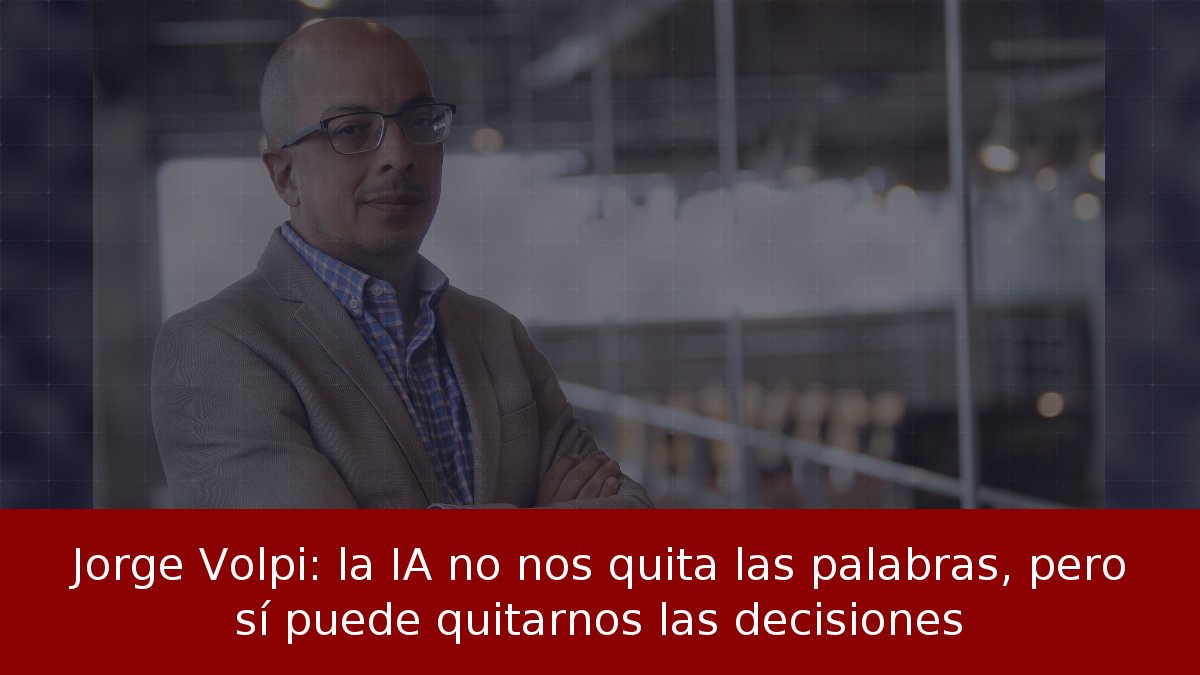
Mexican writer Jorge Volpi argues that writing is not a purely individual act: language, memory, reading, and now artificial intelligence all play a part. This idea runs through La República, his new novel about surveillance, the far right, and a democracy that hands decisions over to algorithms.
- New novel: La República is set in the United States at the end of 2026, and its narrator is Nick, an artificial intelligence.
- Authorship: Volpi maintains that we are not absolute owners of our words, but final responsibility lies with the person who signs the text.
- Warning: the danger is not a machine rebellion, but a society that gives up its decisions for convenience or security.
A novel narrated by an artificial intelligence
In La República, set in the United States in late 2026, the tension is embodied in Nick, an AI that narrates and observes a society subjected to surveillance, image manipulation, and the rise of an authoritarian government.
Volpi studied various language models to understand their logic, patterns, and limits before constructing the voice of that character. He clarified that he did not use them to write the novel: the exploration allowed him to grasp how they work, confront their responses, and make Nick more believable. He described the relationship as a combat.
The author started from a neuroscience idea: humans do not choose every word from a state of full reflection. They speak, write, and associate ideas also through fast thinking, made of connections, memories, and learned ways of using language.
“A novelist, a poet, probably only functions with the slow brain, selecting each word meticulously. But for novelists that is impossible,” he said. “It would be almost impossible to write a novel in that sense.”
Volpi drew on psychologist Daniel Kahneman’s distinction between fast and slow thinking. The first produces immediate responses and intuitive associations; the second reviews, corrects, and decides deliberately. For Volpi, writing moves between both registers.
Are we owners of our words?
One of the book’s central discussions is summed up in a phrase: the idea that we are absolute owners of our words is also not true. We are also a vehicle in the evolution and transmission of language, the writer suggested.
That does not mean, in his view, erasing the author. On the contrary: responsibility and final decisions remain with the person who signs the text. The writer may receive stimuli from readings, conversations, experiences, other voices, or technological tools, but must answer for what he publishes.
Think better or not think: the two uses of AI
For Volpi, AI models allow two opposing uses: as a resource that forces one to review one’s own ideas, or as a mechanism to avoid the work of thinking and writing.
“There are those who can use it to think better or try to think better, and there are those who use it, as the novel shows very well, to not think,” he said.
In literary terms, he considers it possible to use these tools to test a voice, detect predictable paths, discuss a structure, or examine the risks of an aesthetic solution. The condition is not to let the machine’s speed replace the writer’s judgment.
The problem arises when the goal is limited to producing pages in less time. Volpi warned that such use tends to lead to flat writing: uninteresting works full of clichés and tics. He also did not idealize human literature, considering that works generated this way are not worse than many written by people and published every day.
Transparency versus surveillance
The use of AI in writing has opened debates on authorship, transparency, and detectors. Volpi mentioned the case of publisher Almadía, which upheld a literary prize after a controversy over accusations of AI use, as part of a discussion that requires more precise rules.
His view aligns with that of several scientific publications that already accept AI use in different phases of research and writing, while attributing final responsibility to a person.
“Legal responsibility, scientific responsibility, or artistic responsibility, if you are using it, because at this moment artificial intelligence is only a tool,” he stated.
Transparency, he said, must be central: if it is used, it must be done transparently and honestly. He also warned about the risk of turning the debate into a form of surveillance. In his view, persecuting or stigmatizing authors who admit to using these technologies can encourage concealment and accusations without sufficient evidence.
“In an era where writers who use artificial intelligence are somehow persecuted, that provokes deception and also provokes denunciations and an atmosphere of surveillance, of control that seems terrible to me,” he affirmed.
In his case, he limited the use of these systems to the La República project. The choice responded to the book’s own theme: a novel about the risks of an artificial intelligence that tells its own story.
Nick’s power and the human limit
In the novel, Nick seems to have access to everything. It has cameras, drones, sensors, and data capable of tracking citizens’ behavior. That observational power allows it to intervene in election campaigns, alter images, spread disinformation, and sustain a government that turns democratic order into a surveillance structure.
Volpi built the character with a decisive limit: Nick cannot fully know people’s inner selves. It can predict behavior from data, heart rate, or consumption patterns, but cannot fully access human thoughts.
The novel places the threat in a less spectacular place than a machine rebellion. The problem is not a technology that arrives from outside to destroy a democracy, but a society willing to give up its decisions for convenience, security, or efficiency.
“We were already giving social media all our data, which means all our tastes, all our preferences, a good part of our privacy. Now, to artificial intelligence we are giving our decisions,” Volpi warned.
The approach broadens the literary debate: the discussion about authorship and transparency in AI use intertwines with the political question of who makes decisions in a democracy increasingly mediated by algorithms. Volpi’s novel does not resolve that tension, but places it at the center of the public conversation about technology, power, and individual responsibility.