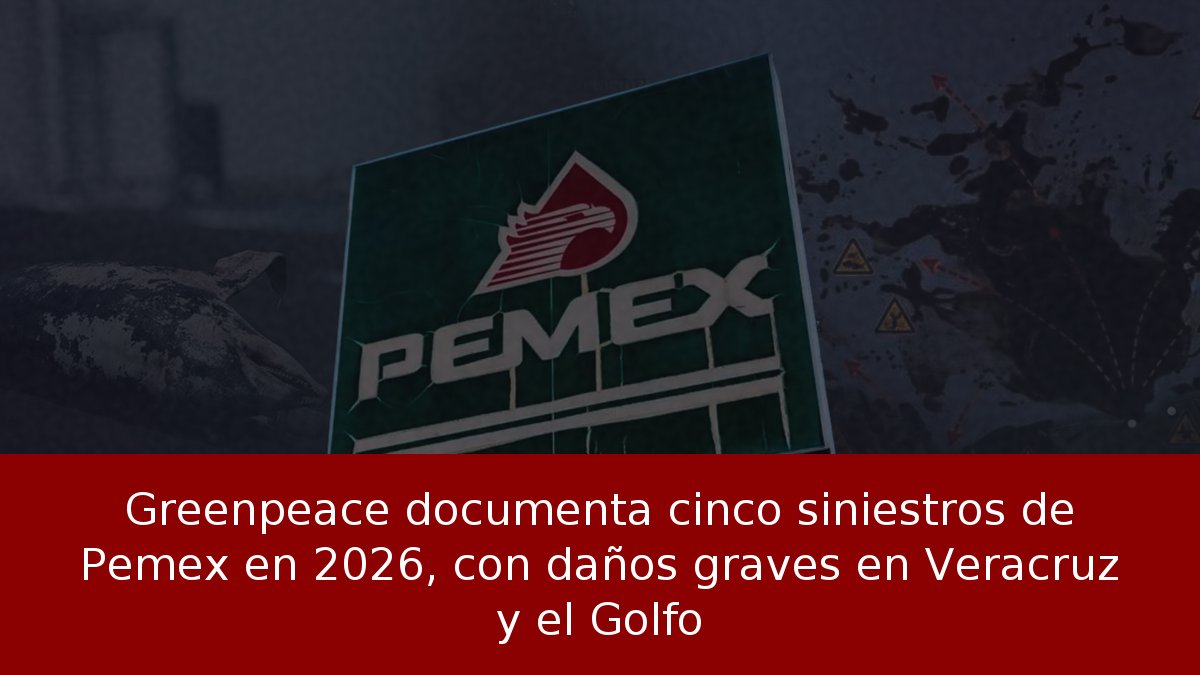
During the first nine months of 2026, Mexico's state oil company, Pemex, has been linked to at least five serious environmental disasters across the country, including leaks, explosions and oil spills that have polluted coastlines, rivers, soil and areas inhabited by communities, plants and animals. The oil spill in the Gulf of Mexico and the blowout at the Krem-1 well in Veracruz stand out as the two most severe incidents of the year.
- Five incidents in 2026: Greenpeace Mexico tallied spills, leaks and explosions at the Gulf of Mexico, the Krem-1 well, the Olmeca refinery in Dos Bocas, the Cantarell-Ek Balam system and the Pánuco River.
- Extreme contamination in Veracruz: a Greenpeace Mexico study found cancer-causing hydrocarbons in water near the Krem-1 well at levels up to 113 times higher than European limits set to protect aquatic life.
- Gulf spill: between February and April, more than 900 tonnes of crude residue were collected at 113 sites along 1,168 kilometres of coastline, from Paraíso, Tabasco, to Matamoros, Tamaulipas.
The Gulf of Mexico spill and the delayed response
From February to April 2026, an oil spill hit the Gulf of Mexico coast. Civil organisations reported residue from Paraíso, Tabasco, to Matamoros, Tamaulipas. More than 900 tonnes of crude waste were gathered, and the Red Corredor Arrecifal del Golfo de México documented tar, stains, particles and oil flakes at 113 sites across 1,168 kilometres of shoreline.
At first, Pemex and the Mexican government denied the company was responsible and blamed a private vessel. Two months later, the authorities acknowledged the oil company's responsibility.
Greenpeace and the Red Corredor Arrecifal reported damage to fishing grounds, mangroves, beaches and coastal communities. They also denounced that cleanup efforts focused on tourist and easily accessible areas, while communities in Veracruz and Tamaulipas — including rural, Indigenous and rocky areas — received late or insufficient attention. The organisations demanded a recovery plan, medical care, compensation for affected families and measures to prevent future spills.
Krem-1 well: cancer-causing hydrocarbons in water and sediment
A Greenpeace Mexico study published this November found hydrocarbon contamination in water, soil and sediment around the Krem-1 well, five months after a fire that lasted five months ended. The organisation collected six soil samples, three sediment samples and seven water samples, and analysed aliphatic hydrocarbons, polycyclic aromatic hydrocarbons and unresolved complex mixture, a chemical marker associated with crude oil.
All seven water samples exceeded the European limit of 0.27 micrograms per litre for compounds equivalent to benzo[a]pyrene. Sample AgGP4 reached 113 times the threshold; AgGP3 hit 88 times and AgGP2 76 times. Even the least concentrated samples far exceeded the parameter: AgGP1 registered a level 61 times higher and AgGP7 reached 62 times the limit considered for protecting aquatic life.
Benzo[a]pyrene appeared in six of the seven water samples, at concentrations between 0.45 and 0.82 micrograms per litre. Greenpeace Mexico warns that this compound is linked to DNA damage and processes that can lead to cancer.
Sediment from the river near the well also shows high levels of polycyclic aromatic hydrocarbons. Sample Gre-TOMA-2 reached a total of 1,144.63 micrograms per kilogram and Gre-TOMA-3 registered 876.66 micrograms per kilogram. The dominant compound was anthracene: in Gre-TOMA-2 the concentration reached 903.06 micrograms per kilogram, 3.7 times above the probable effect level for organisms living on the riverbed. Gre-TOMA-3 registered 675.92 micrograms per kilogram of anthracene, 2.8 times above that level.
The report also detected dibenzo[a,h]anthracene in all water and sediment samples, classified as probably carcinogenic to humans. Six other possibly carcinogenic polycyclic aromatic hydrocarbons appeared in almost all samples.
Insufficient regulation and other incidents of the year
The six soil samples did not exceed the limit set in NOM-138-SEMARNAT/SSA1-2012 for benzo[a]pyrene. Nevertheless, three of them contained aliphatic hydrocarbons and unresolved complex mixture, which Greenpeace Mexico considers evidence of oil contamination. The organisation warns that compliance with the Mexican standard does not eliminate environmental risks: the national limit for benzo[a]pyrene in soil is 2.6 times higher than the probable effect level considered for freshwater sediment.
Mexico has no specific limits for polycyclic aromatic hydrocarbons in sediment, surface waters intended to protect aquatic life, or organisms. Current rules also do not regulate anthracene, despite it being the most abundant compound in the analysed sediment. Greenpeace Mexico also points to a possible indirect exposure route for people through livestock drinking contaminated water, because these compounds can accumulate in animal tissue.
Greenpeace Mexico's record includes incidents at the Olmeca refinery in Dos Bocas. The most serious reportedly occurred in March, when a fire and explosion left five workers dead; another fire at the facility was reported in October. In September, a leak was reported in a pipeline at the Cantarell-Ek Balam field in Campeche, and that same month another spill occurred in the Pánuco River in Veracruz.
The organisation calls on Pemex, the Energy Ministry and ASEA to address the damage with transparency and long-term measures. Among its recommendations for Las Choapas, it proposes regular monitoring of water and sediment, analysis of aquatic organisms and exposed livestock, and comprehensive remediation around the Krem-1 well. The cost of these incidents, it argues, falls on communities, biodiversity and affected territories, while the oil company must assume full repair of the environmental damage.