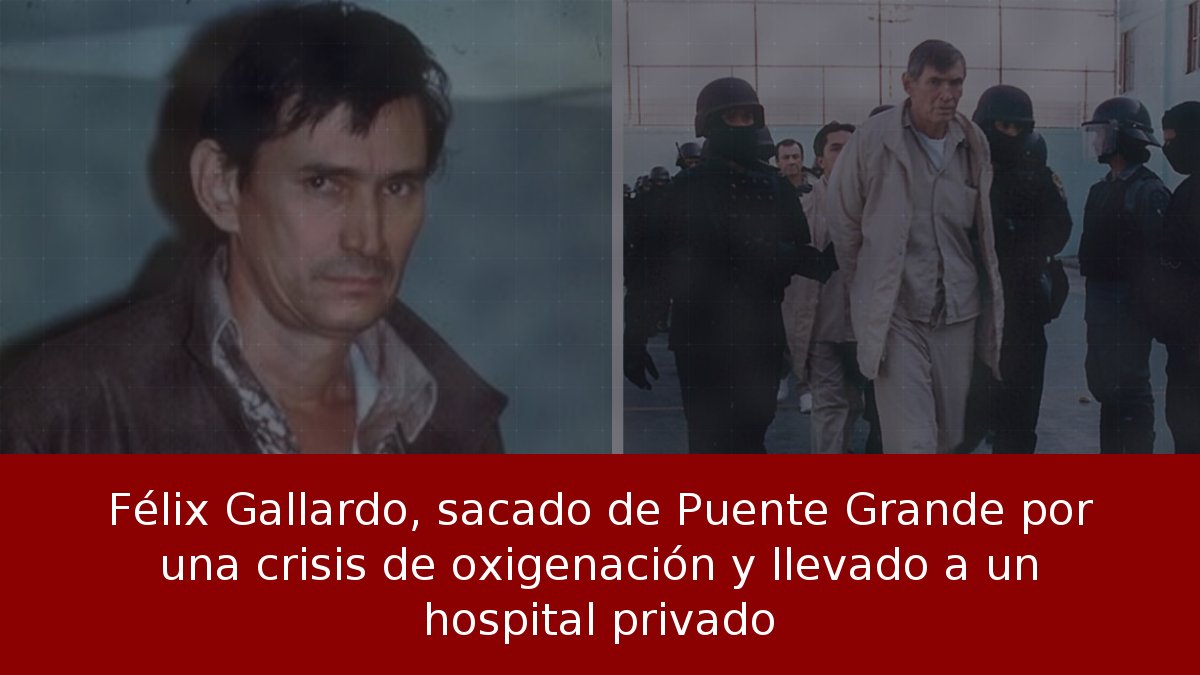
On the afternoon of November 13, 2026, Miguel Ángel Félix Gallardo, the founder of the defunct Guadalajara Cartel, was urgently removed from the Puente Grande prison and taken to a private hospital in Jalisco. The transfer, carried out under heavy security, was due to an oxygenation problem that required medical attention outside the penitentiary.
- Reason for transfer: the former crime leader suffered an oxygenation issue that necessitated hospital care.
- Destination: preliminary reports place him at a hospital at the intersection of Circunvalación and Ávila Camacho avenues.
- Judicial context: the emergency arises while a legal process is underway that could allow him to serve his sentence under house arrest.
A medical emergency amid his legal situation
According to initial accounts, the man also known as “El jefe de jefes” was admitted to a private hospital located at the confluence of Circunvalación and Ávila Camacho. The security operation that accompanied the move from Puente Grande prison underscores his status as an inmate, one who is serving two simultaneous sentences totaling decades behind bars.
The first sentence, of 40 years, relates to cocaine trafficking, weapons stockpiling, and bribery. The second, of 37 years, corresponds to the kidnapping and murder of DEA agent Enrique Kiki Camarena, events that occurred in 1985.
From Culiacán to the birth of a cartel
Born on January 8, 1946, in Culiacán, Sinaloa, Félix Gallardo built his criminal career after serving in the now-defunct State Judicial Police and working as a bodyguard for Leopoldo Sánchez Celis, then governor of Sinaloa. He was arrested on April 8, 1989, the last of the three kingpins who founded that organization to fall into the hands of justice.
In 2022, former President Andrés Manuel López Obrador acknowledged the capo’s deteriorating health and ordered an evaluation of his transfer to house arrest. A medical report detected, among other conditions, diabetes, hypertension, glaucoma, and latent pulmonary tuberculosis.
The frustrated path to house arrest
The transition to home detention was thwarted months later when the company responsible for the electronic bracelet canceled the monitoring contract. A federal judge in Jalisco halted the process, and according to 2023 reports, Félix Gallardo remains held at Puente Grande prison, where he does gardening work in exchange for a weekly wage of 400 pesos.
Meanwhile, the other two founders of the Guadalajara Cartel have resolved their cases: Ernesto Fonseca Carrillo obtained definitive release, and Rafael Caro Quintero was extradited to the United States.
In May 2024, a judge denied the amparo filed by the former cartel leader, who alleged presumed torture by prison authorities. Judge Francisco René Ramírez dismissed the recourse, ruling that “El Jefe de Jefes” did not provide sufficient evidence. With that decision, the former capo remained incarcerated and lost the possibility of obtaining house arrest.
The recourse sought to have him fitted with a locator bracelet instead of confinement, as journalist Rubén Mosso reported via Milenio. The same judge who received the amparo in February later determined its dismissal.
Félix Gallardo’s claim was not without documented precedent. In his book Bienvenido a Sinaloa, journalist Diego Enrique Osorno recounted that the capo “era constantemente castigado, constantemente sancionado” and that authorities prevented him from receiving family and intimate visits during his imprisonment.
This new medical episode reopens the debate over the health conditions of an elderly inmate with multiple ailments, as well as the feasibility of judicial authorities reconsidering his prison situation. For now, the hospital transfer keeps the immediate future of the Guadalajara Cartel founder in suspense, with his health being evaluated outside Puente Grande prison.