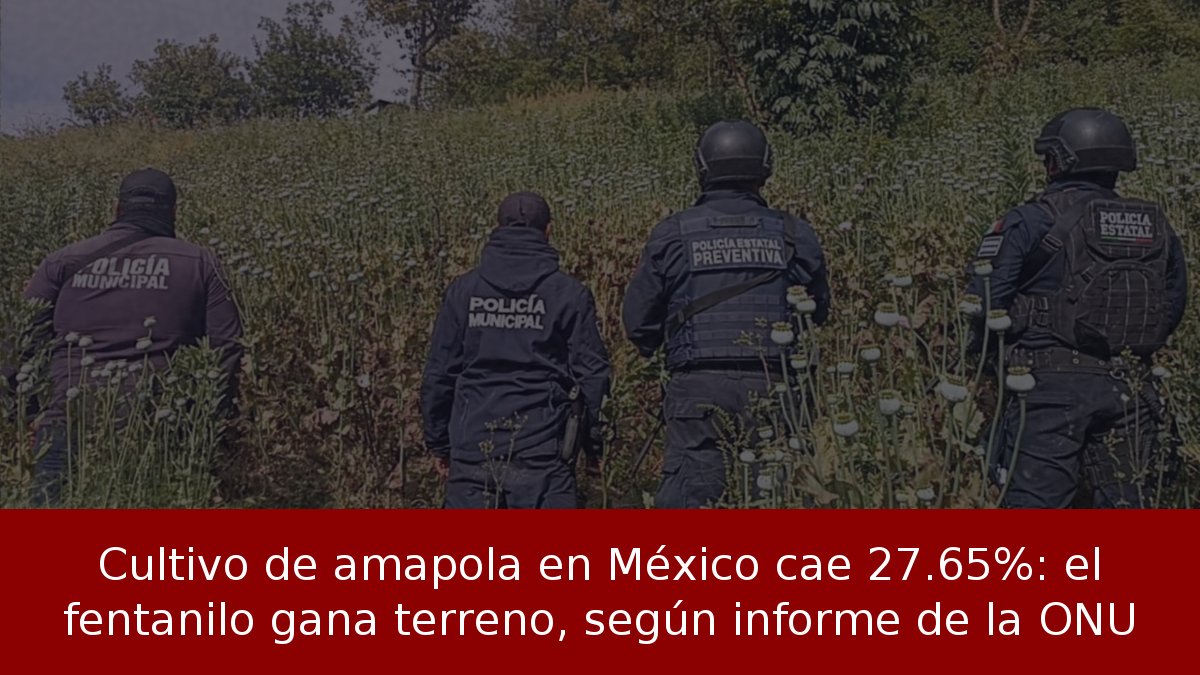
Mexico's opium poppy cultivation fell 27.65% in the 2023-2024 cycle compared with the previous period, a decline that coincides with the rise of synthetic opioids such as fentanyl in the international drug market and with official strategies against narcotics production. This is according to the seventh monitoring report presented by the Mexican Government and the United Nations Office on Drugs and Crime (UNODC).
- Planted area: fields went from 11,095 hectares in 2022-2023 to 8,028 hectares in the following cycle.
- Potential production: dry opium gum dropped 36.48%, from 166.31 to 105.64 metric tons.
- Eradication: federal forces destroyed 9,087 hectares of poppy in 2024, according to records from the Attorney General's Office (FGR).
Causes of the decline
The report identifies several factors behind the trend: eradication efforts, rural development programs and weather conditions that affected producing areas. However, its authors warn that the result cannot be attributed to a single cause, due to changes in territorial coverage and the statistical design used for measurement.
The analysis notes that the shift responds to the economic and operational advantages of synthetic drugs, which involve lower costs, logistical ease and greater profitability. This context reduces economic incentives to sustain poppy production in countries like Mexico.
The change in regional drug trafficking dynamics has also driven a transformation of plant-based narcotics and the growth of artificial substance trafficking, a phenomenon that affects security strategies and international cooperation.
Sembrando Vida and the climate factor
At the national level, the report stresses that actions against illicit crops were not limited to destroying plantations but also included economic alternatives for rural communities.
Among them is Sembrando Vida, a program that provides support of up to 5,000 pesos per month and inputs for residents of producing states such as Guerrero, Sinaloa, Nayarit, Chihuahua and Durango.
The document cites an evaluation by the National Council for the Evaluation of Social Development Policy (Coneval), according to which the initiative helped offset income that some families stopped receiving when they abandoned poppy cultivation, through their voluntary incorporation into legal agricultural activities.
Added to this are the severe drought in mountain regions and damage caused by Hurricane Otis in Guerrero, which affected plots and reduced field work coverage in that state.
Eradication and methodological caution
FGR records indicate that federal forces destroyed 9,087 hectares of poppy during 2024. The figure represents a reduction of 10.62% compared with the 10,167 hectares eliminated in 2023 and 20.28% compared with the 11,398 in 2022.
Given these results, the study's authors asked for caution in interpreting comparisons between the two cycles, since the decline could combine an effective reduction in fields, less field coverage in the south of the country and adjustments in statistical methodology.
The report thus offers a dual reading: the drop in poppy production is real in the records, but its exact magnitude still requires verification. Meanwhile, the growing weight of fentanyl is reshaping Mexico's drug trafficking map and poses new challenges for security and rural development policies in producing states.