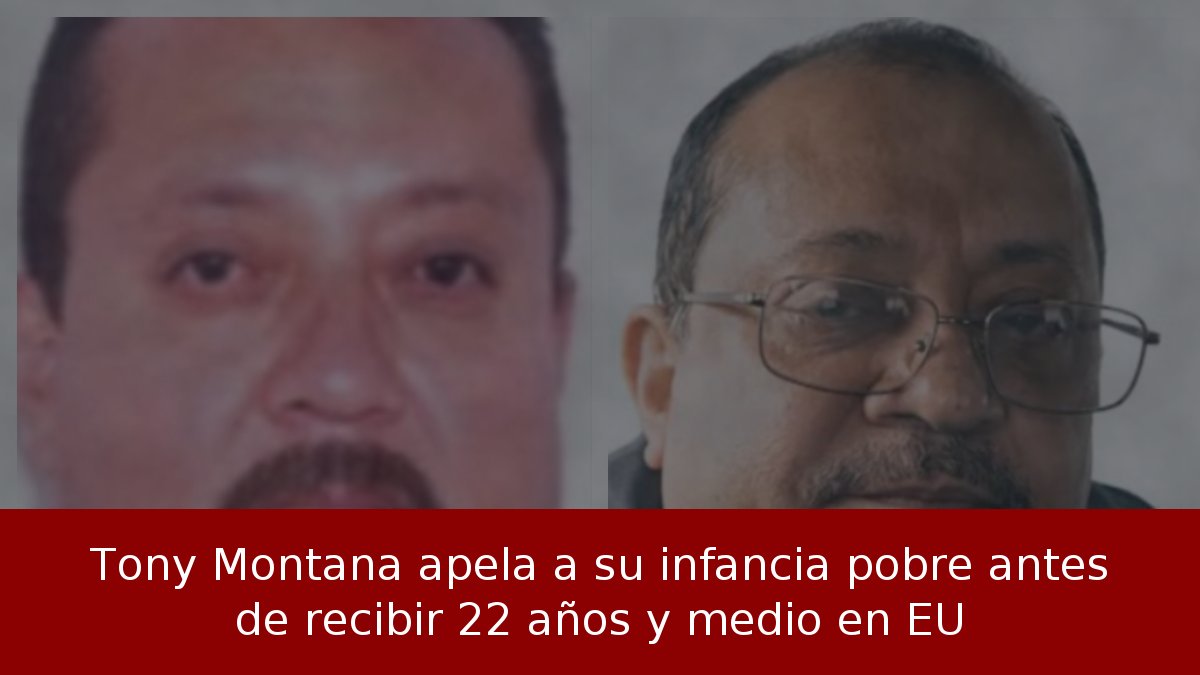
Antonio Oseguera Cervantes, known as Tony Montana and the brother of Nemesio Oseguera Cervantes, El Mencho, was sentenced to 22 and a half years in prison in the United States for conspiring to distribute cocaine and methamphetamine for the Jalisco Nueva Generación Cartel (CJNG), as well as possession of firearms tied to drug trafficking. The sentence was handed down in the District Court of Columbia, in Washington, after the defendant pleaded guilty.
- Sentence breakdown: 17 and a half years for conspiracy to distribute narcotics and five additional years for possession and use of firearms.
- Plea for leniency: before the ruling, Oseguera Cervantes sent a letter to Judge Beryl A. Howell in which he described his childhood in poverty and his father's abandonment.
- Context: the Mexican national was transferred to the U.S. on February 27, 2025, along with 28 other high-profile drug traffickers, including Rafael Caro Quintero.
A sentence between the parties' requests
Judge Beryl A. Howell imposed a penalty that fell between the 30 years sought by the U.S. Attorney's Office and the 20 years proposed by the defense. The sentence was divided into 17 and a half years for conspiracy to distribute narcotics and five additional years for possession and use of firearms.
Oseguera Cervantes was 68 years old when he acknowledged his criminal responsibility. In his message to the court, he described a family history marked by poverty, paternal abandonment, and migration to the United States during his adolescence.
“I deeply regret my actions and the harm they caused. I know I made serious mistakes and I accept responsibility for them,” wrote the defendant.
He also offered an apology to the court, to society, and to those who may have been affected by his conduct.
The letter: poverty, abandonment, and migration
In the letter addressed to Howell, Antonio Oseguera Cervantes recounted that he grew up in a family of seven siblings. He said his father abandoned them when they were still young and that his mother was left to raise them alone.
“I come from a very poor family. There were seven of us children, and my father abandoned us when we were still very small. My mother raised us alone,” he stated.
He added that they faced periods when they did not have enough food, though they tried to get ahead. El Mencho's brother said he arrived in the United States at approximately 16 years old, as the third child in the family, and that he migrated to work and help support his mother and siblings.
“I worked in the United States for more than 30 years,” he affirmed in the document.
He was later deported to Mexico, while his first family remained in U.S. territory, where his children grew up and built their own lives. After returning to Mexico, Oseguera Cervantes formed another family and had two children, a boy and a girl. According to his letter, the mother of both died of cancer when they were minors, so he took on their upbringing.
The defendant indicated that those two children were already adults and attending university. He also mentioned that he had two other younger children: a six-year-old girl and a two-year-old boy.
The plea for compassion and the judicial response
In his request, Tony Montana said he wanted to see his younger children grow up and remain present in their lives. He noted that one of his greatest fears was dying far from his family due to the chronic conditions he faced and because he was close to turning 70.
“Your Honor, I understand that I must face the consequences of my decisions. I am not asking the Court to ignore what I have done,” he wrote.
He asked the judge to take into account his age, health, family, and life circumstances when setting the penalty. He requested a sentence that would allow him to return to his relatives while he could still be part of their lives. “I ask the Court for compassion and mercy,” he expressed at the end of the letter.
The request did not change Judge Howell's position. During the hearing, the judge rebuked the defendant for his participation in the CJNG's criminal structure and the shipment of narcotics to the United States.
“You are responsible for the arrival of tons of drugs to this country. You were deeply involved in all of the CJNG's activities,” Howell told him before imposing the sentence.
The penalty included charges for cocaine and methamphetamine trafficking, as well as for carrying firearms to facilitate those crimes. Oseguera Cervantes had admitted to trafficking cocaine and methamphetamine destined for the United States for the CJNG. The case file noted that the organization collaborated with the Sinaloa Cartel, particularly with the Los Chapitos faction.
The process and the transfer to the U.S.
Before the guilty plea was formalized, Oseguera Cervantes's defense and U.S. Department of Justice prosecutors filed a joint motion to cancel a status hearing scheduled for June 18, 2026. Both parties requested that the change of plea take place during the week of July 27 or on the nearest available date.
The document stated that prosecutors and the defendant's lawyers reached an agreement on the terms of the guilty plea. They also requested additional time to complete the necessary procedures to formalize that pact. The parties asked that this period be excluded from the deadline under the U.S. Speedy Trial Act, which regulates the time to bring a person before a court. The request was based on the need to finalize the agreement between the defense and the prosecution.
Antonio Oseguera Cervantes pleaded guilty on July 31, 2026 to conspiracy to distribute cocaine and methamphetamine to the United States, as well as carrying a firearm to facilitate drug trafficking. The judicial resolution included both charges.
The Mexican national was transferred to the United States on February 27, 2025, along with 28 other high-profile drug traffickers handed over by Mexico. Among those included in that group was Rafael Caro Quintero. The transfer was described as an “expulsion” rather than an extradition. After his transfer, Oseguera Cervantes remained in U.S. custody to face federal drug trafficking and weapons charges.
Nemesio Oseguera Cervantes was identified as the top leader of the CJNG, the organization for which his brother admitted to having trafficked cocaine and methamphetamine. The referenced case file indicated that El Mencho was reportedly killed in February 2026 and that the sentence against Antonio Oseguera Cervantes was resolved months after his guilty plea.
The sentence against Tony Montana closes a judicial chapter that began with his mass transfer to the U.S. and that highlights Washington's strategy of prosecuting relatives of criminal leaders as key pieces to dismantle drug trafficking networks. The ruling also confirms that personal arguments, however emotional, do not replace criminal responsibility in cases of large-scale drug trafficking.