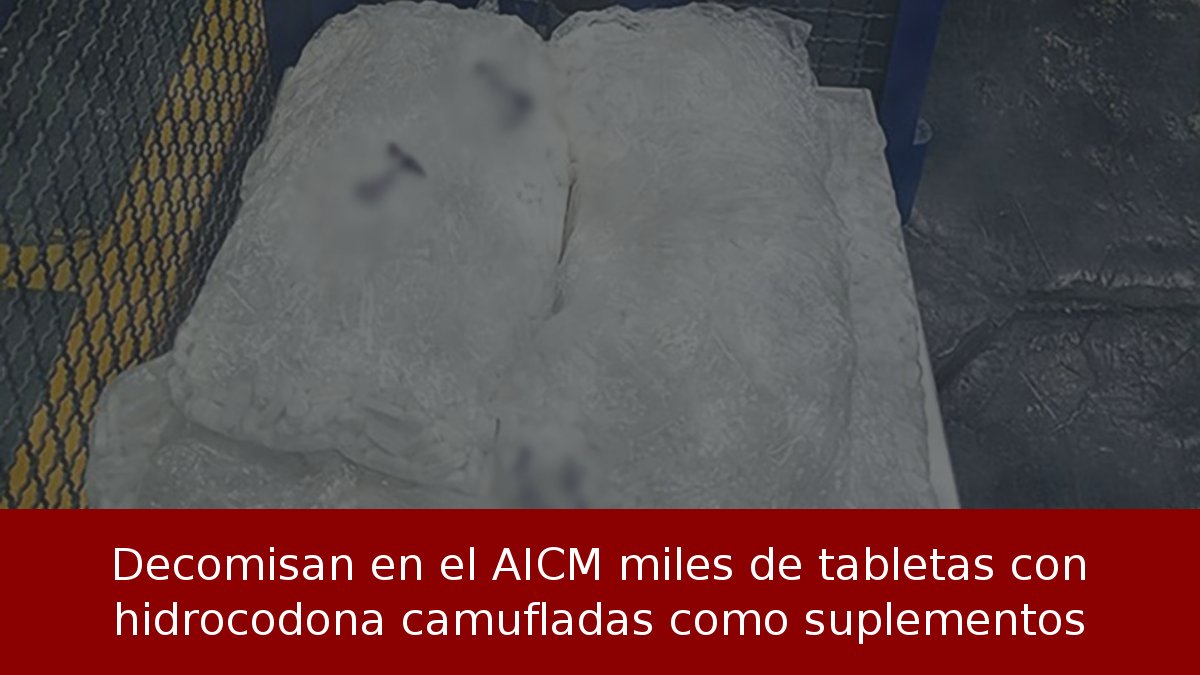
Mexico’s National Customs Agency (ANAM), working with the navy and the public security ministry, seized 8,659 pills at the Mexico City International Airport (AICM). The tablets combined the opioid hydrocodone with paracetamol and were concealed in supplement bottles; authorities placed their value on the illegal market at more than 8.6 million pesos.
- Key Point: Hydrocodone is a semisynthetic opioid that Mexico classifies as a narcotic and the United States regulates as a controlled substance.
- Key Point: The white pills, marked “M367,” were discovered in five vitamin or supplement containers carried by a traveler arriving from Colombia.
- Key Point: The customs agency’s laboratory confirmed the presence of both hydrocodone and acetaminophen, and procedures began to refer the shipment to federal prosecutors.
- Key Point: Although paracetamol is usually available without prescription in Mexico, combining it with hydrocodone places the product under the same strict narcotics controls.
Airport seizure and laboratory confirmation
Officers inspected baggage belonging to a passenger who had traveled from Bogotá, Colombia, arriving in Terminal 1 of the AICM, according to a joint statement. The pills were white, stamped “M367,” and distributed inside five bottles of the kind typically used for vitamins and food supplements.
Because customs staff could not immediately establish what the pills contained, they imposed a precautionary seizure and took samples for analysis. At the ANAM central laboratory, specialists performed infrared spectroscopy, solvent extraction and qualitative chemical tests. The analyses confirmed that the tablets contained hydrocodone and acetaminophen.
The drug information database Drugs.com says the “M367” imprint matches a formulation of 325 milligrams of acetaminophen and 10 milligrams of hydrocodone bitartrate, originally made by the U.S. laboratory Mallinckrodt Pharmaceuticals. That marking is only a physical identifier for the manufacturer, not a trade name or generic label.
Legal classification and medical warnings
MedlinePlus, a service of the U.S. National Library of Medicine, identifies hydrocodone as an opioid painkiller that adjusts how the brain and nervous system react to intense pain. In Mexico, Article 234 of the General Health Law lists the substance as a narcotic under the name “dihidrocodeinona,” a status that triggers strict sanitary controls and special oversight by the health ministry.
The U.S. Drug Enforcement Administration describes hydrocodone as a semisynthetic opioid related to codeine in its structure and to morphine in its effects. The agency places pure hydrocodone in Schedule II, the most restrictive level for controlled substances in the U.S. system. Before 2014, products mixing hydrocodone with non-controlled ingredients such as acetaminophen were classified in Schedule III, a lower tier established by Congress through the Controlled Substances Act of 1970.
The DEA abolished that difference on October 6, 2014, when a final rule took effect and moved all hydrocodone combination products into Schedule II. The agency contended that adding non-narcotic substances like acetaminophen does not make the product less likely to be abused, stating in its communication:
“no disminuye su potencial de abuso”
The U.S. Food and Drug Administration cautioned that hydrocodone combined with acetaminophen exposes consumers to:
“los riesgos de adicción, abuso y uso indebido”
The FDA also highlighted the danger of overdose and death associated with these combinations.
Why the combination is tightly controlled and what happens next
Acetaminophen, called paracetamol in Mexico, is not an opioid and is not a controlled substance. According to COFEPRIS, it is present in many medicines sold in the country, either by itself or with other active ingredients. In most formats, paracetamol can be bought without a prescription at pharmacies and other authorized outlets.
The risk of the shipment seized at the AICM lies in the mixture itself. Paracetamol alone does not face special restrictions, but once it is combined with hydrocodone the resulting product inherits the same sanitary controls that govern the opioid, as indicated by the health ministry.
The pills stayed under the custody of customs authorities after the central laboratory confirmed their contents. ANAM started the administrative steps to hand the shipment over to the Federal Attorney General’s Office (FGR).
The incident illustrates how ordinary supplement containers can be used to smuggle highly regulated opioids on international flights. When a freely sold painkiller is blended with a Schedule II narcotic, the legal status does not relax; instead, the entire product takes on the stricter classification of the opioid. That dynamic makes such combinations an attractive format for traffickers seeking to evade detection.