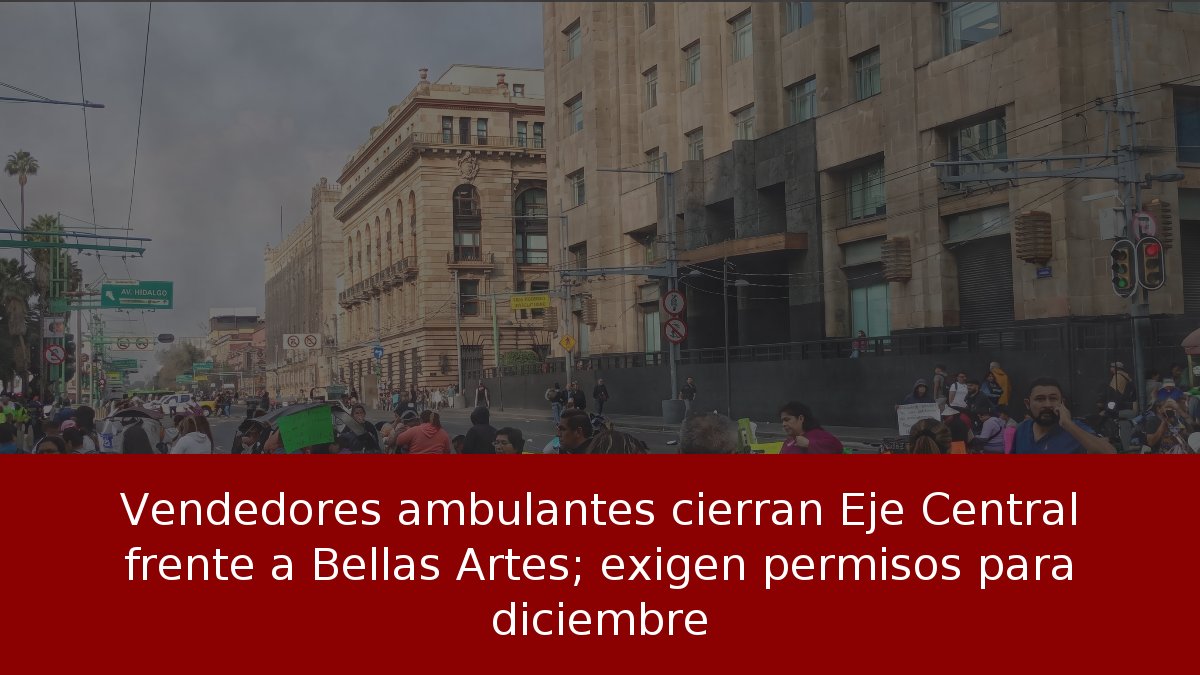
At least 50 street vendors blocked traffic on Eje Central Lázaro Cárdenas, heading north near the Palacio de Bellas Artes, to demand that the Mexico City Government issue permits allowing them to set up stalls during the December holiday season. The protest began shortly after 2:00 p.m. on Tuesday, November 17.
- Key Point: The demonstrators are demanding permits to sell in the Alameda Central during the year-end celebrations.
- Key Point: They claim they have been unable to work for over three months due to the lack of authorization to install their stalls.
- Key Point: Personnel from the Mexico City Government Secretariat arrived to talk, but as of the latest report no agreements or reopening of the road had been announced.
Motorcycles and electric bicycles used to halt traffic
To stop vehicles and draw the attention of city authorities, the protesters used motorcycles and electric bicycles. Their main demand is that the necessary permits be issued so they can occupy their sales spaces in the coming weeks, especially with the December celebrations approaching—a season in which they hope to resume their commercial activities.
The vendors said they have been idle for more than three months because they lack authorization to set up their stalls. They therefore conditioned lifting the blockade on the authorities addressing their demands.
Dialogue without confirmed results
In response to the protest, staff from the Mexico City Government Secretariat went to the scene to establish communication with the vendors' representatives. Officials held a meeting with the demonstrators; however, as of the time of the report, no agreement had been announced that would allow the road to be cleared or resolve the vendors' situation.
While talks continue, the protesters maintain their demand for a response on the permits and the conditions for returning to their activities in the Alameda Central.
Traffic disruptions in the Historic Center
The impact on mobility is concentrated mainly on Avenida Juárez and extends to Paseo de la Reforma, so traffic near the Palacio de Bellas Artes is also experiencing complications.
The protest comes amid differences between vendors and city authorities over the regulation of informal commerce in the Alameda Central, one of the public spaces in the Historic Center of Mexico City.
Last August, measures to reorganize commercial activity in the park sparked discontent among various vendor groups, particularly over the reduction of available spaces for setting up stalls. On August 21, after three days of rest and reorganization operations, a decrease was reported in the number of vendors occupying the Alameda. The central walkways remained practically clear for visitors, and fewer food and beverage stands were seen around the fountains.
However, the measures did not end the protests. Vendor organizations continued to demonstrate around the park to express their disagreement with the reduction of spaces and to request dialogue with the city government. In that context, the Mexico City Government Secretary, César Cravioto, had said that police presence in the Alameda Central would be maintained as part of efforts to recover spaces for visitor transit.
The reorganization measures have also been accompanied by complaints about the conditions for continuing commercial activity and the alternatives available to vendors. The conflict has led to various mobilizations on roads near the park, including Eje Central, Avenida Juárez, and Hidalgo, affecting drivers and public transport users.
Tuesday's mobilization once again puts the situation of street vendors in the Alameda Central and the issuance of permits to trade in the area at the center of the discussion. For now, the vendors maintain their demand for permits for the December season, while Government Secretariat personnel seek to reach agreements with their representatives. As of the latest report, neither a solution to their demands nor the time when traffic would be cleared on Eje Central Lázaro Cárdenas had been confirmed.