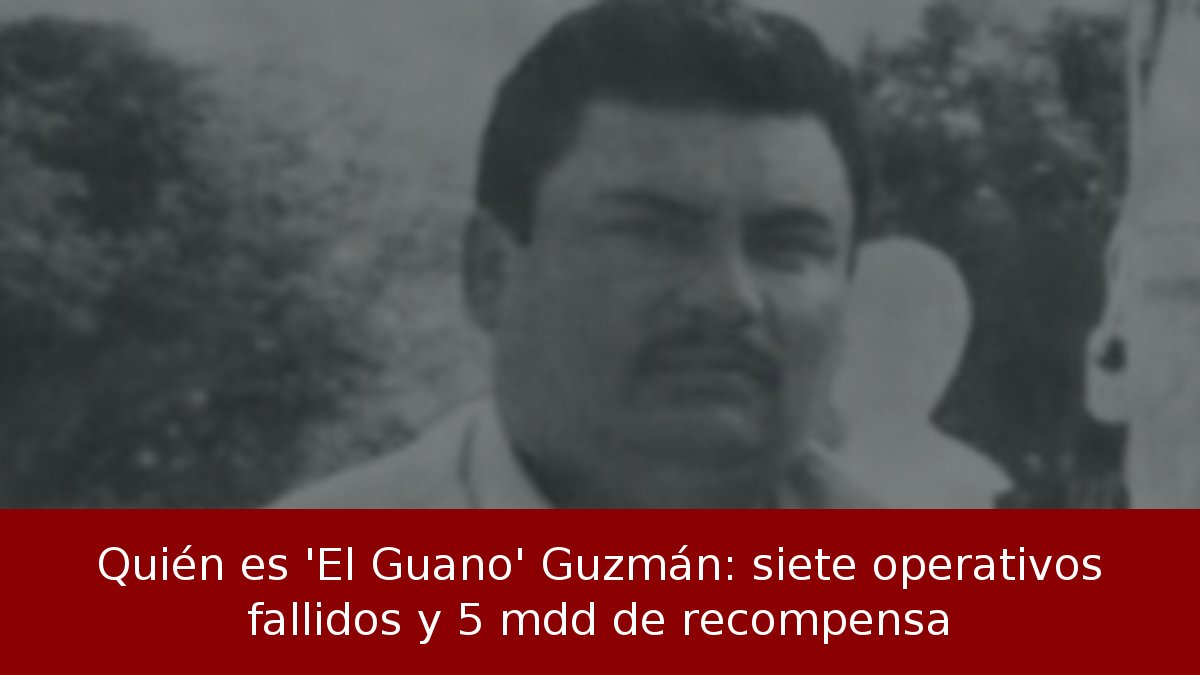
Aureliano Guzmán Loera, known as “El Guano,” is back in public debate after Ariadna Montiel, Morena’s national leader and a 4T figure, was accused of meeting him in 2024; Montiel rejected the claim. The U.S. State Department is also cited. He is the brother of Joaquín “El Chapo” Guzmán and one of the Sinaloa Cartel’s most senior operators. His history spans armed attacks on federal forces, the alleged killing of a family member and repeated operations that failed to detain him. He remains at large in the mountain region where Sinaloa, Chihuahua and Durango converge.
- Key Point: In October 2016, his group used a grenade against an Army convoy in Sinaloa while trying to free Julio Óscar Ortiz Vega, “El Kevin,” a close ally in military custody. Five soldiers were killed and ten wounded, and “El Kevin” escaped during the chaos. Roughly 50 military vehicles were sent into the area, but Guzmán Loera was not found.
- Key Point: Authorities blame him for the April 2015 death of his half-brother Ernesto Guzmán Hidalgo in the Sinaloa mountains. The killing strengthened his reputation for violence, even within his own family.
- Key Point: A 2018 Sedena document said he then led a network of at least 300 people, organized in cells called “Los Coteros,” “La Válvula” and “Gente de Aboyta,” with operations in Badiraguato and Escuinapa, Sinaloa, and Tamazula, Durango.
- Key Point: In the United States, a federal grand jury in Arizona indicted him on Nov. 13, 2019, on four charges tied to an international heroin, cocaine and fentanyl conspiracy. A second indictment on Feb. 19, 2020, added two counts involving marijuana, heroin, cocaine and methamphetamine distribution.
Power base in the Golden Triangle
His main territory is the Triángulo Dorado, the highland area shared by Sinaloa, Chihuahua and Durango that is used for poppy and marijuana cultivation and for synthetic drug production. His standing inside the Sinaloa Cartel rose steadily after his brother’s first arrest. In Chihuahua, his organization is accused of kidnapping, extortion, torture and killing large numbers of people, including public officials and business owners. Journalistic reports say rival criminal groups respect him little; recurring clashes have endangered land and hundreds of local lives.
Seven major operations, no arrest
Since 2011, he has avoided at least seven large military operations in the Sinaloa and Durango sierra, making him one of Mexico’s most elusive trafficking bosses. The first documented operation came in 2011, before authorities saw him as a senior cartel figure. That low profile helped him build a territorial base in Badiraguato, Sinaloa, and Tamazula, Durango. In 2014, a four-month operation backed by the DEA targeted a house in Santiago Papasquiaro, Durango. Soldiers tried to block the town’s exits, but a crowd stopped them by claiming private-property invasion, giving him time to escape.
In October 2016, during a clash near Huixiopa and Bacacoragua, he was wounded, according to Rogelio Terán, commander of the Ninth Military Zone. Gunmen entered the hospital where he was treated, killed the soldier who had aided him and rescued the capo. More than 50 Army vehicles deployed in the sierra without capturing him. In April 2017, an incursion in Badiraguato sparked reports that he had been arrested, but the Sinaloa government denied it; then-Gov. Quirino Ordaz Coppel said he knew of no detention.
Between Feb. 23 and 24, 2023, a Secretaría de Marina operation in El Durazno, Tamazula, produced no arrest. Journalist Óscar Balderas reported that the capo left through a false door with at least an hour’s advantage over federal forces. The latest operation occurred on April 22, 2026, in La Cebadilla, Tamazula, with the Army, National Guard and Navy, plus U.S. intelligence support. Ten people from his inner circle were detained, including right-hand man Abel “N,” but Aureliano Guzmán Loera escaped again.
Arizona charges and political fallout
The Arizona grand jury’s first accusation, dated Nov. 13, 2019, listed four counts related to a conspiracy to distribute heroin, cocaine and fentanyl internationally. The second, issued Feb. 19, 2020, added two counts connected to international distribution of marijuana, heroin, cocaine and methamphetamine.
The political controversy began with the claim that Montiel met “El Guano” in 2024; she denied it. The case now has two tracks: a repeatedly failed manhunt and a partisan dispute over an alleged meeting. Until his capture, the file will feed both the Arizona proceedings and Mexican political argument.