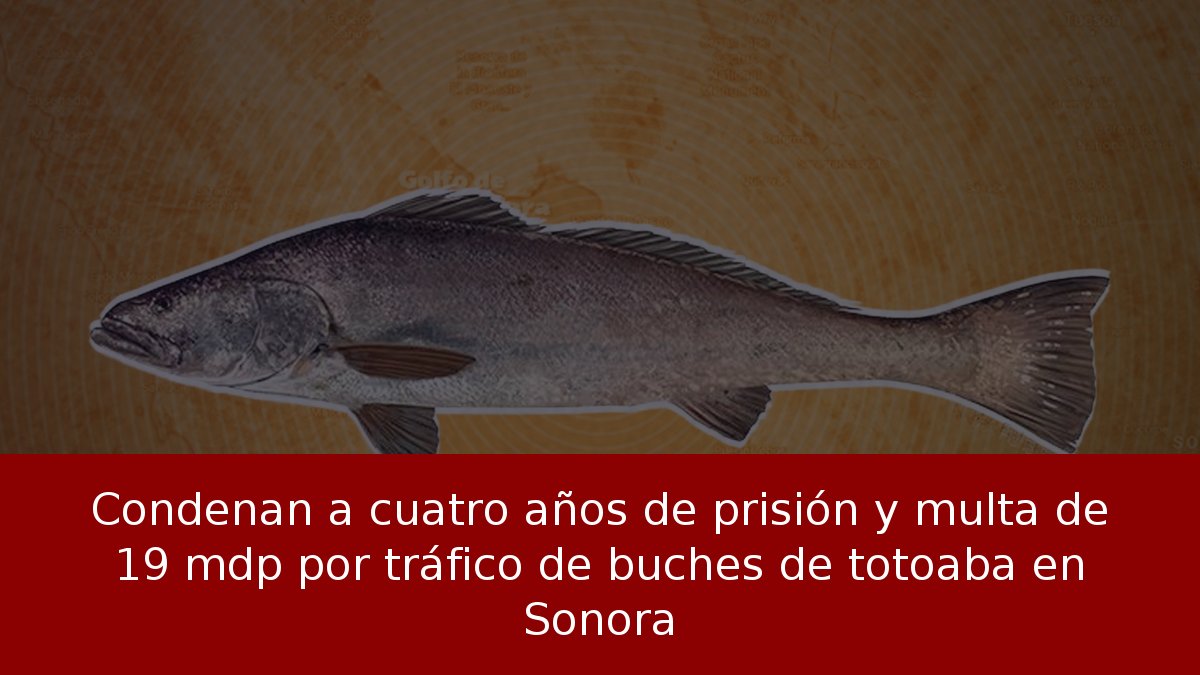
A Mexican court has sentenced a man identified as Jorge “N” to four years in prison and ordered him to pay 19,027,591 pesos in damages after he was found with 41 totoaba swim bladders hidden in a vehicle with California license plates. The ruling, announced this Wednesday by the Attorney General’s Office (FGR) and the Federal Environmental Protection Agency (Profepa), resulted from a joint investigation by both agencies.
- Sentence: Jorge “N” must serve four years and pay more than 19 million pesos for illegal trafficking of totoaba swim bladders, also known as buches.
- Arrest: On December 10, 2019, members of the Secretariat of National Defense (Defensa) and the State Public Security Police detained him in Sonora and seized 35 packages containing the bladders, which were turned over to the FGR.
- Official reaction: The FGR and Profepa called the ruling “a milestone” that “sends a very clear message to those who attack the environment and the country’s biodiversity.”
Investigation and legal basis
After the arrest, the FGR opened an investigation and Profepa provided expert reports to identify the species and quantify environmental damage. Those elements were key for the judge to set the reparation amount. The case was framed under Article 420, section IV, of the Federal Criminal Code, which punishes crimes against biodiversity, with aggravating factors for commercial purpose and for affecting a protected natural area.
The ruling considered the damage to the Alto Golfo de California and Delta del Río Colorado Biosphere Reserve, which allowed the court to establish both ecological harm and the commercial intent behind possessing the bladders. Authorities said the financial compensation aims to fully remedy the impact on the totoaba macdonaldi fish, the vaquita marina and the Alto Golfo de California ecosystem, species that share habitat in the area where the arrest occurred.
“Sends a very clear message to those who attack the environment and the country’s biodiversity,” the FGR and Profepa said, calling the ruling “a milestone.”
Links to organized crime and the black market
The case of Jorge “N” is part of a broader phenomenon: trafficking of totoaba swim bladders is linked to criminal groups. According to a previous report by this newsroom, the Sinaloa Cartel uses the species as barter with Chinese mafias to obtain fentanyl chemical precursors, a mechanism that allows organized crime to bypass the international banking system through direct exchange.
The product’s high value explains criminal interest: a kilo of totoaba bladders fetches around 80,000 dollars on the Asian black market, where popular belief attributes healing and aphrodisiac properties to them. For 15 years, the Sinaloa Cartel’s involvement has been the most serious problem the Mexican government faces in conserving the vaquita marina and combating totoaba trafficking.
Illegal totoaba fishing not only threatens that species but also the vaquita marina, which drowns in the same nets used to catch it. Both species live in the Alto Golfo de California and share a critical conservation status due to this practice.
Partial efforts and the vaquita’s decline
Government actions have produced limited results. In 2025, Semarnat reported a 97% drop in illegal fishing in the vaquita marina’s most protected zone, with 12 people charged for crimes against biodiversity and illegal fishing, six of whom were bound over for trial.
However, the vaquita marina population continues to fall: it dropped 98.6%, from 567 individuals recorded in 1999 to between seven and ten, according to the latest scientific monitoring led by the National Commission of Natural Protected Areas.
The totoaba macdonaldi, a fish endemic to the Gulf of California that can measure up to two meters and weigh up to 150 kilograms, is listed as endangered by Mexican Official Standard NOM-059-SEMARNAT-2010. It also appears in Appendix I of the Convention on International Trade in Endangered Species of Wild Fauna and Flora (CITES).
The sentence against Jorge “N” sets a precedent by combining prison time with a substantial financial penalty. Nevertheless, the vaquita marina’s continued decline and the persistence of the Asian black market show that isolated judicial actions, however symbolic, are insufficient against a trafficking network involving transnational organized crime. The challenge for authorities will be to replicate exemplary sanctions and dismantle the financial structures that sustain illegal fishing in the Alto Golfo de California.