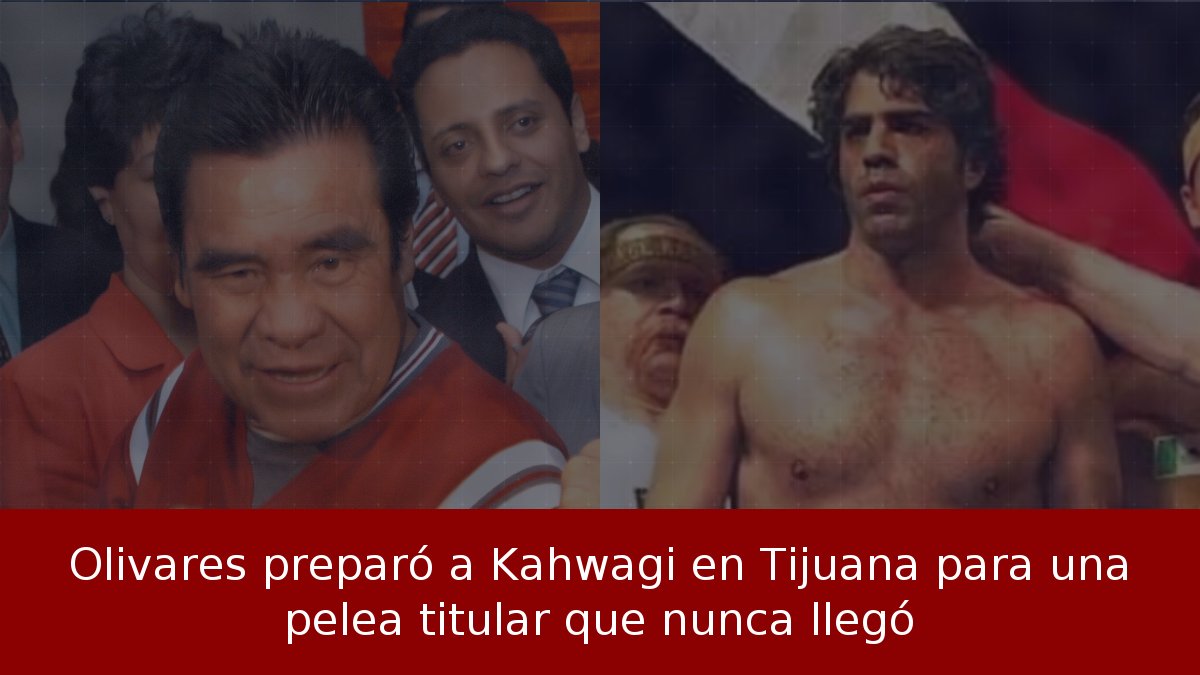
Long before his name became tied to politics, business and television, Jorge Kahwagi Macari had a little-known chapter in boxing: in early 2002 he placed himself under the guidance of Rubén “Púas” Olivares to prepare for a fight that could have opened the door to the Mexican cruiserweight championship. The training took place at the Canastota gym, in the Cerro Colorado area of Tijuana.
- The trainer: Rubén “Púas” Olivares, a former world champion, agreed to work with Kahwagi after Fernando Peña Garavito intervened.
- The projected opponent: David “Torpedero” Méndez, in a bout for the national cruiserweight title that ultimately never materialized.
- The routine: Kahwagi combined physical and technical sessions with trips from Mexico City and with business and political commitments.
- The outcome: in 2002 he won the Mexican cruiserweight championship and racked up 11 wins before the limit between 2001 and 2005.
A gym on the border and a former champion as guide
Kahwagi’s arrival in Tijuana was aimed at strengthening his physical and technical work ahead of a possible fight for the national cruiserweight title. The Mexico City fighter had turned professional in 2001, after practicing amateur boxing during his university years, and his entry into the ring coincided with a period in which he also maintained business and political activities.
The trips between Mexico City and Tijuana were part of that routine. The aspiring fighter had to fit training around commitments outside the sport, a condition that marked his early years as a boxer. Before seeking out Olivares, Macari had already had contact with the boxing scene on the border: he also trained at a gym linked to Erik “Terrible” Morales, where he caught the attention of promoter Fernando Beltrán.
For Kahwagi, training with the “Púas” meant placing himself under the orders of a man who knew the pressure of fighting for belts and defending them before large crowds. The projected fight against David “Torpedero” Méndez was especially important because he had been a professional for only a few months and the bout could give him a different position within the cruiserweight division.
The fight that never came and the title he did win
The duel against Méndez was announced as part of his rise in the national circuit, but it did not materialize as planned. That circumstance left the work with Rubén “Púas” Olivares as a separate episode from the fight.
During 2002, Kahwagi reached the Mexican cruiserweight championship. The result strengthened a career that later added regional titles linked to the World Boxing Council and the World Boxing Organization. His first professional stage spanned 2001 to 2005, with 11 wins before the limit. Ten years later he returned to the ring to face Ramón Olivas in Cebu, Philippines.
The preparation with “Púas” Olivares did not by itself define Jorge Kahwagi’s path to the championship, but it revealed the ambition that accompanied his first months as a professional. The then-boxer sought the backing of a recognized voice to shape a career that from the start advanced under unusual attention.
The memory that resurfaces between death and illness
The memory of those training sessions resurfaces after the death of Jorge Kahwagi on September 30, 2026, when various stories of his time in boxing circulated again. Olivares’s name also regained public presence due to a health problem he faces at 79 years old.
The former boxer reported that he suffers from a detached retina in his right eye and requires surgery to recover his vision. To raise funds and pay for the operation, Rubén put up for sale land, properties, photographs, gloves and crafts made by him. Among his memories are wood carvings, including a representation of the Last Supper with apostles wearing boxing gloves.
The “Púas” career included world titles at bantamweight and featherweight, as well as his induction into the International Boxing Hall of Fame in 1991. Thus, while seeking resources for an operation that could restore part of his sight, Rubén “Púas” Olivares is once again linked to a different picture of his career: that of a former world champion who, in a gym in Tijuana, prepared Jorge Kahwagi to pursue a place in Mexican boxing.