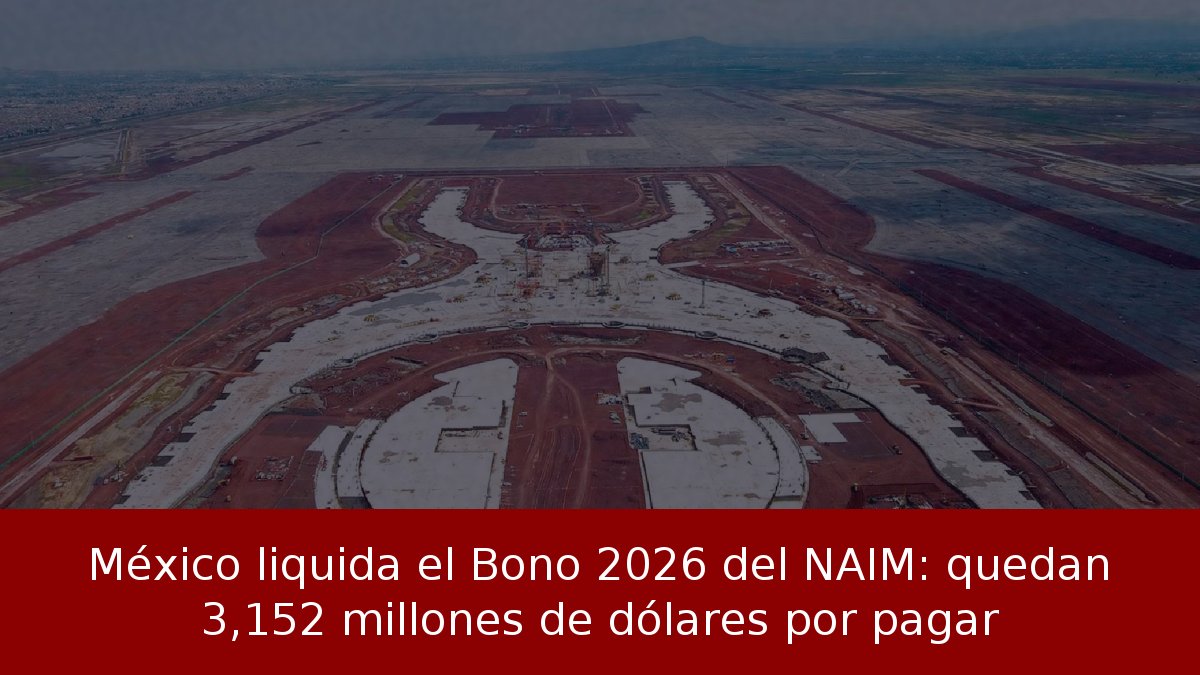
The cancellation of the New Mexico City International Airport (NAIM) in Texcoco, ordered by former president Andrés Manuel López Obrador in 2018, continues to weigh on public finances. The Mexico City International Airport Trust (MEXCAT) amortized 565.9 million dollars to settle the so-called 2026 Bond, one of the series issued to finance the project that never became operational. Despite the payment, the remaining debt stands at 3.152 billion dollars, which must be covered by 2047.
- Recent payment: MEXCAT settled the 2026 Bond for 565.9 million dollars on November 2, 2026.
- Outstanding debt: after the amortization, the total balance was reduced to 3.152 billion dollars, with three preferred notes still in circulation.
- Payment source: the Airport Use Fee (TUA) paid by AICM passengers remains committed to covering interest and principal.
A financial relief that does not solve the underlying issue
According to the Secretariat of the Navy (Semar), the agency that administers the AICM on behalf of Morena governments, the amortization took place on November 2, 2026, and reduced the debt balance. However, specialists warn that the payment responds to an unavoidable contractual obligation and does not necessarily reflect the airport's economic solvency.
“The MEXCAT Trust announces the full payment of the 4.250 percent secured preferred notes due in 2026 (2026 Bond), for an amount of 565.9 million dollars. The amortization was made on November 2, 2026, reducing the total debt balance to 3.152 billion dollars. After this operation, three secured preferred notes remain in circulation,” Semar reported.
The trust was created as a financial vehicle to build the NAIM and placed bonds on international markets. Its main guarantee is the collection rights of the TUA paid by each AICM passenger. Although the government carried out repurchase and restructuring operations after the cancellation, those revenues remain committed as a payment source.
The factors behind the collection
Semar attributed compliance with the payment to the recovery in passenger numbers after the Covid-19 pandemic, with an annual growth rate of 4 percent between 2021 and 2025. Also influential were the authorizations granted in 2025 and 2026 to increase operational capacity from 43 to 46 operations per hour, as well as the appreciation of the exchange rate.
For Juan Antonio José, an aviation sector specialist, the official report has a propagandistic character that sidesteps the operational and financial challenges of the country's main terminal.
“It is an obligation. What they are doing is propaganda; it is not a relevant matter that they are paying. Progress in bond payments does not mean the Airport has financial health; the financial balances would have to be seen transparently,” the expert said.
Along those lines, he raised that the real question is how the finances of Benito Juárez International Airport stand and how profitable it is to operate with 46 operations per hour.
The TUA, committed until 2047
Carlos Torres, also an aviation sector specialist, recalled that the original debt amounted to 6 billion dollars, so progress in its liquidation represents about half of the total. He warned that the news is not entirely positive for the AICM, since the TUA remains committed and those resources are not channeled to maintaining the terminal.
“Until the issued bonds are settled, the Airport will not have (financial) health at 100 percent. The payment gives certainty to investors, but this does not mean it has healthy finances, under the logic that ideally it should be self-sufficient with its resources,” he emphasized.
Torres further stressed that infrastructure that never entered operation—the NAIM in Texcoco—is being paid for, and that its cancellation brought hidden costs and conflicts for the AICM.
The 2026 Bond payment represents a step on the liquidation path, but the schedule extends to 2047 and the AICM's financial capacity will remain tied to TUA revenues. While Semar celebrates compliance, specialists insist that transparency about balances and operational profitability is the pending task to determine whether the terminal can sustain itself without committing its resources to a canceled project.