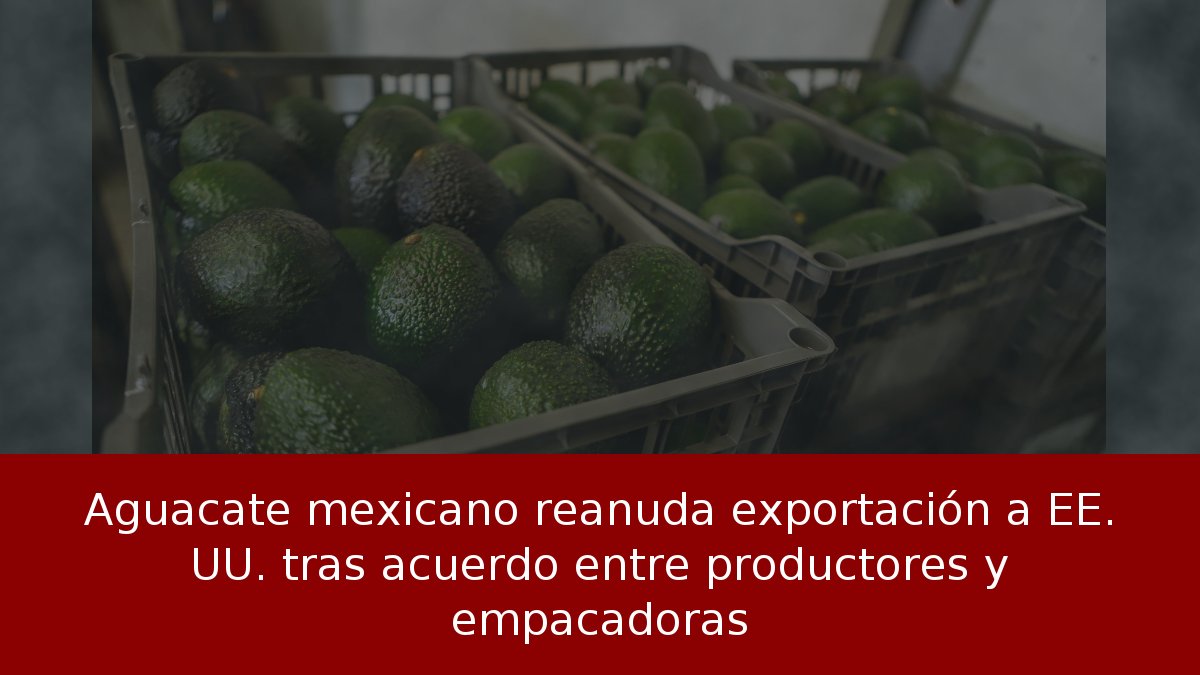
Mexico's avocado exports to the United States will resume on Thursday, November 5, after growers and packing plants reached an agreement that ends three weeks of disruption to the industry. Agriculture and Rural Development Secretary Columba López confirmed the move during President Claudia Sheinbaum's morning press conference.
- Resumption: Export flows to the U.S. restart on November 5 following an understanding between farmers and packers.
- Root of the conflict: A price collapse, with payments of 13 to 20 pesos per kilo, and the detection of the avocado seed borer led to the suspension.
- Certifications underway: The federal government is advancing two certification schemes for the avocado chain: one labor-related and one on deforestation-free sourcing.
Deal reached late Tuesday night
López said the agreement between workers and packing companies was finalized around 11:00 p.m. on Tuesday, November 3. “Tomorrow agro-exports will be restored,” she said at the conference.
The dispute stemmed from a drop in fruit prices. According to the secretary, some areas reported payments of 13 pesos per kilo, while the maximum reached 20 pesos—amounts producers deemed insufficient to cover their production costs. Farm laborers also suffered from the interruption: “There were three weeks when harvests were affected,” she said.
Asked about possible support for those affected during that period, López did not announce a specific program. She noted that restarting export activity will allow payments tied to marketing to resume.
Pest reports and clarifications on shipments
The official addressed videos circulating about alleged pests in avocado shipments. She clarified that one case occurred in Jalisco and involved fruit destined for an avocado oil plant, not for agro-exports. The shipment was stopped at one of the state's five inspection points, and the spread of the images led to a different interpretation of the fruit's destination.
Regarding another report in Nayarit, she specified that the screwworm was not inside the avocado but in the boxes, and that the product did not leave. López asserted that Michoacán has not recorded cases of screwworm in 28 years of avocado exports. “We are super sure that there is absolutely no screwworm pest,” she stated.
The secretary said traceability is one of the requirements for agro-exports. She noted that 50 municipalities are free of the pest and 13 agroecological zones have been identified under the Plant Health Law.
Phytosanitary monitoring and pending certifications
The National Service for Agro-Alimentary Health, Safety and Quality (SENASICA) and local plant health boards register plots with owner or lessee data, in addition to maintaining training and permanent trapping. Each month, a random review of 500 hectares is conducted within the more than 168,000 hectares under surveillance. “It will identify whether there is any pest or disease,” López explained about the inspection mechanism.
The federal government maintains sanitary measures for fruit destined for international markets, including the United States, and continues with registration for deforestation-free certificates, a requirement aimed at ensuring that exported avocado does not come from deforested land. This is in addition to the labor certification mechanism, whose progress was not detailed at the conference.
With the resumption of exports, the avocado sector faces the challenge of recovering the pace of harvesting and shipments after three weeks of paralysis, while sanitary authorities maintain surveillance in production areas to prevent detected pests from undermining international market confidence. The full implementation of both certifications will be key to consolidating Mexican avocado access to the United States in the medium term.