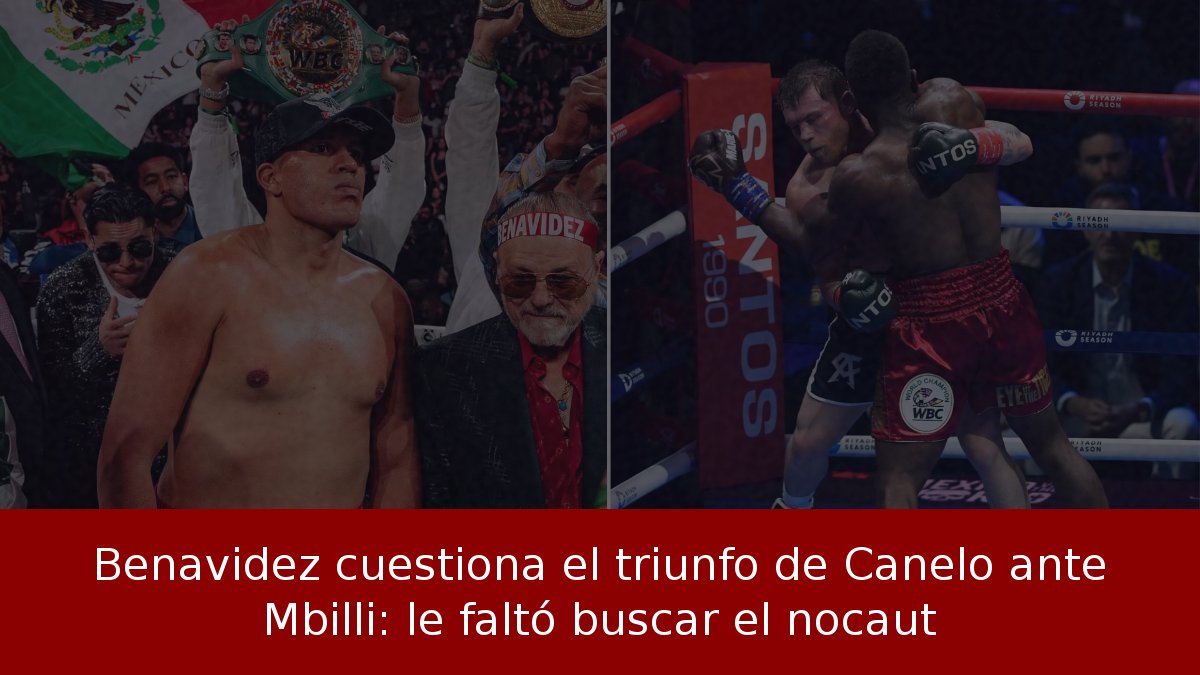
Saúl “Canelo” Álvarez regained the World Boxing Council super middleweight belt by defeating Christian Mbilli in Riyadh, yet David Benavidez was not fully persuaded. The Mexican-American had anticipated a more aggressive showing and a finish before the final bell against an opponent he regarded as vulnerable and technically inferior to the Guadalajara native.
- Outcome: Álvarez reclaimed the WBC super middleweight title with scorecards of 115-112, 116-111 and 117-110.
- The critique: Benavidez argued that the champion spent too much time waiting for Mbilli’s counterpunches instead of applying pressure.
- The comparison: the “Mexican Monster” contrasted the bout with Canelo’s technical knockout of Caleb Plant in 2021.
- His schedule: Benavidez will face Michal Cieślak on December 5 in a cruiserweight unification fight.
A clear win, but lacking the expected urgency
The “Mexican Monster” did not question the result or Álvarez’s control across the 12 rounds. His complaint centered on the absence of sustained pressure against an Mbilli who, in his view, lacked the resources to trouble the tapatío.
For Benavidez, the gap between the two should have pushed Canelo to take greater risks. He felt the champion spent too long waiting for his opponent’s entries when he had the tools to advance, move his waist and drive him toward the ropes.
“If he wins all that money we expect him to go in there and knock this guy out, we don’t expect him to go in looking only for counterpunches,” Benavidez said during an interview with Fight Hub TV.
Thus, Canelo’s victory was not in dispute, but the manner in which he built it was. Benavidez saw a champion who controlled the fight from the start, yet without the urgency that, in his opinion, a rival like Mbilli demanded on a night when a knockout seemed within reach.
The Caleb Plant reference and the weight of huge purses
The “Red Flag” invoked Canelo’s fight against Caleb Plant to explain what he expected to see in Saudi Arabia. In November 2021, Álvarez raised his pressure in the second half of the bout and secured a technical knockout in the eleventh round.
Before the Riyadh event, Benavidez said Mbilli’s style favored the Mexican. He saw the French-Cameroonian as exposed to body attacks and combinations, and even predicted a win before the distance. After the decision, he maintained that assessment of the disparity between the two.
“Canelo is much better than Mbilli. You all saw it, he had more tools. He just wasn’t looking for the knockout like he should have,” he stated.
The comparison with Caleb Plant exposed Benavidez’s point: he saw an effective and comfortable Canelo, but one who paced himself, preferring to secure the win rather than show a better version and empty the tank in pursuit of a finish.
A rivalry without a ring and Benavidez’s future
David Benavidez and Saúl Álvarez have exchanged verbal jabs for years but have never shared a ring. The Mexican-American has said he does not expect that fight to materialize, though he has also acknowledged Canelo’s stature in Mexican boxing.
That admiration for Álvarez’s career explains why he mixed praise for his technique with reservations about his performance against Christian Mbilli. He also believes a rematch against Terence Crawford would be the challenge that could demand a different version of Canelo, and recalling the Mexican’s second fight against Gennady Golovkin, he argued that Álvarez can respond with greater intensity after a close loss.
Meanwhile, on December 5, Benavidez will face Michal Cieślak in a cruiserweight unification bout, seeking to add another belt to his collection. Oleksandr Usyk has already expressed interest in facing him if he returns to 200 pounds, a possibility David received enthusiastically.
So, while building his own path at cruiserweight, Benavidez saw in Riyadh a champion who regained the title with plenty of craft but without emptying the tank, leaving pending the final blow many expected. For someone who predicted a body knockout, Canelo’s victory over Mbilli felt incomplete when the last bell rang.