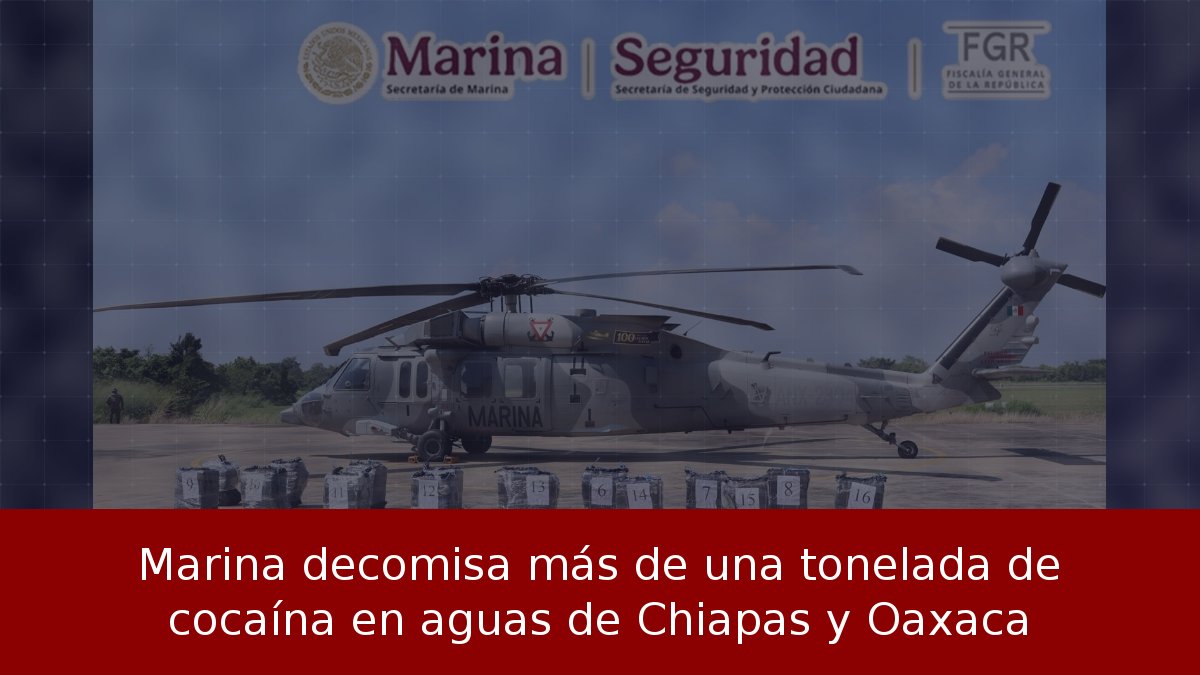
Two maritime operations off the coasts of Chiapas and Oaxaca led to the seizure of more than one ton of cocaine and the arrest of one individual, according to Omar García Harfuch, head of the Secretariat of Security and Citizen Protection (SSPC). Harfuch announced the results on social media, noting that personnel from the Mexican Navy, under the Secretariat of the Navy (Marina), carried out the actions.
- Key Point: The Mexican Navy confiscated over a ton of cocaine and detained one person in two separate operations near Chiapas and Oaxaca.
- Key Point: Since President Claudia Sheinbaum Pardo took office, the Navy has seized more than 97 tons of cocaine at sea through ongoing maritime, aerial, and land surveillance.
- Key Point: Harfuch emphasized that each seized shipment directly weakens organized crime’s finances, reducing its ability to buy weapons, bribe officials, and commit violence, while also keeping drugs off the streets.
Persistent maritime surveillance
Harfuch explained that the Navy’s surveillance efforts—conducted by sea, air, and land—are continuous, and the cumulative seizures reflect their effectiveness. He stated that under President Sheinbaum’s administration, the Navy has now secured over 97 tons of cocaine in Mexican waters. Each confiscated load, he said, strikes a blow to criminal groups by depriving them of resources to purchase arms, corrupt authorities, and fuel violence, as well as by limiting the drugs that reach young people.
“Seguiremos combatiendo a estas organizaciones, sus estructuras y sus recursos para proteger a las familias mexicanas”, concluyó Harfuch.
Simultaneous operations in the State of Mexico
In a separate post on X, Harfuch reported that, on instructions from President Sheinbaum and with support from State of Mexico Governor Delfina Gómez, 38 simultaneous operations were conducted across the state to combat extortion, homicides, and other violent crimes. The operations resulted in 32 arrests. Agencies involved included the SSPC, the Secretariat of National Defense (Defensa), the Navy, the Attorney General’s Office (FGR), the National Guard (GN), and the National Intelligence Center, working with the State of Mexico’s Security Secretariat and Attorney General’s Office, plus support from Pemex and municipal authorities.
Among those detained were “Miky Juárez,” “El Gigan,” and “El Pollo,” identified as alleged leaders of groups linked to extortion, drug offenses, and illegal LP gas sales, along with two municipal police officers from Nezahualcóyotl. The operation against Los Gigan, tied to the CJNG, followed seven months of investigation. Authorities seized firearms, narcotics, vehicles, and approximately 178,000 liters of LP gas.
“Seguiremos golpeando las estructuras criminales, sus recursos y sus redes de protección. Ningún cargo público ni fachada de sindicato puede servir de escudo para delinquir”, concluyó el mensaje.
Seven-month investigation into Los Gigan
Days earlier, the capture of Miguel Juárez Pérez, alias “El Miky,” 35, was announced. He is a member of the Federation of Mexiquense Organizations (FOMAC), a group accused of homicide, extortion, and water theft in Ecatepec, State of Mexico. Reports suggest he succeeded Alejandro Gilmare Mendoza, alias “El Choko,” as head of the organization. On October 31, Ecatepec’s municipal security directorate officially described him as a priority target and alleged generator of violence. His arrest took place on Tuesday, October 27, at a property in the Progreso de la Unión neighborhood, through a joint operation involving the Navy (Semar), SSPC, the Specialized Prosecutor’s Office for Organized Crime (FEMDO), and naval personnel assigned to municipal police. According to official data, FOMAC is affiliated with the Union of National Unions and Organizations (USON).
The results presented by Harfuch combine the fight against maritime drug trafficking with the dismantling of networks engaged in extortion and the illicit fuel market in the State of Mexico. The challenge for authorities will be to maintain pressure on structures like Los Gigan, which operate with ties to larger organizations and possible institutional protection networks.