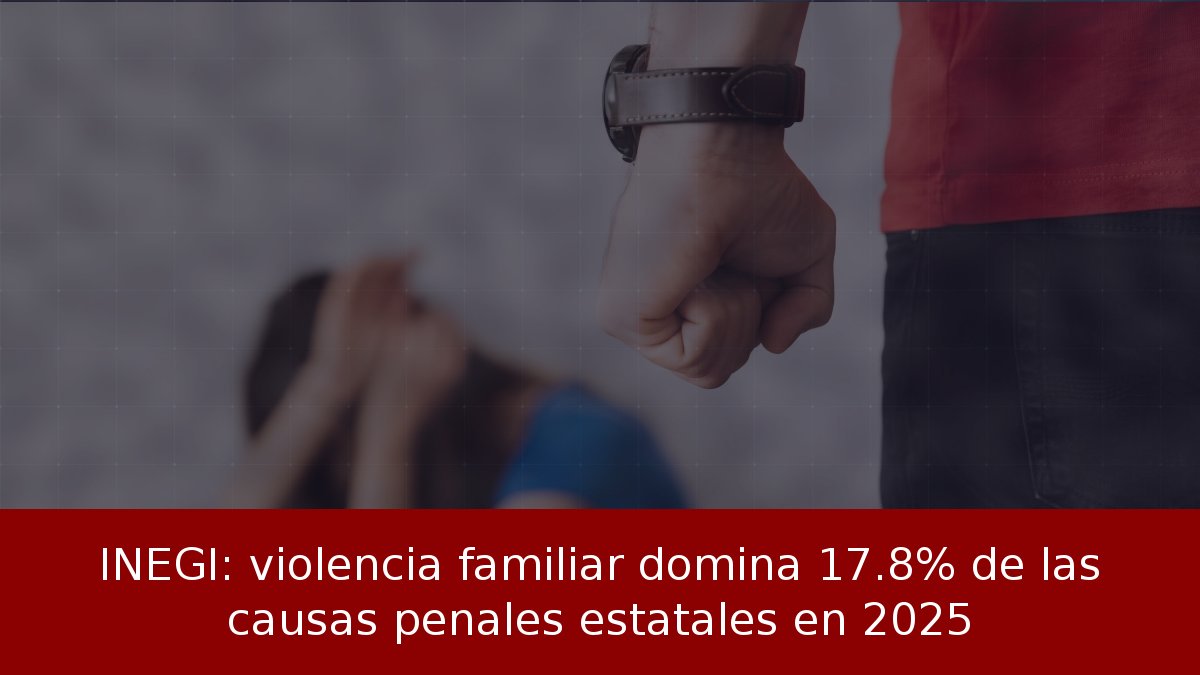
Family violence emerged as the most common offense in criminal cases filed with state judicial branches (PJE) in 2025, accounting for 17.8% of all records, according to the National Census of Federal and State Justice Administration by INEGI.
- Top offense: Family violence made up 17.8% of state court criminal cases and rose 7.8% compared with 2024.
- Runners-up: Drug dealing (narcomenudeo) at 15.3% and robbery at 13.3% complete the top three at the state level.
- Federal sphere: Offenses involving weapons, explosives and destructive materials represented 52.7% of cases filed with the federal judiciary (PJF).
- Overall figure: Crimes counted in PJF and PJE criminal cases totaled 364,546, up 10.5% year over year.
Most frequent crimes in state courts
According to the institute, state courts recorded 321,682 crimes in incoming criminal cases, equal to 88.2% of the 364,546 tallied jointly by the PJF and the PJE.
After family violence, the offenses most present in state jurisdictions were drug dealing, with 49,313 records; robbery, 42,845; assault, 26,466; property damage, 17,111; failure to meet family obligations, 11,650; homicide, 10,653; threats, 10,102; fraud, 8,598; and sexual abuse, 7,303.
INEGI detailed that 292,622 criminal cases entered the Accusatory Penal System and the Comprehensive Justice System for Adolescents during 2025, an 8.6% increase over 2024. Of that total, 22,221 cases belonged to the PJF and 270,401 to state judicial branches.
The institute specified that for incoming cases, “only competent criminal cases filed with control or guarantee courts were considered.”
Rulings, pending cases and budget
In the same period, 185,617 determinations and/or conclusions were recorded, 19% more than in 2024. Of that total, 15,197 corresponded to the PJF and 170,420 to the PJE. At year's end, 497,161 matters remained pending: 63,650 at the federal level and 433,511 in state judicial branches; overall, pending cases fell 1.3% from the previous year.
The census clarifies that for state courts, determinations, conclusions and pending matters use as their reference unit the persons prosecuted, accused or sentenced and the legal status of each, respectively. For the PJF, by contrast, the information refers to concluded and pending criminal cases.
On budget matters, the PJF and PJE spent a total of 138,695,173,968 pesos in 2025. Of that amount, 82,299,550,286 pesos (59.3%) went to the PJF, while 56,395,623,682 pesos (40.7%) were spent by state judicial branches. Of the federal budget, 89.2% corresponded to the Judicial Administration Body.
At prices from the second half of July 2018, the combined budget exercised was 98,937.9 million pesos: 58,708.2 million for the PJF and 40,229.7 million for the PJE. Compared with 2024, the PJF's budget decreased 2.6%, while that of state judicial branches increased 1.5%.
The federal justice picture
At the federal level, offenses involving weapons, explosives and other destructive materials accounted for 52.7% of crimes recorded in criminal cases filed with the PJF, a 34.4% increase compared with 2024.
Of the 42,864 crimes recorded in cases filed with federal justice, those related to weapons, explosives and destructive materials totaled 22,582, followed by tax offenses with 2,217 and hydrocarbons and derivatives with 1,306.
The body highlighted that the census results provide information on “management and performance” of the Federal Judiciary, Agrarian Tribunals and state judicial branches in areas such as justice administration, juvenile justice, alternative dispute resolution mechanisms, expert services and public defense.
Gender composition in the judiciary
At the close of 2025, the PJF and PJE reported 1,512 magistrates, of whom 46.6% were women and 53.4% men. There were also 4,982 judges: 47.2% women and 52.8% men.
Compared with 2024, when women represented 32.2% of magistrates and 43.9% of judges, the proportions rose 14.2 and 3.3 percentage points, respectively. The census also recorded one non-binary judge in the Judicial Administration Body, equal to 0.02% of the total.
The weight of family violence in state courts' workload reflects a phenomenon that goes beyond the criminal sphere: its sustained growth puts pressure on courts' resolution capacity and on victim support programs, in a context where pending state matters exceed 433,000 cases.