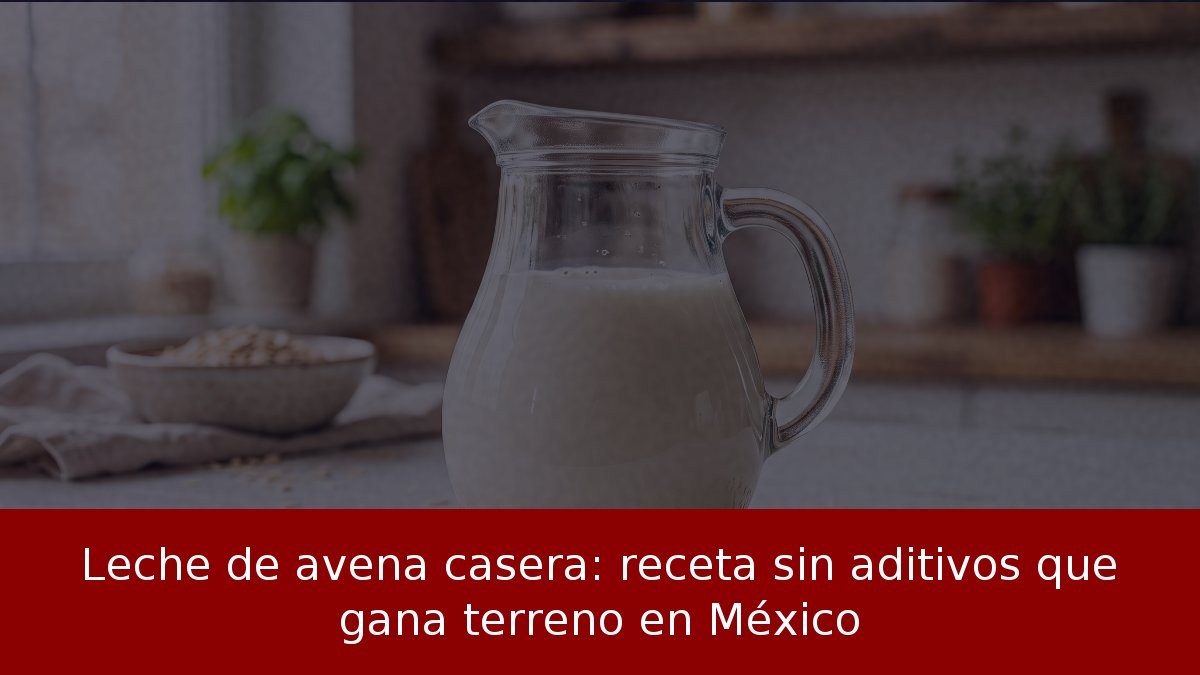
Making plant-based milk at home no longer requires special equipment: oats, water and a strainer are enough to produce a creamy, opaque drink without the industrial additives found in supermarket cartons. The homemade version is gaining ground in Mexico among people with lactose intolerance, those following vegan diets, or anyone trying to cut processed ingredients from daily meals. Its mild flavor works in coffee, smoothies, cereal and baking.
- Key Point: The recipe calls for 150 grams of fine oat flakes, 1 liter of cold drinking water, an optional pinch of salt and an optional teaspoon (5 milliliters) of honey or liquid piloncillo.
- Key Point: Total time is about 8 hours and 20 minutes, but only 17 minutes are active (blending, straining, bottling); the rest is unattended soaking, and no cooking is needed.
- Key Point: One batch yields 1 liter, roughly four 250-milliliter servings, and keeps 2 to 3 days refrigerated because it contains no preservatives.
- Key Point: Each serving provides an estimated 45 calories, 1 gram of protein, 8 grams of carbohydrates, 1 gram of fat and 1 gram of fiber.
Why the method works
The core technique is soaking the flakes beforehand, which softens the grain and releases its natural flavor without heat. After draining and rinsing, the oats go into a blender with the cold water, salt and any sweetener, and are processed at full power for 2 minutes until the mixture is opaque and free of visible lumps. Using cold rather than hot water prevents a gelatinous consistency. Skimming off the foam and sediment that rise to the surface keeps the drink from separating when heated.
Straining through cheesecloth or a cloth bag is what defines the texture: the more times the liquid is passed through clean fabric, the smoother and more uniform it becomes. The recipe suggests repeating the step two or three times for a finer result. Whole oats or thick flakes produce a thicker drink than instant oats.
Step by step
- Put the oat flakes in a large bowl and cover them with plenty of drinking water.
- Cover the bowl and refrigerate for 8 hours, or overnight.
- Drain the flakes in a colander and discard the soaking water, which carries off excess starch and the grain's harsh taste.
- Rinse the flakes under running water with your hands.
- Transfer the rinsed flakes to a blender with the liter of cold water, the salt and the chosen sweetener.
- Blend at maximum speed for a full 2 minutes.
- Remove the foam and sediment that rise to the top with a ladle.
- Line a wide-mouthed pitcher with cheesecloth or a cloth bag and pour the mixture in slowly.
- Squeeze by hand to extract the last drops of liquid.
- For a finer texture, strain again two or three times through clean cloth.
- Bottle in a glass container with an airtight lid and refrigerate.
Sweeteners are entirely optional and can be left out for a version with no added sugar. The drink should be stored well covered in the refrigerator; it is normal for solids to settle, so shake well before each use.
How to serve it
The oat milk works cold straight from the fridge with a dusting of cinnamon, and it can replace cow's milk in morning coffee or a cappuccino because it foams in a similar way. Its neutral taste pairs with cocoa, fruit or spices without changing the final result. At breakfast it goes with granola, chopped fruit or a bowl of cooked oats, reinforcing the cereal flavor. In baking it substitutes for milk in pound cakes, hot cakes and banana or strawberry smoothies. For a sweeter option, mix it with cocoa powder and a little honey for a vegan chocolate drink.
Oats stand out among commonly eaten grains for their soluble fiber content, including beta-glucans, a type of fiber linked in the diet to lowering cholesterol. The drink's fat content is naturally low because the grain contributes minimal lipids. As shoppers grow more wary of packaged goods and their additives, a kitchen-made batch offers households a simple way to control exactly what goes into the carton.