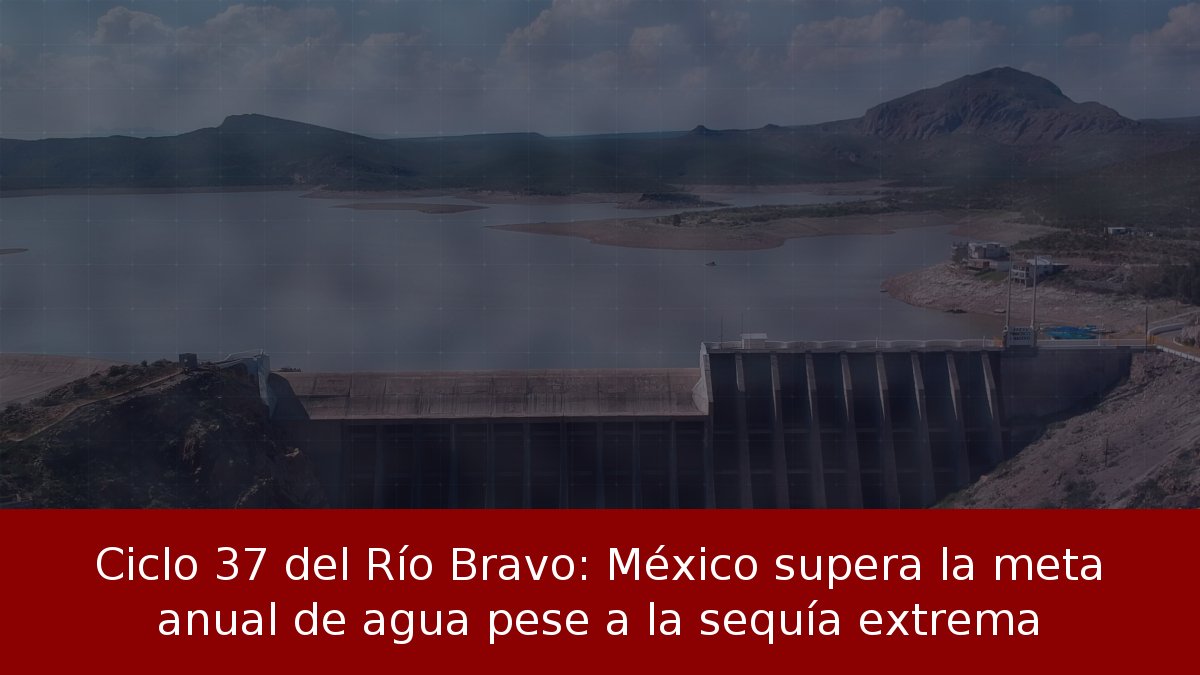
Authorities in Mexico have closed out the opening year of the 37th delivery cycle for the Rio Grande basin by providing the United States with a volume above 430 million cubic meters. This transfer occurred while extreme dry conditions continue to strain water availability across the border zone. A joint communication issued on October 24 indicated progress in cross-border water cooperation, although it also underscored the ongoing difficulty of securing enough supply for local residents and farming operations that rely on these flows.
- Key Point: Mexico satisfied its yearly minimum by delivering roughly 431.7 million cubic meters, equal to at least 350,000 acre-feet.
- Key Point: U.S. Agriculture Secretary Brooke Rollins acknowledged the milestone while making clear that unresolved debts and regular future supplies still need attention.
- Key Point: Severe drought reduces the overall volume available and forces officials to weigh treaty obligations against drinking water, household use, and crop production.
- Key Point: Even after meeting the annual target, Washington continues to press for accumulated water commitments to be settled and for predictable flows to Texas border communities.
Compliance in the first year of the 37th cycle
The Mexican government has formally ended the initial year of cycle 37 under the bilateral water agreement signed in 1944, which defines how shared supplies are allocated between the two nations.
According to the foreign ministry, various federal agencies worked together and applied joint measures that were announced on February 3, 2026, to reach the annual minimum volume required by the pact.
The handover took place amid difficult hydrological circumstances. Extreme drought limits how much water can be drawn from the basin, requiring a balance between cross-border duties and domestic priorities. The foreign ministry stated that the country fulfilled its obligation without placing the right to water, community consumption, or food output at risk, particularly along the frontier.
Washington's recognition and unsettled issues
From the American side, Agriculture Secretary Brooke Rollins stated that Mexico met its commitment by sending no less than 350,000 acre-feet during the 2026 water year. This amount works out to nearly 431.7 million cubic meters, and it formed the core of the joint official announcement.
Rollins noted that the target was reached for a second consecutive year under President Donald Trump's direction and with cooperation from President Claudia Sheinbaum. She added that such back-to-back compliance had not been seen since Trump's earlier term in office.
Nevertheless, the U.S. official emphasized that completing this period's quota does not settle every disagreement over how the shared waters are divided. Washington still views regular deliveries and the resolution of past due amounts as necessary, especially to support the southern part of Texas.
Agricultural producers in that region count on these water volumes to continue operating, protect their crops, and help produce food. For this reason, American authorities regard steady and dependable future supplies as a pressing matter.
Bilateral water agenda still in play
In February 2026, both governments rolled out strategies to deal with the treaty's requirements at a time when hydrological conditions restrict what can be delivered. The main points that continue to be contested are:
- Future supplies: The United States seeks an uninterrupted, reliable flow of water.
- Outstanding debt: Washington argues that accumulated water obligations must be addressed.
- Farm operations: Growers and ranchers in South Texas need these resources to stay in business.
- Mexican availability: Drought and basin hydrology reduce the room to distribute water without hurting local communities.
Finishing the first year of cycle 37 shows that an annual goal can be met, but it does nothing to erase the cross-border tensions over water responsibilities. Ensuring continuous deliveries and managing the backlog will be central to the next stage of collaboration between the two governments. At the same time, the severe drought remains a backdrop that could complicate future cycles if rainfall does not improve.