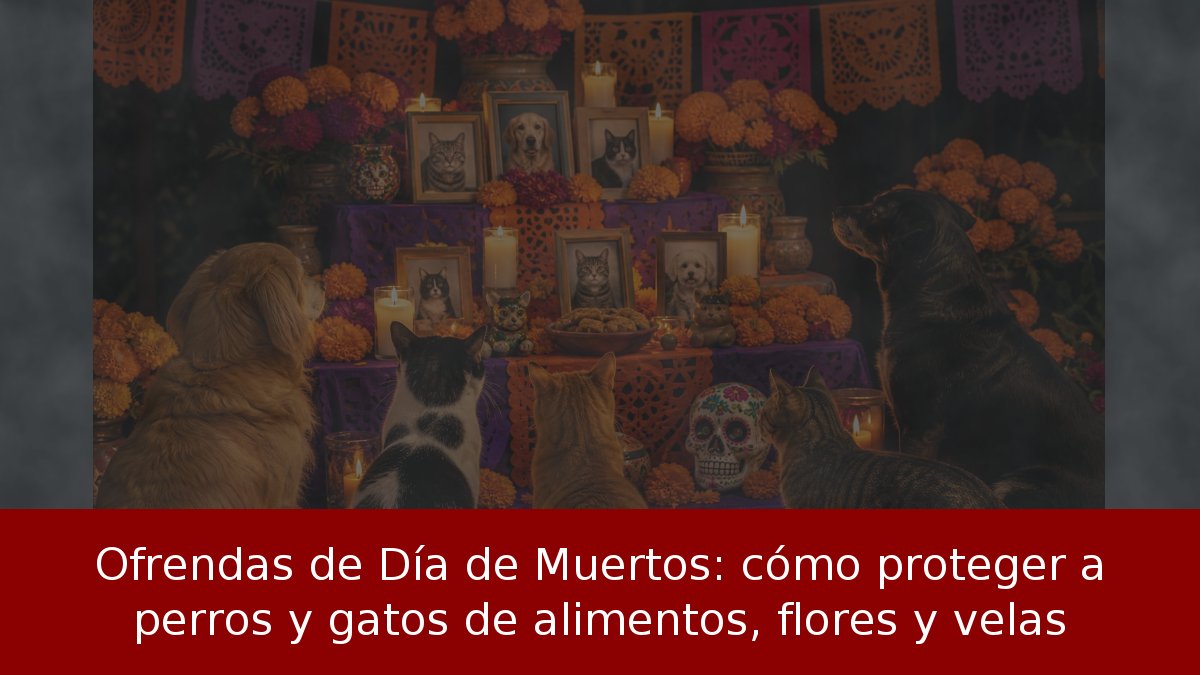
With the arrival of Day of the Dead, Mexican households that share space with dogs and cats must review in advance how to set up the offering. The tradition can be maintained, but it requires adjustments in the location and elements of the altar so that animals are not exposed to foods, flowers, candles, smoke, or water containers that endanger their well-being. The UNAM-Banfield Veterinary Hospital, through UNAM Global, notes that these precautions are relevant because a significant portion of the country's homes house companion animals.
- Human foods: dishes prepared for people often contain fat, sugar, salt, or seasonings that are not part of the diet of dogs and cats; in addition, sweets and bread can remain within their reach for several days.
- Cempasúchil and vases: if an animal accidentally ingests the flower, it may suffer digestive disturbances; the water in vases should not serve as a drinking bowl because it accumulates stem and flower residue.
- Candles and smoke: candles and votive candles can cause burns or falling objects if an animal's tail, paw, or curiosity reaches them; copal and incense require ventilation and avoiding direct exposure.
- Costumes and accessories: they should be removed when the animal tries to take them off or changes its way of moving.
A reality covering two-thirds of households
The 2025 National Self-Reported Well-Being Survey by INEGI indicates that 66.4% of households in Mexico have at least one companion animal. The country is home to 41.2 million dogs and 19.2 million cats, according to the same survey. This presence makes it necessary to review where the offering is placed and what objects remain within the animals' reach during the celebration.
Fausto Reyes Delgado, medical and institutional development director of the UNAM-Banfield Veterinary Hospital, recommends anticipating and examining both the components and the location of the offering:
“The offering is part of a very important tradition for families, and it is not about stopping setting it up when we have companion animals at home. The recommendation is to anticipate: observe where it will be located, what elements it contains, and which ones could be within their reach.”
Flowers, water, and food under watch
Cempasúchil, common in this season, can cause digestive disturbances if an animal accidentally ingests it. The water in vases should not be used as a drinking bowl either, since over the days it can accumulate stem and flower residue. Keeping flowers and containers out of the reach of dogs and cats reduces the possibility of incidents.
Foods prepared for human consumption may contain fat, sugar, salt, or seasonings different from the usual diet of dogs and cats. Sweets, bread, and other products can also remain within the animals' reach for several days. Supervision should extend to family gatherings, where different people might offer them bites without knowing what foods they have already received. Respecting their schedules, portions, and usual food avoids unnecessary changes in their diet.
Fire, smoke, and accessories
Candles and votive candles involve the risk of burns or falling objects if an animal's tail, paw, or curiosity reaches them. Contact with fire can cause injuries to the face, ears, or limbs. If the animals have free access to the space where the offering is, electric candles allow preserving the visual element without a lit flame.
Copal and incense require avoiding direct exposure to smoke and keeping the room ventilated. If the dog or cat tries to move away, shows discomfort, or exhibits changes after staying near the smoke, it should be removed from that environment. Accessories and costumes should also be removed if the animal tries to take them off or modifies its way of moving.
Reyes Delgado called for veterinary medical attention if the animal consumes a food or object from the offering or if it presents vomiting, diarrhea, difficulty breathing, lethargy, or another unusual sign.
“It is not advisable to wait for the problem to progress before seeking guidance.”
Identifying, when possible, the object or food with which it had contact can help during the consultation with the veterinarian.
The warning about tourism on Day of the Dead
At the same time, UNAM researchers warn that tourism around Day of the Dead can turn a family and community commemoration into a spectacle for visitors, with practices that interfere with rituals dedicated to the deceased and economic benefits that do not always reach indigenous peoples.
Anthropologist Cristina Oehmichen, from the Institute of Anthropological Research, explained to UNAM Global that the tension arises when “distinguishing what is celebrating and what is showing the tradition.” The warning comes as tourist interest in the celebrations grows, fueled by films, parades, and the dissemination of images on social media.
In Janitzio, Michoacán, a research study documented that some tourists posed in front of families praying for their dead and even stepped on graves during the celebration. For the families, the cemetery is a space of recollection; for some visitors, it becomes a place to take photographs.
Oehmichen noted that tourist presence can modify the organization of rituals. When tours and visits gain weight, activities begin to adjust to scheduled times and the most visually striking or photogenic elements are prioritized. This process leaves out everyday practices of the communities that do not fit the tourist representation. The so-called festivalization shifts the ritual meaning of the commemoration toward activities designed for visitor consumption.
A case cited by the research is the Day of the Dead parade in Mexico City. The activity emerged in 2016, after the opening sequence of Spectre, a film in the James Bond saga, showed a monumental procession of skulls through the capital's streets. The cinematic representation was later incorporated into the city's official tourist calendar. The parade is not part of the traditional practices that communities carry out in cemeteries, homes, and altars to receive their deceased.
UNAM's dual call—one veterinary and one anthropological—coincides on one point: the celebration can be preserved if it adapts to the real conditions of each space, whether it is coexistence with companion animals or respect for community rituals. In the case of pets, reviewing the offering beforehand and seeking timely attention for any symptom are the measures that make the difference.