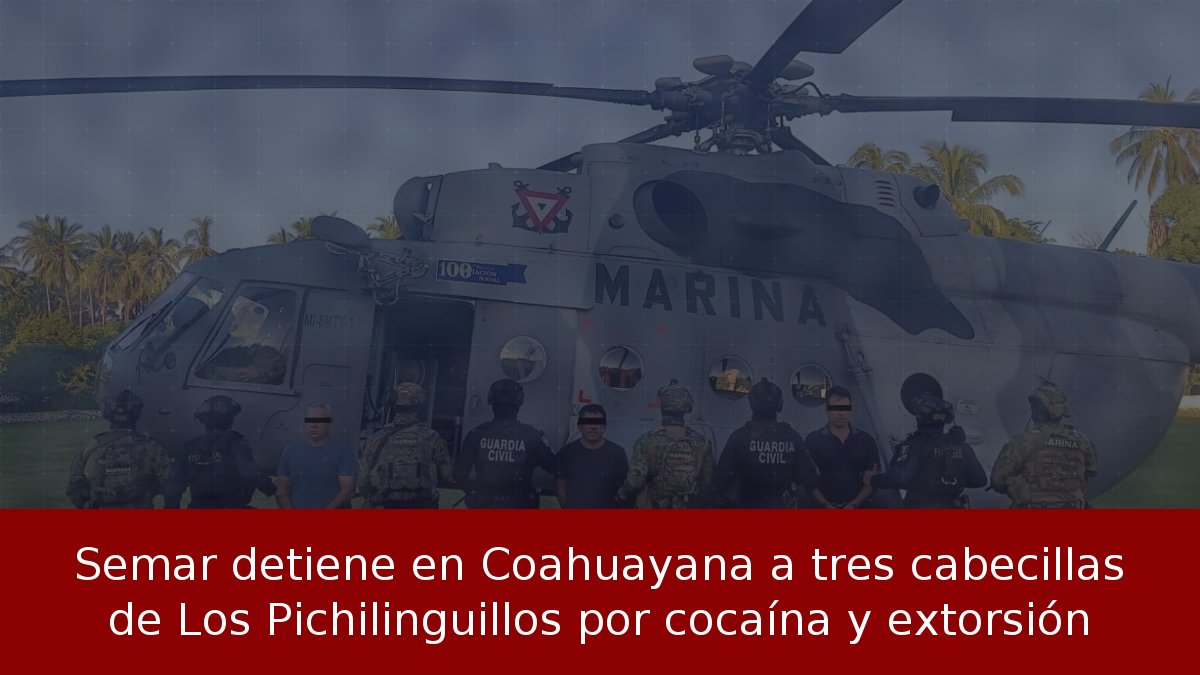
Three alleged leaders of the criminal organization known as Los Pichilinguillos were arrested in an operation led by the Secretaría de Marina (Semar) in Coahuayana, Michoacán. The suspects are linked to homicide and to cocaine trafficking via maritime routes, as well as extortion of banana producers in the coastal region of the state.
- Identities: the detainees are Bernardo “N”, alias “Mando”; Leobardo “N”, alias “Lioba”; and Leopoldo “N”, alias “Negrito”.
- Outstanding charges: they had arrest warrants for various crimes and are accused of generating violence in Michoacán.
- Modus operandi: the group engaged in extortion of banana producers, protection rackets, and cocaine smuggling along sea routes.
A capture based on information shared among agencies
The arrests were carried out based on information provided by the Fiscalía de Michoacán, elements of the Secretaría de Seguridad Ciudadana (SSPC), the Fiscalía General de la República (FGR), and state security forces. After their detention, the three individuals were transferred to Mexico City and placed at the disposal of the corresponding Public Ministry agent, who will determine their legal status.
According to the state prosecutor's investigations, Los Pichilinguillos operated in the coastal region of Michoacán, where in addition to drug trafficking they maintained a scheme of protection rackets and extortion against banana producers.
Control of maritime routes between Faro de Bucerías and Huahua
Information obtained by this outlet indicates that “Lioba”, “Negrito”, and “Nando” are brothers and that they controlled cocaine trafficking routes along the coastal strip between Faro de Bucerías and Huahua, in the municipality of Aquila. That area is considered a strategic logistics point for the landing of drugs from Central and South America on Mexico's Pacific coast.
The group is also accused of coordinating the movement of narcotics from that strip of Aquila to Apatzingán, for later redistribution to central Mexico and various points in the United States.
Arrest warrants for homicide, kidnapping, and forced disappearance
Authorities specified that Bernardo “N” and Leopoldo Fabián “N” face judicial orders for qualified homicide, related to an armed attack that occurred on May 28 in the municipality of Aquila, where three people died and a woman was injured.
The attack took place on the coastal highway, near the town of Colola, when the victims—including two members of the Nahua indigenous community of Pomaro and two teachers—were shot at while traveling in a pickup truck. Lucas “N”, Jerónimo “N”, and Felipe de Jesús “N” died in the attack, while Adelaida “N” was wounded.
In addition, Bernardo “N” has three additional arrest warrants for aggravated kidnapping and forced disappearance of persons, while Leopoldo Fabián “N” faces two more for the same crimes, stemming from investigations from 2020.
Another blow in the same region: the capture of “Mando 20”
The detention of Los Pichilinguillos adds to another federal operation reported on October 23, when the capture in Tecomán, Colima, of David “N”, alias “Mando 20”, was announced. He is accused of being responsible for a car bomb attack against the Community Police of Coahuayana, which occurred on December 6, 2025 and left six dead and eleven injured.
The Secretary of Security and Citizen Protection, Omar García Harfuch, reported that along with “Mando 20”, two other alleged members of a faction of the Jalisco Nueva Generación Cartel (CJNG) were arrested: Sinuhe “N” and Cristian “N”. According to the lines of investigation, David “N” allegedly led a CJNG cell with presence in Tecomán and nearby municipalities, and was directly responsible for the attack on the community police.
The operation resulted from coordinated investigations between the Naval Intelligence Unit of the Secretaría de Marina, the Secretaría de Seguridad y Protección Ciudadana, and the Fiscalía General de la República. During the raids, firearms, vehicles, cash, documentation, and objects with CJNG logos were seized.
Coahuayana is located on the border between Colima and Michoacán and has been disputed for at least five years by the CJNG and cells of the rival group Cárteles Unidos, according to David Saucedo, an expert in public security and organized crime. Control of that area allows access to Federal Highway 200, a road that connects the municipalities of the Michoacán coast and is key to the CJNG's territorial expansion. Saucedo detailed that Coahuayana functions as a “wall” that Cárteles Unidos maintains to stop the CJNG's advance toward the Sierra Madre del Sur.
With these detentions, authorities seek to dismantle a structure that combined maritime drug trafficking with extortion of agricultural producers, two sources of income that sustained its operation on the Michoacán coast. The judicial process that the three accused will face in Mexico City will be decisive in confirming the weight of the accusations and the real reach of the organization in the region.