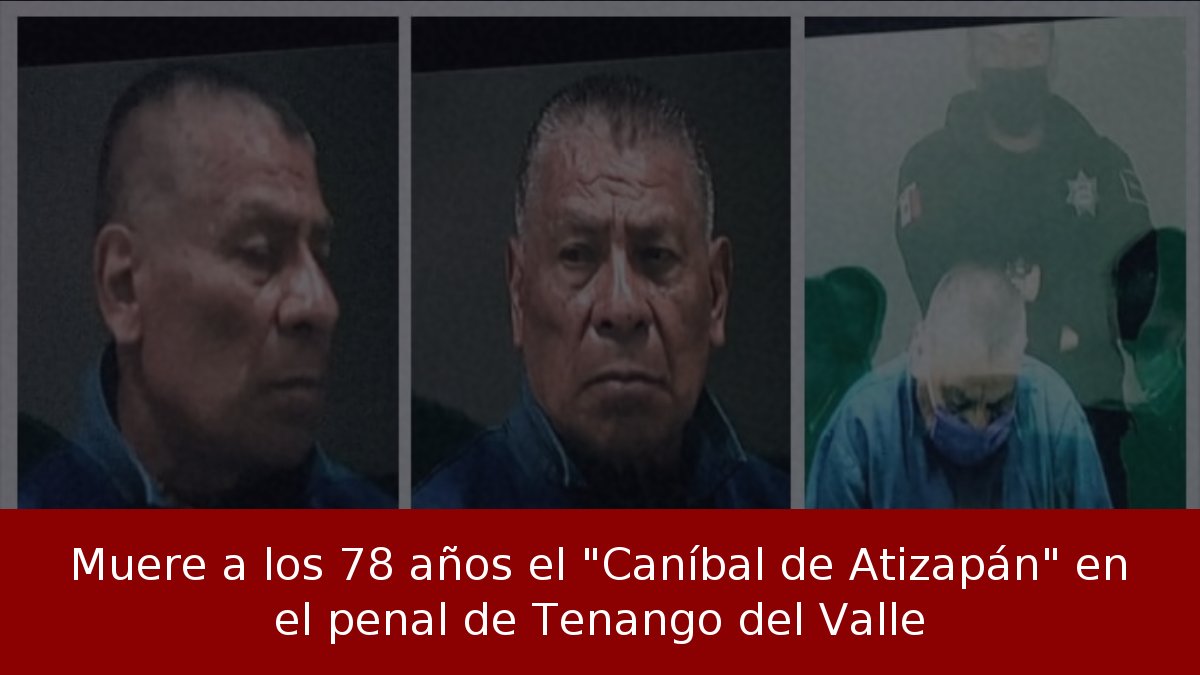
Andrés Filomeno Mendoza Celis, known as the "Caníbal de Atizapán," died at 78 in his cell at the Tenango del Valle prison in October 2026 from natural causes tied to chronic respiratory complications and uncontrolled type 2 diabetes. He was serving a life sentence and had accumulated additional convictions for femicide, homicide, and forced disappearance after authorities found human remains and belongings of his alleged victims at his home in Atizapán de Zaragoza.
- Death: Mendoza Celis died at 78 in the Tenango del Valle Center for Social Reintegration and Penitentiary due to chronic respiratory complications and uncontrolled type 2 diabetes.
- Prior conditions: He suffered from tracheal stenosis and nosocomial pneumonia, which led to his transfer in 2025 from the same prison.
- Accumulated sentences: He received life imprisonment, a 92-year term, and six 55-year sentences handed down between March 2022 and February 2024.
- Findings at the home: Authorities located between 4,300 bone remains and 4,600 human fragments, linked to at least 19 victims.
The case that shocked Atizapán de Zaragoza
The investigation began on May 15, 2021, when Mendoza Celis was arrested following the femicide of Reyna González Amador. The victim's husband, an active police officer, went to the property without confronting him and later returned with a patrol car. Officers found the woman lifeless in a hidden room in the basement.
Subsequent inspections of the home revealed an excavated area beneath the structure, covered by a concrete floor. To break the ground, authorities used heavy machinery and tools. Inside, they found between 4,300 bone remains and 4,600 human fragments.
Forensic analyses and DNA tests linked the findings to at least 19 victims: 17 adult women, one child, and one man. Investigations also connected him to up to 30 homicides committed over nearly three decades.
Among the possible victims was Édgard, a seven-year-old boy and son of María Mares. As of February 22, 2022, authorities in the State of Mexico had identified six of the 19 people who may have been killed inside the property.
Credentials, clothing, and videos in the house of horror
At the Atizapán de Zaragoza home, officials also found official credentials, clothing, footwear, bags, and women's accessories, as well as photographs and notebooks with names and descriptions of people. Agents seized VHS and 9-millimeter video tapes documenting attacks on his victims.
The judicial file resulted in eight convictions issued between March 2022 and February 2024. In addition to life imprisonment, Mendoza Celis received a 92-year prison sentence and six 55-year sentences for femicide and crimes related to homicide and forced disappearance.
In June 2022, the Supreme Court of Justice of the Nation premiered the documentary miniseries Caníbal, indignación total, dedicated to the crimes attributed to Andrés Filomeno Mendoza Celis. The production addressed the case with the aim of exposing femicides and their consequences in Mexico.
The notebook and testimonies that described the crimes
Videos and photos from inside the house circulated during the investigation, showing the rooms he rented to a couple and their children, the secret basement where he dismembered his victims, and a notebook with chilling details in which he recorded the weight of each body part and the date of the crime.
In a video broadcast by journalist Carlos Jiménez, a tour was shown of the house where Andrés lived for more than 30 years and where he may have killed around 29 victims, according to his notebook, as detailed by Dilcya García, Central Prosecutor for Gender of the State of Mexico Prosecutor's Office. In those notes, one record was from 1994, meaning he apparently had been doing the same for nearly three decades.
In his home there was a single bed, piled-up objects, furniture where he hung photos of himself at political events, a cupboard, and disordered clothing. It is believed he lured women to the basement so their screams would not be heard, offering them support, food baskets, and work based on his community participation position.
Mendoza Celis said he sometimes practiced cannibalism and added that his experience as a butcher allowed him to know how and where to cut the meat. Although his lawyers suggested he reserve his right to testify, he stated:
"Lo hecho hecho está, sólo quiero decir la verdad, ahí está el esposo (de Reyna), él vio todo".
He only cried when told that he would not leave prison for the crimes, but did not cry when narrating how he killed and dismembered his victims one by one. He detailed that he chose them for being pretty but killed them when they rejected him, which is why he wanted to preserve their faces; he tore them off carefully along with their scalps after stabbing them in the heart.
His first victim was Norma "N", who disappeared on August 6, 2011, in the municipality of Tlalnepantla, State of Mexico; according to her disappearance file, she worked at a bar called "El Barrigón." The second was Berenice Sánchez Olvera, around 20 years old, who worked at the bar "El Marinero." He also courted two more women who again rejected a romantic relationship: Alyn and Gardenia, whom he met at "El Barrigón" and for whom no identification file exists.
In 2016 he met Flor Ninive at another bar, who also worked as a waitress; he invited her to eat and gave her gifts, but she also refused to be his romantic partner, so he killed her in October of that year. Rubicela, a food delivery app worker, was seen by him when she went to pick up an order at a restaurant, and he kidnapped her there; he liked her so much that he wanted her only for himself and ended her life in 2019.
Bruno, husband of Reyna González, the victim through whom he was discovered, gave a statement describing how he said goodbye to his wife on Friday at five in the morning and then went to work. She told him she would go buy cell phone parts that day, as that was her trade, so she arranged to meet Andrés, but never returned. The next day he forced his way into the 72-year-old man's home and found the gruesome scene of his wife dismembered on a dining table.
The husband of Reyna González, mother of two little girls aged four and eight, asked that it stop being mentioned that she had a relationship with this man and explained that he was a family friend whom they pitied and tried to support financially because of his advanced age, so they fully trusted him.
"Mis hijas no pueden ver la televisión porque dicen que ella tenía una relación extra marital, lo cual no es cierto, no sé si él lo inventó", said the man through whom Andrés "N" was arrested and who acknowledged they helped the elderly man because of his age and even invited him to eat at their home.
All of Mexico was horrified because it was not the only body: police found skulls and several bones, but the most chilling were flayed faces with complete scalps, well preserved. This man's skill at cutting skin was explained by neighbors' testimonies, who reported that he worked for several years at a meat processing plant for human consumption in Tlalnepantla. The cuts to separate skin from muscle were very precise; he also preserved them with salt to remove moisture and keep them in good condition.
With the death of Mendoza Celis, the judicial chapter of one of the most documented serial violence cases in the State of Mexico closes, although investigation files and pending proceedings regarding still-unidentified victims keep forensic review open. The case leaves pending both the full identification of the people whose remains remain unnamed and attention to the families who for years demanded answers from state authorities.