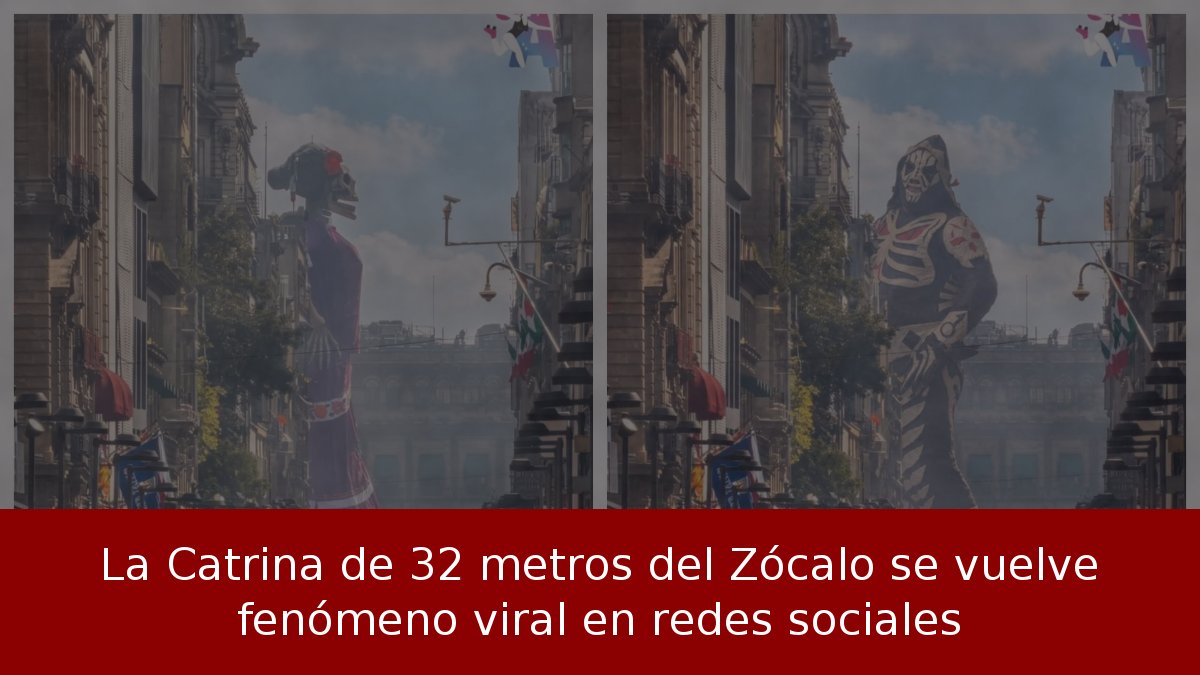
The giant Catrina in the Zócalo draws crowds not only because it stands over 32 meters tall. The Day of the Dead installation has also taken over social media, where users turn it into a creature that roams Mexico City, appears alongside giant robots, and even threatens the Torre Latinoamericana. The sculpture is aiming for a Guinness record as the world's tallest Catrina. It remains in the Plaza de la Constitución until November 2, with free access 24 hours a day.
- Record in sight: the figure seeks the Guinness title as the tallest Catrina on the planet and stays in the Zócalo until this November 2, open to the public at no cost around the clock.
- Monumental scale: it exceeds the Christ the Redeemer in Rio de Janeiro by at least 2 meters and was built by the Taller de Arte Xibalbá after nine months of planning.
- Digital phenomenon: memes depict it as a movie-style menace, a visitor from another universe, or the star of impossible battles in the Historic Center.
From ceremonial installation to internet star
In posts circulating on X, TikTok, and Facebook, the figure stops being a Day of the Dead installation. It becomes a film-style threat, a visitor from another universe, and even a partner in an impossible battle on the streets of the Historic Center. One of the most shared memes starts with an edited image in which the Catrina walks among buildings of the Historic Center. The scene shows smoke, fires, and people running, as if the figure had awakened and begun to destroy the city.
Another montage plays with the phrase: “Psychologist: La Sheinbaumzilla doesn't exist.” Then the supposed creature appears, a mix between the monumental Catrina and a Japanese movie monster. The joke gains force from the real height of the installation.
Other images use the scene of a giant dog walking between skyscrapers. Instead of the animal, the post imagines the Catrina crossing the city streets “out of nowhere on a Thursday.” The humor lies in presenting the installation as an apparition that surprises anyone during their daily commute.
Engineering and production behind the figure
The project began with an original request to build a 30-meter figure, but the team proposed enlarging it to set distance from the current record. The structure uses between 21 and 22 tons of steel, plus about 70 tons of concrete ballast. The material allows the figure to withstand wind and possible seismic movements without needing a foundation on the Zócalo plaza.
The purple dress also involves off-scale numbers. Production required between 3,000 and 3,500 linear meters of fabric, plus about 3,000 meters of LED lights that illuminate the body and bones from inside at night.
Assembly took between eight and nine days. 140 people from the workshop participated, and more than 200 when adding crane, tent, supplier, and cleaning services. The figure arrived in the Historic Center in parts and was assembled on site like a puzzle.
The installation is surrounded by about 100,000 cempasúchil flowers and elements from the Ajolotes en el Corazón exhibition. It also pays tribute to José Guadalupe Posada, author of the Calavera Garbancera, an image that over the years became the Catrina.
Science fiction and horror comparisons
Scale is again the center of the joke. At over 32 meters, users imagine it above houses, street stalls, billboards, and multi-story buildings. One montage places the figure on a Historic Center street next to an Optimus Prime. The image simulates a science fiction showdown seen from afar, with pedestrians walking as if they didn't notice two characters of impossible proportions occupying the avenue.
The post is accompanied by the meme format “I had a really weird dream. And what did you dream? The dream:”. The answer is a city invaded by the Catrina and a robot, with a scene that seems taken from a monster movie.
Comparisons also reach the metal realm. Users imagine that even Ktulu, a creature inspired by the H. P. Lovecraft universe and present in the title of Metallica's instrumental “The Call of Ktulu,” peeks into the Zócalo to meet the giant Catrina. The idea fits with montages that show the figure as if it had stepped out of a horror film or a battle between kaijus. The Catrina appears amid smoke, destroyed buildings, and fleeing crowds, far from the static image received by those who visit it in the Plaza de la Constitución.
Memes also place the Catrina next to the Torre Latinoamericana, among the streets of the Center and in front of constructions that allow the size of the installation to be gauged. The real image is enough to draw attention; the altered versions do the rest.
The exhibition ends this Monday, November 2. During these days, the Catrina remains in the Zócalo, while social media already takes it to scenarios ranging from a monster invasion to a strange dream in the middle of the Historic Center. The phenomenon confirms how a ceremonial piece can become viral content and a new pop symbol of the capital, amplifying its reach beyond the physical plaza.