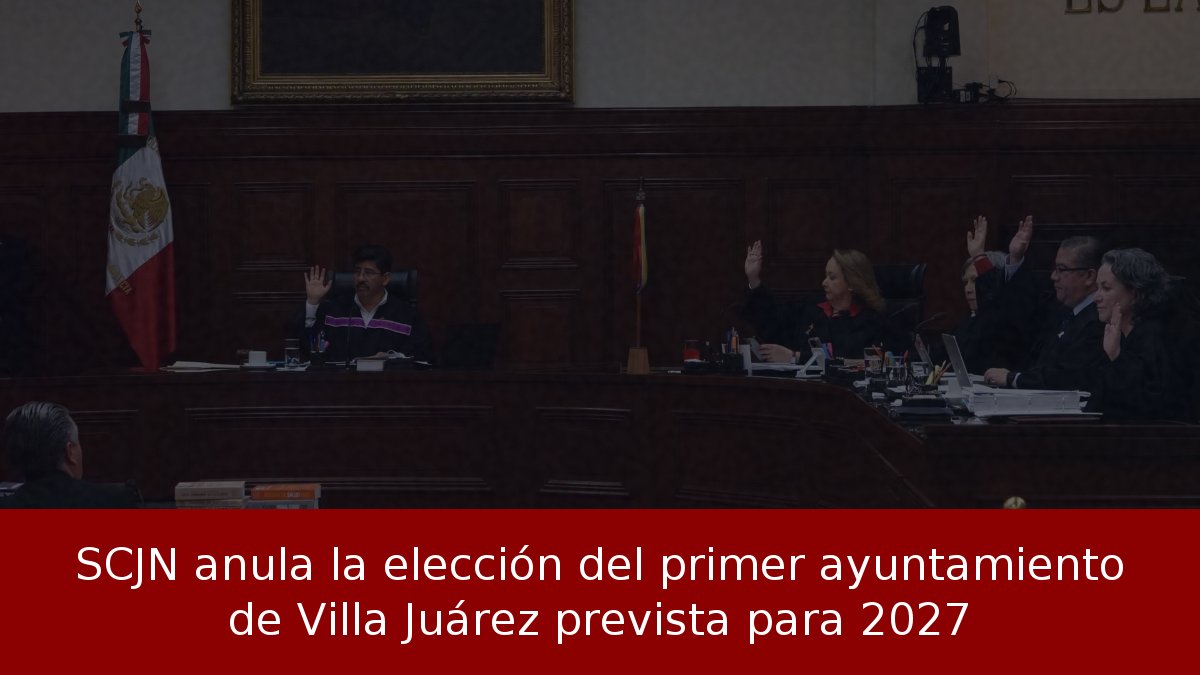
The Pleno of Mexico's Supreme Court (SCJN) struck down the electoral provisions of the decree that created the municipality of Villa Juárez, Aguascalientes, finding that only 32 days passed between its publication and the start of the local electoral process. The ruling was issued on October 29, 2026, in the acción de inconstitucionalidad 125/2026.
- Missed deadline: The decree was published on September 7 and the local electoral process began on October 9, a gap of 32 days against the 90 required by Article 105 of the Constitution.
- Annulled articles: The Pleno invalidated the second and third transitory articles of Decree Number 566, which provided for the election of the first ayuntamiento in the 2027 elections and the installation of a Provisional Municipal Council.
- Recognized powers: The Court acknowledged that the Congress of Aguascalientes may create municipalities, but stressed that this authority must respect the Constitution's electoral restrictions.
The timeline that triggered invalidation
According to the high court, any rule affecting an election must be published at least 90 days before the process begins, as Article 105 of the Constitution establishes. In this case, the decree was published on September 7 and the local electoral process started on October 9, so the temporal requirement was not met.
The second and third transitory articles of Decree Number 566 stipulated that the first ayuntamiento of Villa Juárez would be elected in the 2027 elections and would take office on October 15 of that year. They also allowed the Congress of Aguascalientes to appoint a Provisional Municipal Council to operate from January 1 to October 14, 2027.
Effects of the ruling
The judgment also left without effect, by extension, the rules on the council's functions, the transition to the first popularly elected ayuntamiento, and other electoral obligations tied to the 2026-2027 process.
The SCJN recognized that the Congress of Aguascalientes has the power to create municipalities, but specified that this authority must be exercised without contravening constitutional electoral restrictions and taking into account its effects on the organization of elections and citizens' political-electoral rights.
Other territorial criteria from the Pleno
In a separate ruling on June 2, the Court invalidated an official letter that assigned Maloapan to the municipality of Hueyapan, Puebla, because the state's Registral and Cadastral Institute based that definition on Inegi's Geo-statistical Framework rather than a determination by the local Congress. As a result, the community remains without a definitive territorial definition amid a dispute that also involves Atempan.
The Pleno resolved Controversia Constitucional 223/2023 and established that only the Congress of Puebla can set or modify municipal boundaries. An administrative agency cannot substitute that power under the constitutional and legal framework, according to the official statement.
There is currently a procedure before the Puebla Congress, promoted by Hueyapan, to resolve the territorial competence conflict over Maloapan. The Pleno considered that proceeding when analyzing whether there was legislative inaction and concluded that current regulations do not impose on the state Legislature the constitutional obligation to initiate that process on its own.
The lack of certainty, the Court warned, violates the principle of legal security under Articles 14 and 16 of the Constitution, as well as municipal powers under Article 115, sections II, III and IV.
In another matter, on November 11, 2021, the Pleno determined that the 160,000 hectares of the Los Chimalapas jungle belong to Oaxaca and not Chiapas, with 10 votes in favor and one against. The ruling placed the Chiapas municipality of Belisario Domínguez, created in 2011 and covering 84,000 hectares, within Oaxacan territory, though it did not by itself resolve a community conflict lasting more than half a century. The draft by Justice Fernando Franco González Salas set the border between the two states from the Tonalá sandbar at 16 degrees north latitude to the Chilillo hill.
With the annulment of the electoral provisions, the Congress of Aguascalientes must adjust the calendar and transition rules for Villa Juárez, while the Court maintains a strict standard on the deadlines that protect electoral certainty and on the exclusive power of local congresses to define municipal boundaries.