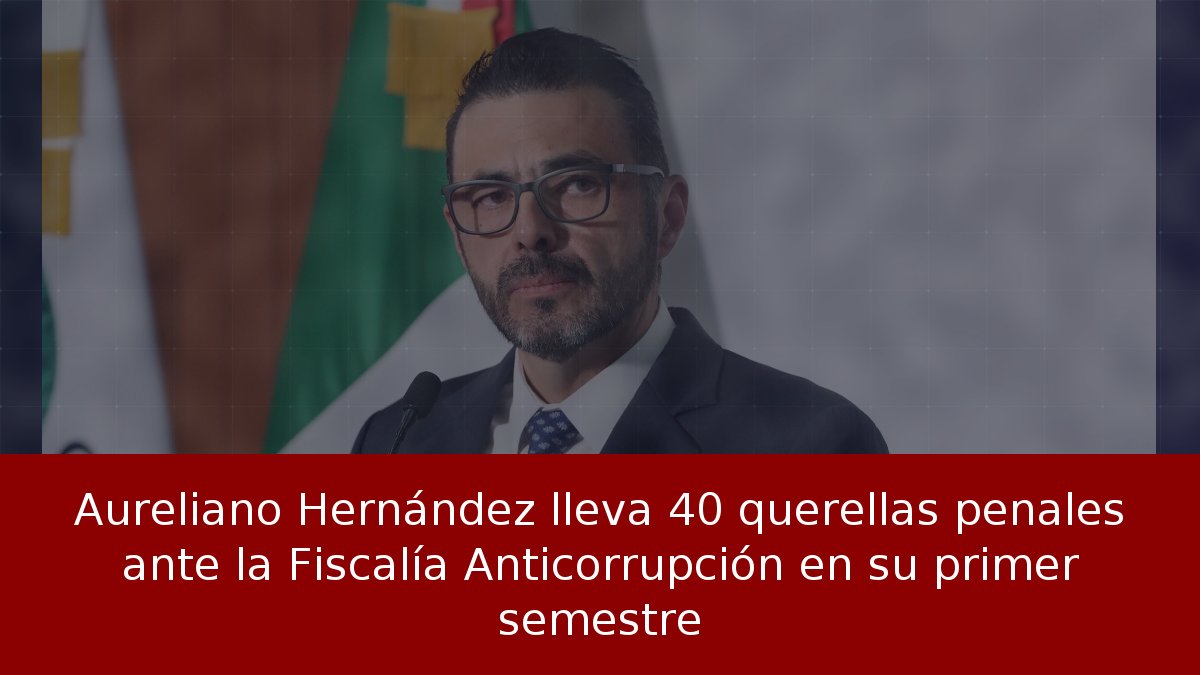
The Auditoría Superior de la Federación (ASF) has filed 40 criminal complaints with the Specialized Prosecutor's Office for Combating Corruption in the first six months of Aureliano Hernández Palacios Cardel's tenure, with investigations into alleged resource triangulation in Nuevo León and Sinaloa standing out.
- Complaints: 40 criminal complaints filed; the 21 from the previous report have already been judicialized.
- Emblematic cases: Nuevo León and Sinaloa, for alleged triangulation and simulation of operations with transfers to accounts of relatives of public servants.
- 2025 Public Account: 374 individual reports and more than 9 billion pesos pending clarification across the three levels of government.
Auditing with legal consequences
In his appearance on October 30, 2026 before the Chamber of Deputies, within the ASF's Oversight Commission, the auditor maintained that the institution seeks to prevent audit observations from remaining mere findings without legal effect. In addition to the 40 complaints, he stressed that for the first time three criminal complaints were filed linked to audits still in progress, that is, before the review was formally concluded.
The files cover alleged irregularities such as public works paid for but not executed, high-specialty medical equipment that could not be located, and allegedly apocryphal documentation used to simulate payment of social security contributions, affecting the State and workers.
Auditing must not remain solely in the identification of irregularities, but must advance toward investigations and legal actions against those responsible, Hernández Palacios stated.
Triangulation and relatives' accounts
Regarding Nuevo León and Sinaloa, the ASF head explained that intelligence work detected alleged schemes of triangulation and simulation of operations, as well as patterns of transferring public resources through payments to suppliers. The final destination of those funds would be related to bank accounts of individuals and legal entities with family ties to public servants.
The auditor did not present a breakdown of amounts per entity nor identify the persons or companies under investigation, but affirmed that the Audit Office uses its new legal powers to reconstruct financial operations, locate possible beneficiaries and preserve evidence. He also warned that the institution will act without distinctions by position, agency or level of government when there are elements justifying an inquiry.
More than 9 billion pending clarification
Along with the complaints, Hernández Palacios delivered the second batch of individual audit reports for the 2025 Public Account: 374 reports, of which 42 correspond to municipalities, 286 to states and 46 to federal entities. The result shows more than 9 billion pesos pending clarification across the three levels of government.
At the state level, more than 1.2 billion pesos were registered for clarification, mainly in education and health; before concluding the reviews, audited entities reimbursed 1.132 billion pesos, of which 553 million came from the health sector and could have been allocated to medicines, supplies, equipment and better care conditions.
In municipalities, the 42 audits left more than 5.2 billion pesos without proof of destination, after reviewing 100 percent of federal resources delivered to those governments. Among federal findings he mentioned the Special Fund for Agricultural Financing and the Federal Educational Authority of Mexico City, with observed amounts of 2.327 billion pesos.
The auditor also reported 60 promotions of the exercise of fiscal verification powers, with notifications to the Tax Administration Service (SAT) and the Mexican Social Security Institute (IMSS) for possible noncompliance in contributions and fees. To this are added nine criminal complaints for coyotaje practices, reiterating that the ASF has no managers or private representatives for auditing procedures.
As part of strengthening investigations, he highlighted agreements with the Financial Intelligence Unit (UIF) and the National Antimonopoly Commission to expand information exchange and detect risk operations, conflicts of interest, improper agreements and anticompetitive practices in public procurement. He also proposed a platform for governments ending their terms to upload pending public account information directly to the Audit Office's servers, and warned that denying documentation to obstruct auditing will have legal consequences.
With the reforms approved in May 2026, the ASF seeks to move from detecting unverified money to clarifying who received the resources, how they were used and who might be involved. The scope of those investigations, especially in Nuevo León and Sinaloa, will mark the litmus test for the agency's new phase and for its relationship with state governments whose accounts remain under scrutiny.