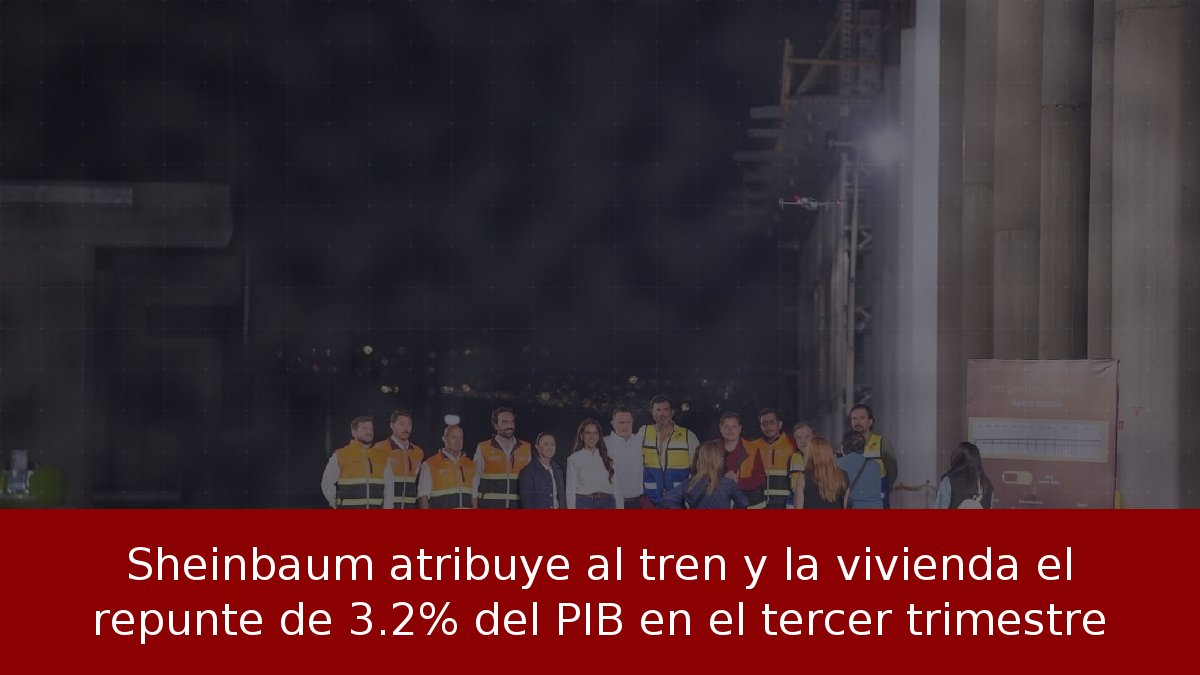
Federal programs for passenger rail and housing have become the main engines of public works in Mexico, contributing close to one percentage point of Gross Domestic Product (GDP) this year, President Claudia Sheinbaum Pardo said during a supervision visit to the Mexico City–Querétaro–Guanajuato train works.
- Economic driver: rail and housing programs added nearly one percentage point to GDP this year, according to the president.
- Growth beat forecasts: Inegi reported annual growth of 3.2% in the third quarter of 2026, above estimates that projected less than 1%.
- Rail construction underway: at least 2,500 kilometers of tracks are being built, of which about 300 are for freight.
- Key date: the first train of the Mexico–Querétaro project will arrive in June 2027 to begin testing.
Growth that exceeded forecasts
Flanked by PAN governors Libia Dennise García Muñoz Ledo of Guanajuato and Mauricio Kuri of Querétaro, the president argued that public investment in infrastructure is having a positive effect on the national economy, especially against forecasts that anticipated lower growth than was recorded in the third quarter of 2026.
Sheinbaum recalled that, based on data from the National Institute of Statistics and Geography (Inegi), Mexico's economy grew 3.2 percent annually in that period, a figure higher than estimates pointing to an advance below one percent.
The president attributed part of that result to infrastructure projects promoted by her administration, especially the construction of new rail lines and housing development.
“Siempre dije: es que no cuentan con la obra pública y la vivienda que estamos construyendo. Y está mostrando sus resultados”, she said during the tour of rail works in Guanajuato.
More than 2,500 kilometers of tracks under construction
As part of the federal strategy to recover and expand rail transport, Sheinbaum detailed that at least 2,500 kilometers of tracks are currently being built in different regions of the country. Of that length, around 300 kilometers correspond to infrastructure for freight transport, while the rest is part of projects to establish new passenger train routes.
The president explained that these systems will not only connect different cities but will also serve a metropolitan transport function in some urban areas. To illustrate the scope of the projects, she compared the construction of the new rail routes to the development of collective transport systems such as the Metro, because they will improve mobility within major urban concentrations.
The strategy aims to expand travel alternatives for the population, reduce travel times and strengthen connectivity between municipalities and cities.
Querétaro-Irapuato segment: jobs and progress
During the supervision, Andrés Lajous, head of the Agency for Trains and Integrated Public Transport, presented progress on the Querétaro-Irapuato segment, which is approximately 102 kilometers long.
The official explained that the project includes the construction of 10 viaducts, a tunnel in Celaya and stations in six Guanajuato localities: Apaseo, Celaya, Cortazar, Villagrán, Salamanca and Irapuato.
According to data presented during the tour, the works currently generate 3,365 direct jobs and around 5,700 indirect ones. Together, the construction of this rail segment represents more than 9,000 sources of work, including positions directly linked to the works and activities related to the supply chain and services.
Lajous also announced that the first train of the Mexico–Querétaro project will arrive in June 2027, when the corresponding tests will begin ahead of its entry into operation. This announcement represents one of the next milestones of the federal rail program, which seeks to restore passenger rail transport and establish new connections between different states.
Name change and closure of a dump
Another announcement made during the presidential visit concerned the viaduct built over the municipal dump, until now known as Viaducto Basurero. From that point, Sheinbaum requested changing the structure's name, considering it necessary to give it a different designation.
At the end of the event, the president told the media that the viaduct will be named Viaducto Apaseo. She also said she agreed with Guanajuato Governor Libia Dennise García to move forward with closing the municipal dump located in the area.
With these works, the federal government seeks to consolidate a passenger rail network and strengthen public investment as one of the components of its economic strategy. The immediate challenge will be to sustain the construction pace and meet the June 2027 date for the first tests of the Mexico–Querétaro train, a milestone that will serve as a gauge of the promise to revive rail travel.