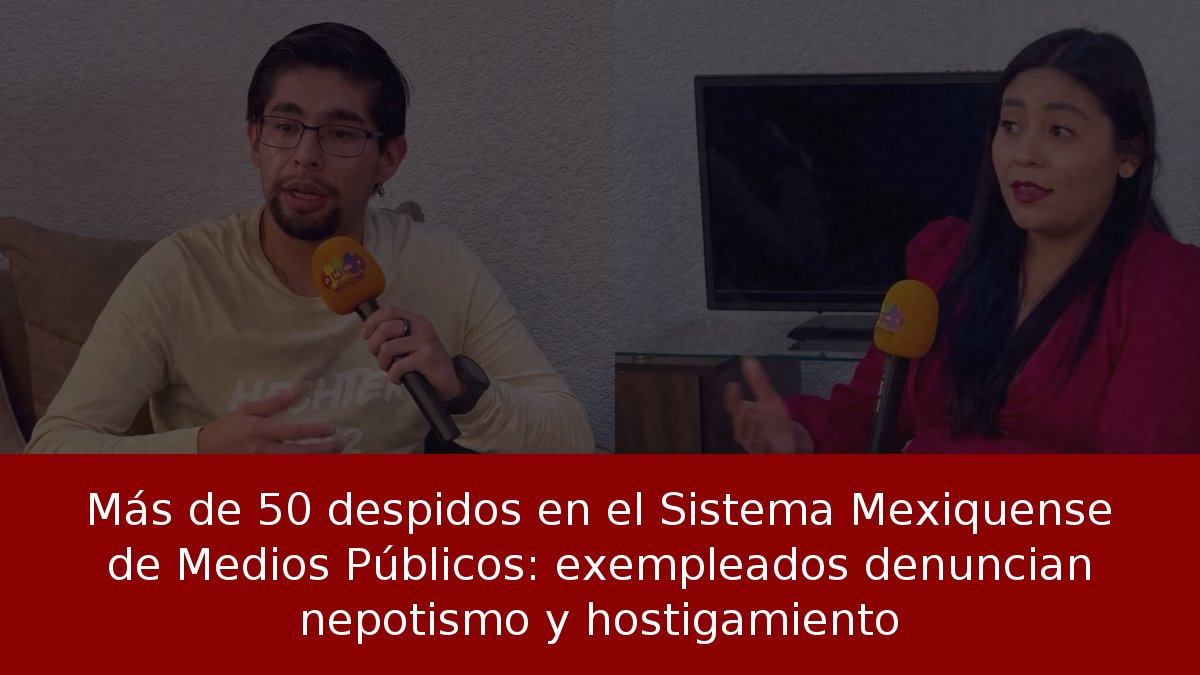
Over 50 employees of the Sistema Mexiquense de Medios Públicos have reportedly been dismissed under the current administration led by Carlos Brito Lavalle, amid allegations of nepotism, workplace harassment, favoritism and precarious working conditions. Two former workers, Fernanda and Diego, publicly denounced these irregularities to local outlets Periodismo Humanista Mexicano and Reporte Valle Toluca, stating that such practices have occurred within Radio y Televisión Mexiquense.
- Mass dismissals: more than 50 employees reportedly lost their jobs at the Sistema Mexiquense de Medios Públicos.
- Whistleblowers: Fernanda and Diego, two former employees, described the irregularities to local media.
- Call to the governor: both asked Delfina Gómez Álvarez to review what is happening at the state public broadcaster.
In an interview shared on social media, the two communicators recounted how their employment with the institution ended and requested that the governor of the State of Mexico, Delfina Gómez Álvarez, intervene to examine the situation at the state public media outlet.
Diego describes deteriorating work environment
Diego, who said he worked at the system for nearly a decade, explained that the arrival of the new administration at the end of 2025 or beginning of 2026 raised expectations among staff due to promises of salary improvements, better working conditions and the granting of permanent positions.
According to his account, over the months the work environment began to deteriorate and conditions became increasingly hostile. The former employee also noted that, from the start of the new administration, employees were dismissed without, in his view, clear explanations for those decisions.
Fernanda denounces alleged workplace harassment
Fernanda, who had been at the institution for about six months, said she began to notice a change in how she was treated starting in March 2026, after taking part in an activity organized by the Instituto Electoral del Estado de México (IEEM).
The communicator explained that on March 5 she presented the talk El arte como protesta en movimientos feministas, in which she shared her artistic and photographic work. The activity was attended and accompanied by electoral counselor Karina Vaquera.
However, she said she later received messages through an intermediary informing her that some people within Mexiquense were unhappy with her participation in that activity because of her relationship with the electoral counselor. According to her version, she was told to avoid contact with Vaquera and other institutions, even though she had no confidentiality agreement preventing her from pursuing professional activities outside the television station.
Fernanda stated that after that episode, work demands increased, even outside her working hours. She recounted receiving calls from seven in the morning requesting information and materials in real time, as well as assignments for different news areas and digital platforms.
She also denounced difficulties in getting her stories published, which forced her to insist with editors and newsroom staff to fulfill the assignments she had been given. The journalist believed these demands were not solely due to production needs but were part of a dynamic to wear her down and push her to leave voluntarily.
“Yo no te voy a despedir, porque sé lo que eso implica. Quiero que tú te vayas por tu propio pie”, she said, describing what she considered a practice of workplace harassment.
Allegations of privileges and hiring practices
Another allegation raised during the interview was the existence of alleged privileges for certain workers who, according to Fernanda, obtained permanent positions and better working conditions regardless of other employees' seniority.
The communicator said some people could leave the premises, skip recordings or work remotely without being reprimanded, while other colleagues faced stricter demands to meet their responsibilities.
Diego also questioned the hiring scheme under which, he claimed, personnel were brought in as freelancers, a situation he described as possible contractual simulation. The former employee considered these practices reflect a management problem rather than a lack of ability among new hires. He also maintained that staff with more than 10 or 20 years of experience, who know how a public media outlet operates, have been displaced.
Both communicators noted that the dismissals have affected people who depend on that income to support their families. Diego mentioned that among those affected are workers with children and relatives with disabilities.
Given this scenario, Diego made a direct call to governor Delfina Gómez to review working conditions within the Sistema Mexiquense de Medios Públicos. He clarified that his statements aim to demand that authorities learn about the alleged irregularities that, he said, occur under the current leadership.
Fernanda agreed with the request and said the governor should know how workers at an institution that regularly accompanies her activities and tours across the State of Mexico are treated. The journalist expressed that uncertainty prevails among employees, who, according to her testimony, go to the facilities fearing that any workday could be their last.
About her departure, she said she felt disappointed, as she considered TV Mexiquense a reference institution for training journalists and communicators. She also regretted that her career at the station ended due to circumstances she attributed to personal interests. Finally, Diego shared a farewell message to his former colleagues, in which he questioned the silence that, out of fear or necessity, he said prevailed in the face of situations they considered unjust.
The denunciations place the management of Carlos Brito Lavalle at the head of the organization under scrutiny and pose a challenge for the government of Delfina Gómez, who must decide whether to open a formal review of working conditions at the state public media outlet, while the affected former workers await an institutional response.