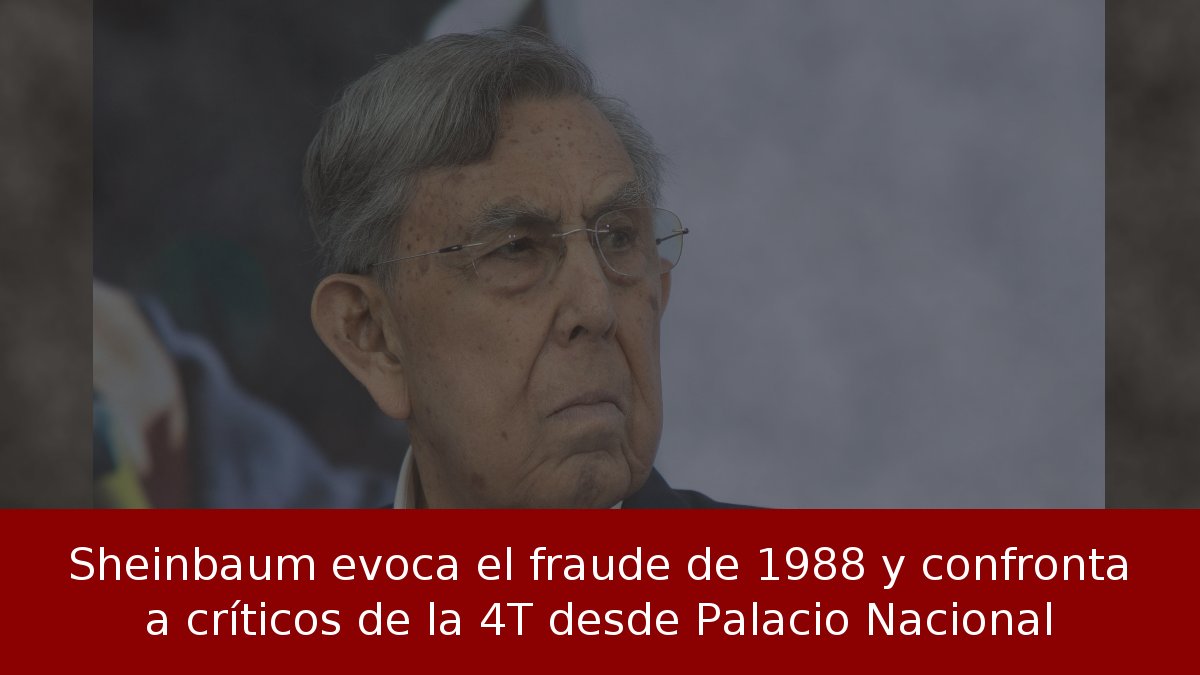
During her morning press conference at the National Palace, President Claudia Sheinbaum Pardo invoked the legacy of Cuauhtémoc Cárdenas and the 1988 election, delivering a message that mixed tribute to the late leftist leader with sharp criticism of opposition politicians, intellectuals, and detractors of the so-called Fourth Transformation movement. She argued that the memory of those elections must be passed on to generations who did not experience them, because, she said, they shaped positions that still structure public debate today.
- Historical memory: Sheinbaum called for preserving the history of the 1988 electoral fraud as a reference for those who did not live through that period.
- Freedom of expression: She claimed that conditions for questioning power were not the same in the 1980s and 1990s as they are now.
- Criticism: She named “Goldenberg” and Aguilar Camín as among those who, in her view, abandoned Cárdenas after the mobilizations.
The PRI split and the unrecognized victory
In her remarks, the president recalled that the breakaway of members of the Institutional Revolutionary Party (PRI) who opposed neoliberalism and supported democracy became a majority within a few months. According to her account, Cárdenas was not recognized as the winner and Carlos Salinas de Gortari took the presidency “against the will of the people.”
Sheinbaum insisted that this episode must be kept alive as a turning point that defined sides and that, in her judgment, remains present in today's political confrontation. The president argued that the history of the 1988 elections, when Cárdenas first ran for the presidency, is essential for understanding the positions now competing in the public sphere.
“The moment of freedom we live today did not exist in the eighties or the nineties,” she said at the National Palace.
Criticism of those who did not join the mobilizations
The president also aimed her message at those who, from her perspective, did not support the mobilizations that followed the 1988 election. In that context she mentioned by surname “Goldenberg” and Aguilar Camín, whom she accused of abandoning Cuauhtémoc Cárdenas with the argument that fraud had not been proven.
With those references, Sheinbaum drew a parallel between the historical debate and current political discussion, placing critics of the ruling movement in the same line as those who, according to her version, turned their backs on the democratic cause of the late 1980s. The president maintained that freedom of expression and the ability to question power that, she asserted, exist today did not have the same conditions during the governments of those decades.
A message with a present-day political reading
The use of Cárdenas's legacy at the morning press conference was not limited to historical terrain. By drawing a parallel between 1988 and the current moment, the president sought to draw a boundary between those who support the Fourth Transformation and those who question it, in a context marked by the death of the leftist leader.
The intervention suggests that the ruling party will continue to invoke foundational episodes of Mexican democracy to position its adversaries and to vindicate its own narrative. The debate over what happened in 1988 and over the role of those who then distanced themselves from Cárdenas is likely to remain on the public agenda in the coming days.