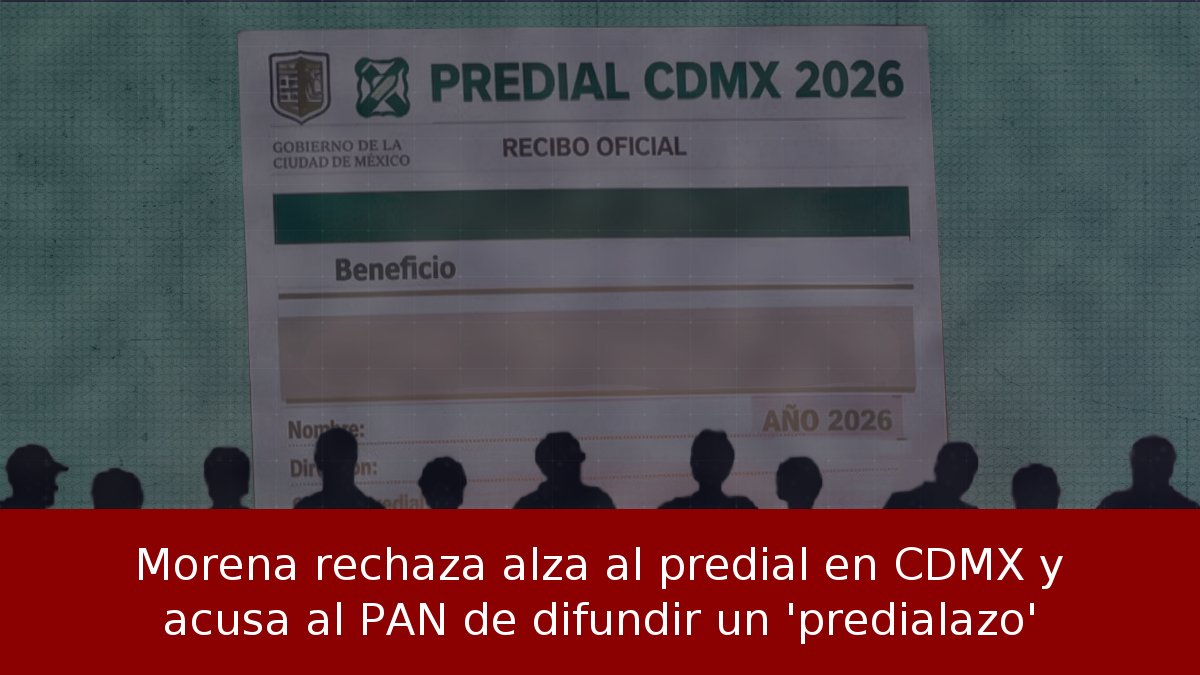
The Morena party in Mexico City has maintained that property taxes will stay flat in 2027 and has blamed the National Action Party (PAN) for circulating misleading claims about a possible increase connected to the General Law for Cadastral and Registry Strengthening and Harmonization. Deputy Ángel Tamariz Sánchez, who speaks for Morena in the capital’s congress, said at the La Chilanguera press conference that the opposition used language from the Valley of Mexico Metropolitan Zone Zoning Program to promote a “predialazo,” or sharp rise in the property tax.
- Key Point: Deputy Ángel Tamariz Sánchez affirmed that the property tax will not go up.
- Key Point: The controversy started after the release of the Valley of Mexico Metropolitan Zone Zoning Program and the approval of the General Law for Cadastral and Registry Strengthening and Harmonization on 6 October with 299 votes in favor.
- Key Point: Any future property tax change would require a proposal from the mayor and then debate and approval by the Mexico City Congress before being added to the local fiscal code.
- Key Point: PAN members allegedly handed out leaflets and posted messages in the capital’s streets warning property owners about higher taxes.
Morena calls the alleged tax hike a false narrative
Tamariz Sánchez explained that the subject had been clarified as soon as doubts emerged. Mayor Clara Brugada Molina, officials from institutions such as Sedatu, and Morena’s parliamentary group all rejected the idea that the zoning program included any increase. He stated:
“El predial no va a aumentar”
The deputy added that the PAN ran a campaign for several weeks around a measure that, according to Morena, was never planned. He said PAN members distributed flyers and spread messages in the streets to warn real estate owners about higher contributions. On 9 October, Brugada herself said that Mexico City would not raise the property tax and urged residents not to be deceived.
Why a cadastral law cannot trigger a local tax increase
Tamariz Sánchez stressed that a property tax increase cannot be applied through a territorial planning program or a cadastral law. A change of that kind would have to begin with a proposal from the mayor. After that, the Congress of Mexico City would need to discuss it and pass it before it could be added to the local Código Fiscal. The public debate arose after the presentation of the Valley of Mexico Metropolitan Zone Zoning Program and after the Chamber of Deputies approved the General Law for Cadastral and Registry Strengthening and Harmonization; that law was passed on 6 October with 299 favorable votes. The legislation provides for a Single Cadastral and Registry Certificate, a Single Cadastral Key for each property, and national platforms to align information across cadasters and public registries. According to the deputy, these measures are meant to standardize data rather than to alter local tax rates.
Rent control and anti-gentrification proposals
Tamariz Sánchez also pointed out that the mayor sent the Law on Fair, Reasonable and Affordable Rents to the capital’s congress. Its purpose is to combat gentrification and reinforce the right to decent housing. The deputy described a pattern that he said is spreading through different neighborhoods of the city and other world capitals: original communities are pushed out by increasing rents, a process in which platforms such as Airbnb have played a notable role. The proposed law creates a registry of lease contracts so that annual rent increases can be monitored and kept from exceeding inflation. Although that rule already exists in the Civil Code, it would now be enforced through a platform available to both landlords and tenants. The project also establishes the Ombudsman for Rental Relations, attached to the Social Prosecutors Office, to mediate disputes between property owners and renters. It likewise formalizes in law the Social Support Cabinet Against Evictions, which is intended to protect the human rights of people facing eviction. A caption in the original article announces a third march against gentrification in Mexico City, with credit to Jesús Avilés/Infobae México.
The dispute over the property tax shows how technical legislation can become political ammunition. Morena presents the new cadastral law as an administrative harmonization tool, while the PAN uses it to raise fears about increasing living costs. At the same time, the parallel rent law initiative demonstrates that the city government is attempting to address housing pressures, even as it firmly rejects the idea of a “predialazo” in 2027.