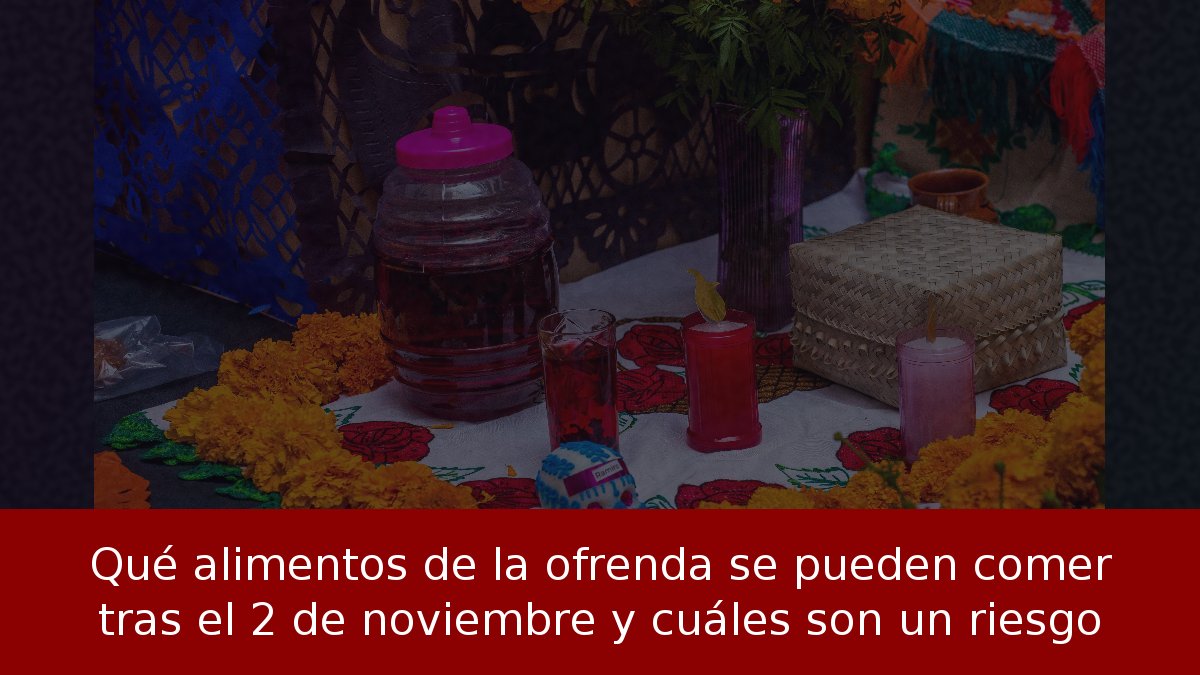
Once the souls have finished their visit—a period many families place between noon and 3 p.m. on November 2—the living may share and eat what remains on the altar. Yet not everything placed there is safe to consume: whether a food is edible depends on how long it sat at room temperature and on what it contains.
- Cultural rule: tradition holds that the offering must not be touched until the departed have consumed the essence of the food.
- Health limit: perishable cooked foods should stay out of the refrigerator no more than two hours, or just one hour when the ambient temperature exceeds 32 degrees Celsius.
- What to discard: dishes containing meat, chicken, fish, milk, cream, cheese, egg or mayonnaise, as well as the water left in the altar glasses.
The belief's origin and the moment to share
Research by the National Institute of Anthropology and History (INAH), documented in a community of Acaxochitlán, Hidalgo, explains the custom's roots. While the souls remain in the home, the altar food must not be handled by the living for any reason, since it is believed that if someone eats from the altar too early, the deceased will be angered or the person will suffer stomach illness.
At noon on November 2, the dead are considered to have departed, taking with them the food's essence—its vital force. After that moment, which some families mark with a blessing, food may be taken from the altar to be eaten privately or shared with guests.
The offering is not cleared all at once. According to the same INAH study, it is customary to dismantle it gradually over several days, unless the food is fully consumed and distributed the same day among relatives, friends or acquaintances.
Which foods keep and which pose a risk
The Secretariat of Health states that perishable cooked foods must not remain outside the refrigerator for more than two hours, a limit cut to one hour when room temperature rises above 32 degrees.
The UNAM, through its Alimentación y Salud platform, notes that fruits with peel and sugar, chocolate or amaranth skulls can be used provided they were kept under hygienic conditions and protected from dust. Traditional pan de muerto can also be salvaged if it shows no mold, abnormal dampness or changes in smell and texture; even if it loses softness over the days, it works for making French toast or puddings, according to the same university source.
Candies, chocolates and packaged products that remain sealed are also safe, as long as they have not expired and show no visible damage. Whole fruits should be washed before eating, and any with bruises or spots should be thrown out.
The issue is not that the food was part of an offering but how long it went without refrigeration. Dishes such as mole with chicken, rice, meat stews, broths, atole with milk and tamales require cold storage and should not sit at room temperature for more than two hours.
The United States Department of Agriculture (USDA) warns that contaminated food does not necessarily smell bad or look changed, and that reheating it does not guarantee it is safe again. Specialists therefore advise against tasting food to check whether it is still good.
Products containing meat, chicken, fish, milk, cream, cheese, egg or mayonnaise should also be discarded, as they are more prone to developing microorganisms. The water in the altar glasses should not be drunk either, since it can become contaminated with dust, insects or environmental microorganisms during the days on display.
Recommendations for setting up and taking down
The IMSS suggests placing prepared dishes only on the central day of the offering and avoiding leaving them exposed for long periods, also to prevent insects. One alternative is to use symbolic portions of the stews and keep the food meant for the family in the refrigerator.
IMSS specialists also remind people to moderate their consumption of pan de muerto, since a 100-gram portion provides about 400 calories.
Signs of spoiled food include mold, color changes, bad odor, slimy texture, excessive moisture or the appearance of insects.
Cempasúchil flowers whose petals remain in good condition can be reused in crafts or added to home composting, while papel picado, candles and copal in good shape are usually saved for the following year's celebration.
Tradition and food safety can coexist if the symbolic value of the offering is distinguished from the actual conditions in which the food was kept. Respecting the moment of the souls does not excuse anyone from checking each product before bringing it to the table: the health recommendation is clear that when in doubt, it is best to throw it out.