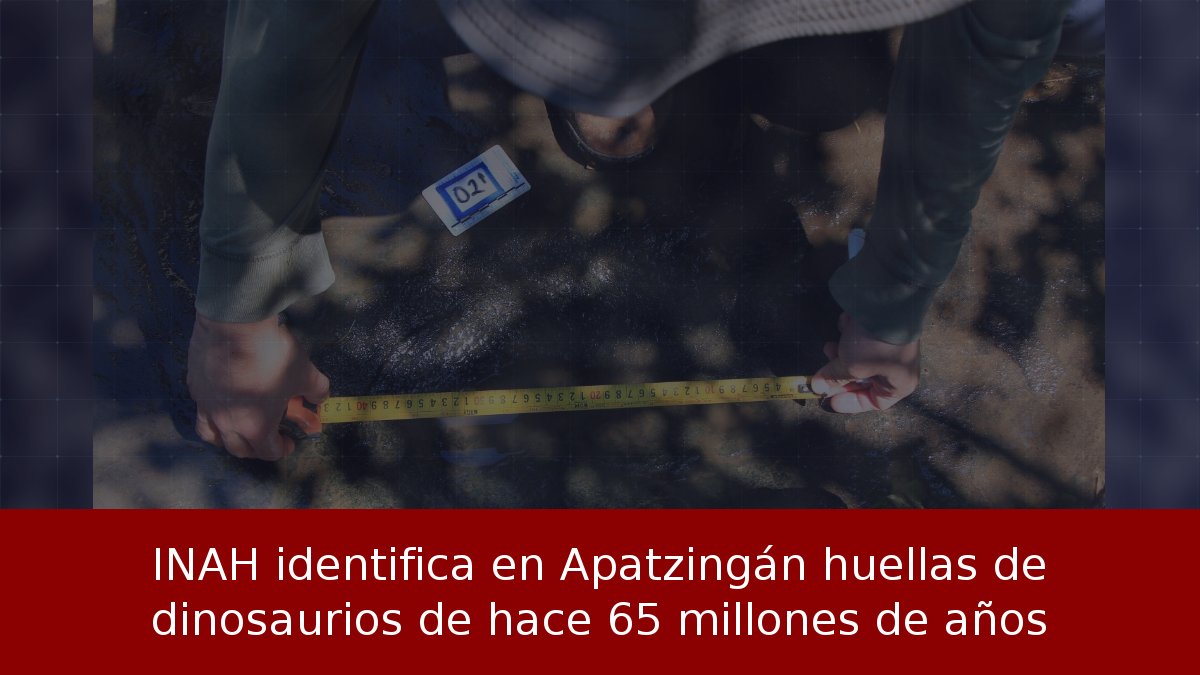
No fewer than fifty fossilized dinosaur footprints, left by several species, have been recorded by specialists from the Instituto Nacional de Antropología e Historia (INAH) in a stream bed at San Juan de los Plátanos, a community in Apatzingán, Michoacán. The federal Culture Secretariat agency said the trackmakers roamed there roughly 65 million years ago.
- What was found: medium and large carnivore and herbivore tracks on sedimentary rock; an initial reading places them in three dinosaur groups, and more terrain remains unchecked.
- How it surfaced: residents reported marks they described as coming from “animales gigantes”; Centro INAH Michoacán sent researcher Raymundo Cervantes Barriga to issue an assessment.
- Size range: individual prints run from 12 to 48 centimetres long and reach 30 centimetres wide, with differing shapes, toe counts and depths.
- Fieldwork: documentation began on 21 October, using photogrammetry, casts and rock samples; part of the terrain is still unexamined.
From a local alert to a preliminary reading
Cervantes Barriga produced the first assessment for the Michoacán centre. Initial checks confirmed medium and large herbivore and carnivore tracks. The team expects the tally to rise because some ground remains unsurveyed. The prints rest on sedimentary rock at the river’s edge. The documented area spans 40 square metres, but the series could extend several metres beyond it.
No two marks are identical. Lengths fall between 12 and 48 centimetres, and widths can reach 30. Shape, size, toe number and depth led researchers to an early division into three dinosaur groups. That grouping still needs confirmation through the palaeontological protocols under way at the site.
Claudia Curiel de Icaza, Mexico’s culture secretary, praised the residents who raised the alarm, saying their notice set the specialists’ work in motion. She also said INAH must study and protect the location so the evidence survives for future generations.
“Estas huellas nos acercan a una historia del territorio mexicano de hace millones de años”, afirmó Curiel de Icaza.
Three possible trackmakers
Cervantes Barriga preliminarily linked some footprints to a family of large carnivorous theropods. They could stand four metres tall and left three-toed marks. The palaeontologist said those traces might belong to tyrannosaurids. That remains an early hypothesis based on the prints’ morphology, not a final identification.
A second set belongs to smaller creatures, up to two metres tall, resembling raptors in the Dromaeosauridae family; their prints also show three toes. The third category covers duck-billed herbivores, or Hadrosauridae, which could reach four metres in height and left three-toed tracks with rounded tips.
Cervantes Barriga placed these dinosaurs in the Late Cretaceous. In his view, the region must then have held bodies of water that the animals approached to feed.
Mapping the rock, guarding the record
An INAH team started documenting and registering the site on 21 October. Work includes rock study, casts and images to map print distribution. Geologist Jasinto Robles Camacho took substrate samples for examination of the area’s geology.
The archaeology unit of Centro INAH Michoacán is also involved. Archaeologists María Fernanda Cabrera and José Luis Punzo Díaz lead the photogrammetry, which should record the prints’ shapes and dimensions precisely. Biologist and palaeontologist José Luis Ávila handles casts; Carlos A. Hernández Luna assists preliminary identification. The team aims to establish how many species appear on Apatzingán’s rock surface.
“Todavía no se determina cuántas especies se vayan a identificar con los protocolos de estudio paleontológico”, precisó Punzo Díaz.
Punzo Díaz added that the variety of marks may expand knowledge about the dinosaurs that lived in what is now Mexico:
“la locomoción, la dirección de su marcha y, con ello, la convivencia entre especies, el comportamiento y la morfología”.
San Juan de los Plátanos would join three other Michoacán sites with earlier track records: Playa Azul (Lázaro Cárdenas), El Aguaje (Aguililla) and the Tiquicheo–Tuzantla boundary. A full confirmation would make Apatzingán the state’s fourth site. INAH lists just over 30 such sites nationwide, including Puebla, Coahuila and Oaxaca, with Michoacán among the states holding records.
The record is still in its first phase. The final species count, confirmation of initial hypotheses and INAH’s safeguards remain open. Because the tracks sit in a stream bed, conservation also depends on conditions beyond the team’s control. The significance is already clear: footprints from 65 million years ago showing several species sharing one setting and, as Punzo Díaz noted, possibly revealing how they moved, behaved and were built.