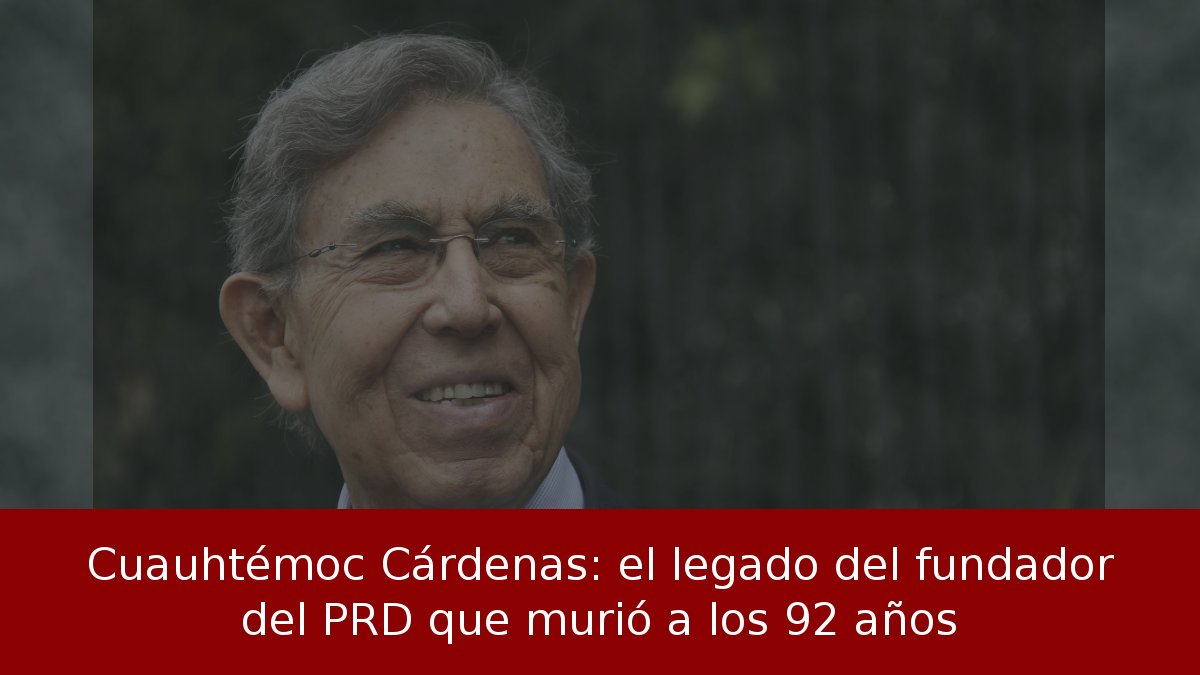
Cuauhtémoc Cárdenas Solórzano, founder of the Party of the Democratic Revolution (PRD) in 1989 and a central figure in Mexico's democratic transition, died this Wednesday, October 28, at the age of 92. He was a three-time presidential candidate and one of the most influential politicians in recent Mexican history.
- Death: Cárdenas passed away at 92 on Wednesday, October 28.
- Career: He served as senator for Michoacán (1976-1980) and governor of that state (1980-1986).
- Break with the PRI: In 1986 he promoted the Democratic Current, and in 1988 he led the National Democratic Front.
- Founding of the PRD: In 1989 he helped create the party, which he presided over until 1993.
- Mexico City government: In 1997 he won the first popular election for head of the Federal District government.
Origins and education
Born on May 1, 1934, in Mexico City, Cárdenas was the son of former president Lázaro Cárdenas del Río and Amalia Solórzano Bravo. He studied civil engineering at the National Autonomous University of Mexico (UNAM) and developed part of his professional career in infrastructure and regional development projects.
Before becoming one of the main opposition leaders, he held various positions within the PRI and in the federal public administration. From 1976 to 1980 he was senator for Michoacán, and from 1980 to 1986 he served as governor of that state. From that position he began to consolidate a political current critical of the economic decisions and presidential succession mechanisms of the ruling party.
The break with the PRI and the 1988 election
Along with Porfirio Muñoz Ledo, Ifigenia Martínez and other leaders, he promoted the PRI's Democratic Current in 1986. The group demanded greater openness in the selection of candidates and questioned the federal government's economic management.
The rupture was precipitated by the designation of Carlos Salinas de Gortari as the PRI's presidential candidate for the 1988 elections. Cárdenas then led the National Democratic Front, a coalition that brought together leftist organizations, opposition parties and former PRI militants.
The July 6, 1988, elections became one of the most controversial episodes in Mexican political history. Computer system failures and fraud allegations accompanied the official victory of Salinas de Gortari. Cárdenas refused to recognize the cleanliness of the process and led mobilizations in defense of the vote, protests that helped drive changes in the electoral system and reorganize the opposition.
Founding of the PRD and presidential candidacies
A year later, in 1989, he participated in the founding of the PRD, a party he presided over until 1993 and which eventually became one of Mexico's main leftist forces.
Cárdenas sought the presidency again in 1994, when Ernesto Zedillo defeated him, and in 2000, the year Vicente Fox achieved presidential alternation after seven decades of governments led by the PRI and its predecessors.
The victory in the Federal District and his legacy
Despite the defeats in his pursuit of the presidency, one of Cárdenas's main electoral triumphs occurred in 1997, when he won the first popular election to head the government of the Federal District, whose head had until then been appointed by the president of the Republic. Cárdenas's victory opened a new political era in the capital, which since then has been governed by leftist forces. He took office in December 1997 and left it in September 1999 to prepare his third presidential candidacy.
After the 2000 elections, he maintained his political activity as a promoter of national development proposals, a defender of energy sovereignty and a participant in debates on democracy and public institutions. In November 2014 he resigned from the PRD, a party he had helped found 25 years earlier, amid differences with the party leadership and the political crisis caused by the disappearance of the 43 Ayotzinapa normalistas.
Throughout his career he defended state participation in strategic sectors, primarily the oil industry, whose nationalization was decreed by his father in March 1938. He also questioned the economic policies of various governments and participated in movements in defense of oil against reforms that allowed greater private participation in the energy sector.
In 2011, the Senate of the Republic awarded him the Belisario Domínguez Medal in recognition of his career and contributions to public life. Among his books are Sobre mis pasos, Cárdenas por Cárdenas and Por una democracia progresista, works in which he addressed his political career, Mexican history and his proposals for national development.
He formed a family with Celeste Batel, a union that began in 1963 and lasted until her death in 2021. With Batel he had three children: Lázaro Cárdenas Batel, Cuauhtémoc Cárdenas Batel and Camila Cárdenas Batel.
Cárdenas's death closes a fundamental chapter in contemporary Mexican politics. His break with the PRI in 1988 and the founding of the PRD transformed the country's electoral map and opened the way to the political pluralism that characterizes Mexico today. His legacy remains in the electoral institutions that were reformed after the 1988 protests and in the Mexican left, which recognizes him as one of its main architects.