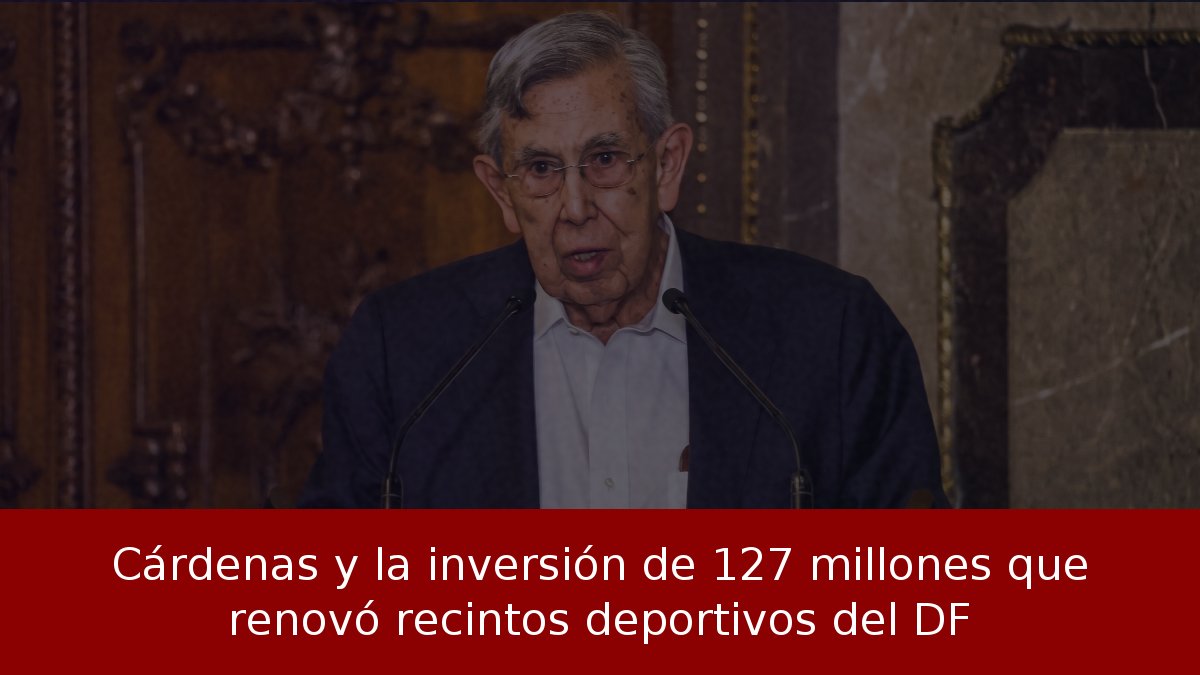
The death of Cuauhtémoc Cárdenas Solórzano at age 92, confirmed by journalist Joaquín López Dóriga on his X account, has revived scrutiny of his political legacy. Among the records of his administration as head of the then Distrito Federal is a less-cited imprint: the restoration of public sports facilities, with the Ciudad Deportiva Magdalena Mixhuca as the flagship project.
- Death: Cuauhtémoc Cárdenas died on Wednesday, October 28, at 92; Joaquín López Dóriga confirmed the news.
- Tenure: He governed the Distrito Federal from December 1997 to September 1999, after winning the first direct election for the post.
- Sports legacy: His government drove the rehabilitation of the Ciudad Deportiva Magdalena Mixhuca with an investment of 127 million pesos.
A politician tied to the recovery of public venues
Cárdenas's link to sports is not explained by football clubs or positions in sports organizations. It is recognized, rather, through conservation and rehabilitation works on public spaces during his Government, which spanned December 1997 to September 1999.
On September 17, 1999, during his second government report before the Legislative Assembly of the Distrito Federal, the politician stated that the capital's 11 major sports properties received 200,000 users per month and had provided nearly 170,000 services in their technical-sports schools.
Cárdenas stressed that these facilities were deteriorated, abandoned, or under the control of groups that restricted access. His administration sought to correct that condition through conservation and rehabilitation works in the DF.
Magdalena Mixhuca, the largest investment
In June 1999, the rehabilitation project for the Ciudad Deportiva Magdalena Mixhuca began, with an investment of 127 million pesos. The complex houses venues for athletics, baseball, fronton, cycling, motorsport, and other disciplines.
The report also recorded works at the Deportivo Plan Sexenal, the Velódromo Olímpico Agustín Melgar, the Alberca Olímpica Francisco Márquez, the rowing and canoeing course Virgilio Uribe, the Unidad Deportiva Francisco I. Madero, the Centro Social y Deportivo Guelatao, and the Centro Hípico de la Ciudad de México.
The remodeling of the Ciudad Deportiva was part of the Magdalena Siglo XXI project. A document hosted by the Secretaría de Gobernación stated that the works included football and baseball fields, a beach volleyball stadium, an indoor pool, and a velodrome, among other interventions.
Today that complex maintains a direct connection to Formula One motorsport. The Autódromo Hermanos Rodríguez is part of Magdalena Mixhuca and hosts the Gran Premio de la Ciudad de México, which in 2026 is held between October 30 and November 1.
The Ciudad Deportiva is located in Iztacalco, east of Mexico City, near the limits with Venustiano Carranza. The complex includes the Autódromo Hermanos Rodríguez, the Palacio de los Deportes, the Velódromo Olímpico Agustín Melgar, and other historic sports venues.
A political career of three presidential bids
Cuauhtémoc Lázaro Cárdenas Solórzano was born on May 1, 1934, in Mexico City. He was the son of former president Lázaro Cárdenas del Río and Amalia Solórzano.
He studied Civil Engineering at the Universidad Nacional Autónoma de México (UNAM) and developed a career that included a Senate seat for Michoacán and the governorship of that state between 1980 and 1986.
In 1987 he led the Corriente Democrática within the PRI. A year later he competed for the Presidency of Mexico as the candidate of the Frente Democrático Nacional, in an election that remained linked to the so-called “system crash.”
After that contest he participated in the founding of the Partido de la Revolución Democrática (PRD) and became its first national president, a position he held from 1990 to 1993. He sought the Presidency again in 1994 and 2000, without reaching Los Pinos.
His 1997 victory in the capital opened a period of left-wing governments in the city. Cárdenas left the head of Government on September 28, 1999, to run again for the Presidency. Among the records of his administration was the start of the rehabilitation of the Ciudad Deportiva Magdalena Mixhuca, the Iztacalco complex that this weekend once again places Mexico City at the epicenter of the official Formula One race.