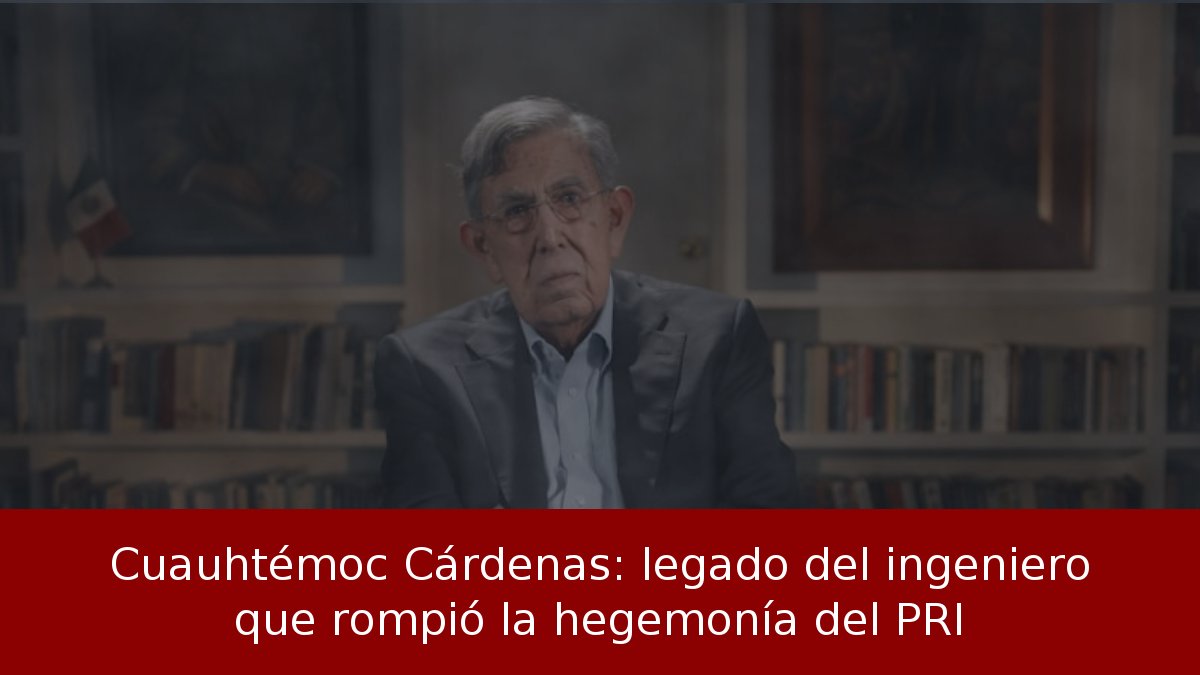
The death of Cuauhtémoc Cárdenas Solórzano at age 92 closes a defining chapter in Mexico's political history. A civil engineer regarded as one of the leading figures of the Mexican left, his remains were moved on Wednesday night to the Panteón Francés de San Joaquín, on Calzada Legaria in the Miguel Hidalgo borough of Mexico City.
- PRD founder: He led the break with the PRI and helped establish the Party of the Democratic Revolution on May 5, 1989.
- Three presidential runs: He was a candidate three times and never won the presidency.
- First elected head of government of the Federal District: He won in 1997 and served until 1999, when he took leave to seek the presidency.
A career shaped by the rupture with the PRI
Born on May 1, 1934, in Mexico City, Cuauhtémoc Lázaro Cárdenas Solórzano was the son of General Lázaro Cárdenas del Río, Mexico's president from 1934 to 1940, and Amalia Solórzano. He studied civil engineering at the UNAM, a background that preceded a long career in public administration and politics.
For 25 years he belonged to the PRI, the party that brought him to the Senate and later to the governorship of Michoacán, an office he held from 1980 to 1986. His path changed in 1987, when he headed the Democratic Current alongside other leaders who demanded greater openness in the party's selection of presidential candidates. Disagreements with the PRI leadership led to his departure and to the construction of an opposition alternative.
1988, the system crash and the birth of the PRD
One of the most consequential episodes of his career came in the 1988 presidential election, when he ran for the National Democratic Front against the PRI candidate Carlos Salinas de Gortari. The vote was marked by the interruption of the vote-counting system, known as the "system crash," and by complaints of irregularities that cast doubt on the result's legitimacy. The controversy made Cárdenas a central figure of the opposition.
The movement he led contributed to the founding of the Party of the Democratic Revolution on May 5, 1989, together with leaders such as Porfirio Muñoz Ledo, Ifigenia Martínez and Heberto Castillo. Cárdenas ran for president again in 1994 and 2000, though he did not win any of the three elections in which he competed.
His most significant electoral victory came in 1997, when he became the first head of government of the Federal District chosen by popular vote. He held the post until 1999, when he requested leave to prepare his third presidential candidacy. Despite being one of its main founders, he resigned from the PRD in November 2014, after expressing differences with the party leadership and questioning its political direction.
Reactions and final public roles
The news drew reactions from members of different political sectors. President Claudia Sheinbaum lamented his death and recognized his part in the democratic movement that drove changes to Mexico's political system. Former president Andrés Manuel López Obrador also recalled his role as a forerunner of the contemporary democratic opposition.
In later years he remained present in public debate on democracy, energy policy and national development. In March 2026 he was named president of Pemex's Consultative Petroleum Commission, one of his last public appointments.
Funeral services were scheduled for Thursday, October 29, starting at 10:00 a.m., with family members and close associates. His wife, Celeste Batel, who died on October 19, 2021, after 58 years of marriage, rests in the same cemetery. The hearse entered the cemetery at around 10:25 p.m., according to reports circulated after his death.
Cárdenas's trajectory is tied to the formation of a competitive electoral opposition and to the transformation of Mexican political life in the second half of the 20th century. His death invites a reckoning with a generation that, from within the dissident ranks, opened the way to alternation in power and a more plural party system.